| Gases | Air | Expired air |
|---|---|---|
| Oxygen O2 Nitrogen N2 Carbon dioxide CO2 |
20.95 79.01 0.04 |
16.4 79.5 4.1 |
| Activity | Energy used (kJ min–1) | Sugar burnt min–1 1g = 17.2kJ ** |
|---|---|---|
| Sleeping Sitting (woman) Sitting (man) Light work (woman) Light work (man) Cross-sawing Very heavy work Exceedingly heavy work |
4.2 5.0 5.8 14.6 17.6 37.6 44.0 - 52.5 over 52.5 |
1g 2.2g 2.5 - 3g > 3g |
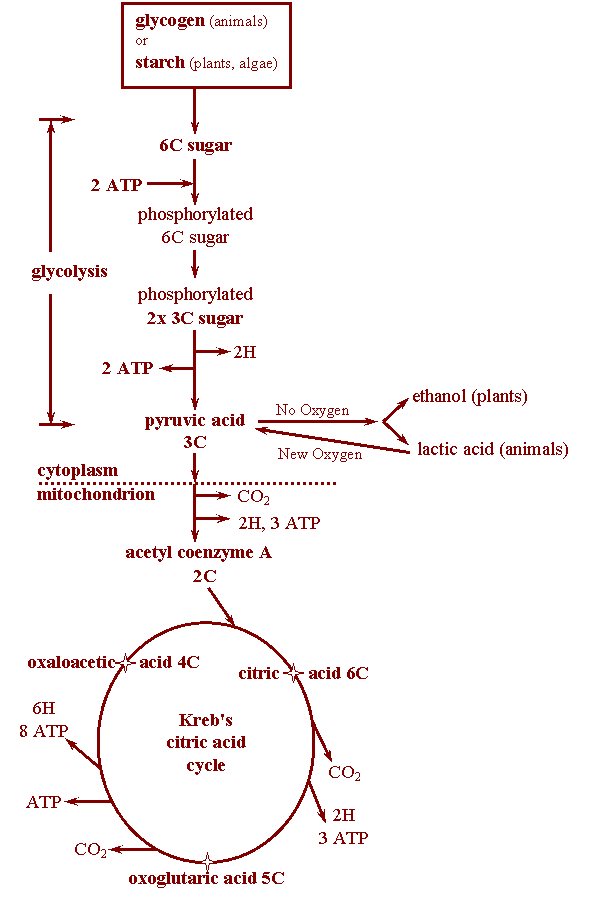 Most of the energy provided for cells comes from the step-by-step breakdown of carbohydrate. This energy is then used to synthesize ATP molecules. In carbohydrate metabolism most of the energy for ATP synthesis comes from the dehydrogenation in which hydrogen atoms are removed and passed thru the hydrogen carrier system. In the diagram only a few steps are detailed. It shows when hydrogen is removed with the number of of ATP molecules synthesized, as well as the number of carbon atoms in the main intermediate compounds, as well as the stages at which decarboxylation occurs with the evolution of carbon doxide.