Cell respiration
Cellular Respiration
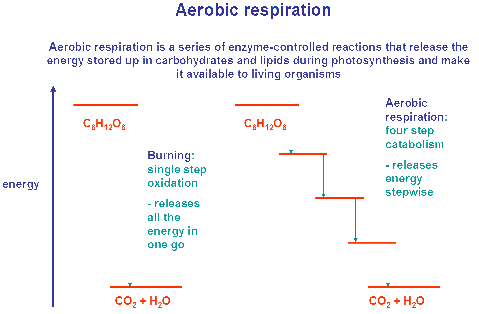
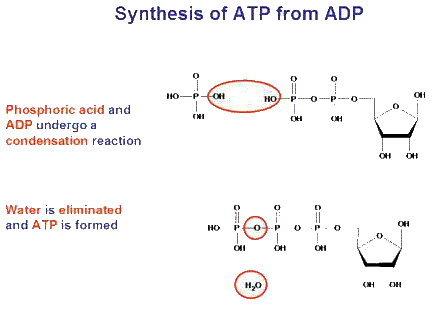
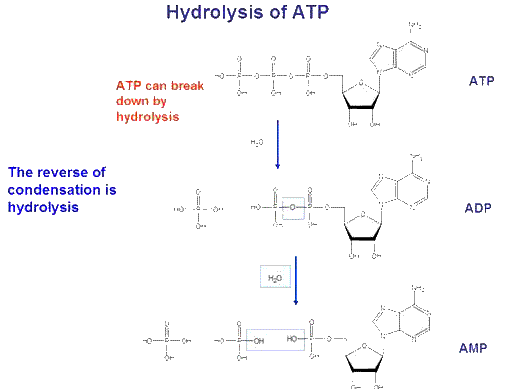
Cellular respiration is the process of oxidizing food molecules, like glucose, to carbon dioxide and water. The energy released is trapped in the form of ATP for use by all the energy-consuming activities of the cell.
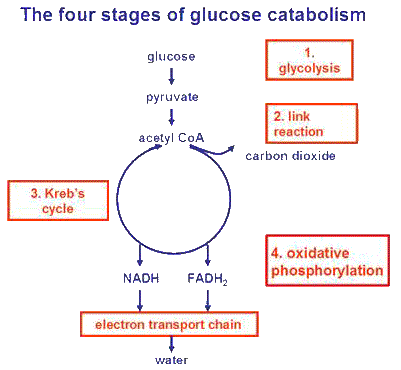
The process occurs in two phases:
- glycolysis, the breakdown of glucose to pyruvic acid
- the complete oxidation of pyruvic acid to carbon dioxide and water.
In eukaryotes, glycolysis occurs in the cytosol. The remaining processes take place in mitochondria.
Mitochondria
Mitochondria are membrane-enclosed organelles distributed through the cytosol of most eukaryotic cells. Their number within the cell ranges from a few hundred to, in very active cells, thousands. Their main function is the conversion of the potential energy of food molecules into ATP. Mitochondria have:
- an outer membrane that encloses the entire structure
- an inner membrane that encloses a fluid-filled matrix
- between the two is the intermembrane space
- the inner membrane is elaborately folded with shelflike cristae projecting into the matrix
- a small number (some 5–10) circular molecules of DNA.
The number of mitochondria in a cell can:
- increase by their fission (e.g. following mitosis)
- decrease by their fusing together.
(Defects in either process can produce serious, even fatal, illness.)
Outer Membrane
The outer membrane contains many complexes of integral membrane proteins that form channels through which a variety of molecules and ions move in and out of the mitochondrion.
Inner Membrane
The inner membrane contains 5 complexes of integral membrane proteins:
- NADH dehydrogenase (Complex I)
- succinate dehydrogenase (Complex II)
- cytochrome c reductase (Complex III; also known as the cytochrome b-c1 complex)
- cytochrome c oxidase (Complex IV)
- ATP synthase (Complex V)
Matrix
The matrix contains a complex mixture of soluble enzymes that catalyze the respiration of pyruvic acid and other small organic molecules.
Here pyruvic acid is:
- oxidized by NAD+ producing NADH + H+
- decarboxylated producing a molecule of:
- carbon dioxide (CO2)
- a 2-carbon fragment of acetate bound to coenzyme A forming acetyl-CoA.
Citric Acid Cycle
The Citric Acid Cycle:
- This 2-carbon fragment is donated to a molecule of oxaloacetic acid.
- The resulting molecule of citric acid (which gives its name to the process) undergoes the series of enzymatic steps
- The final step regenerates a molecule of oxaloacetic acid and the cycle is ready to turn again.
Summary
Summary:
- Each of the 3 carbon atoms present in the pyruvate that entered the mitochondrion leaves as a molecule of carbon dioxide (CO2).
- A pair of electrons (2e-) is removed and transferred to NAD+ reducing it to NADH + H+.
- A pair of electrons is removed from succinic acid and reduces FAD to FADH2.
- The electrons of NADH and FADH2 are transferred to the electron transport chain.
Electron Transport Chain
The electron transport chain consists of:
- 3 complexes of integral membrane proteins:
- the NADH dehydrogenase complex (I)
- the cytochrome c reductase complex (III)
- the cytochrome c oxidase complex (IV)
- and two freely-diffusible molecules:
that shuttle electrons from one complex to the next.
The electron transport chain accomplishes:
- the stepwise transfer of electrons from NADH (and FADH2) to oxygen molecules to form (with the aid of protons) water molecules (H2O);
(Cytochrome c can only transfer one electron at a time, so cytochrome c oxidase must wait until it has accumulated 4 of them before it can react with oxygen.)
- harnessing the energy released by this transfer to the pumping of protons (H+) from the matrix to the intermembrane space
- Approximately 20 protons are pumped into the intermembrane space as the 4 electrons needed to reduce oxygen to water pass through the respiratory chain.
- The gradient of protons formed across the inner membrane by this process of active transport forms a miniature battery.
- The protons can flow back down this gradient, reentering the matrix, only through another complex of integral proteins in the inner membrane, the ATP synthase complex.
Chemiosmosis in mitochondria
The energy released as electrons pass down the gradient from NADH to oxygen is harnessed by three enzyme complexes of the respiratory chain (I, III, and IV) to pump protons (H+) against their concentration gradient from the matrix of the mitochondrion into the intermembrane space (an example of active transport).
As their concentration increases there (which is the same as saying that the pH decreases), a strong diffusion gradient is set up. The only exit for these protons is through the ATP synthase complex. As in chloroplasts, the energy released as these protons flow down their gradient is harnessed to the synthesis of ATP. The process is called chemiosmosis and is an example of facilitated diffusion.