There are several kinds of chlorophyll:
- chlorophyll a: Additional pigments are often used to capture more of the sun-energy but the captured energy must be transferred to a molecule of chlorophyll a before it can be used. Chlorophyll a is the molecule which makes photosynthesis possible by passing its energized electrons on to molecules which will manufacture sugars. All plants, algae, and cyanobacteria which photosynthesize contain chlorophyll "a". The carbon-containing products of photosynthesis are called photosynthates. In plants, these would be glucose and starch, a polymer of glucose.
- chlorophyll b: occurs only in "green algae" and in the plants.
- chlorophyll c: found only in the photosynthetic Chromista and dinoflagellates.
The differences between the chlorophylls of these major groups was one of the first clues that they were not as closely related as previously thought. The difference between chlorophylls a and b are slight (see red circles).
Chlorophylls a and b, but not c, are found in plants and the green algae.
Both types are associated with integral membrane proteins in the thylakoid membrane of the chloroplast, and not found in the cytoplasm, because they are not water-soluble.
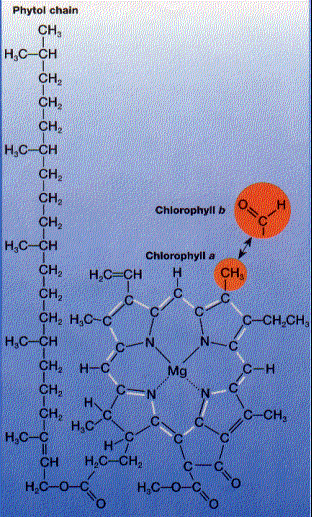
There is a system of alternating single and double bonds (white bars) that run around the porphyrin ring. Although the single and double bonds are drawn in fixed positions, the "extra" electrons responsible for the double bonds are not fixed between any particular pair of carbon atoms but instead are free to migrate around the ring. This property enables these molecules to absorb light.
Both chlorophylls absorb light most strongly in the red and violet parts of the spectrum. Green light is absorbed poorly. Thus when white light shines on chlorophyll-containing structures like leaves, green light is transmitted and reflected and the structures appear green. Chlorophylls a and b differ slightly in the wavelengths of light that they absorb best (although both absorb red and blue much better than yellow and green).
Chlorophylls are greenish pigments which contain a porphyrin ring. This is a stable ring-shaped molecule around which electrons are free to migrate. Because the electrons move freely, the ring has the potential to gain or lose electrons easily, and thus the potential to provide energized electrons to other molecules. This is the fundamental process by which chlorophyll "captures" the energy of sunlight.
- Carotenoids:
Carotenoids are usually red, orange, or yellow pigments, and include the familiar compound carotene, which gives carrots their color. Carotenoids help fill in the gap by strongly absorbing green light. The entire complex ensures that most of the energy of light will be trapped and passed on to the reaction center chlorophylls.
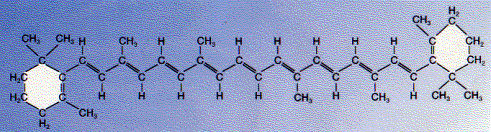
These compounds are composed of two small six-carbon rings connected by a "chain" of carbon atoms. As a result, they do not dissolve in water, and must be attached to membranes within the cell. Carotenoids cannot transfer sunlight energy directly to the photosynthetic pathway, but must pass their absorbed energy to chlorophyll. For this reason, they are called accessory pigments.
One very visible accessory pigment is fucoxanthin, the brown pigment which colors kelps and other brown algae as well as the diatoms.
Carotenoids are contained, with other pigments, in chloroplasts. These carotenoids range from red to yellow because they absorb light most strongly in the blue portion of the spectrum. They thus enable the chloroplast to trap are larger fraction of the radiant energy falling on it.
Carotenoids are often the major pigments in flowers and fruits. The red of a ripe tomato and the orange of a carrot are produced by their carotenoids.
In leaves, the carotenoids are usually masked by the chlorophylls. In the autumn, as the quantity of chlorophyll in the leaf declines, the carotenoids become visible and produce the yellows and reds of autumn foliage.
In the structure of beta-carotene, one of the most abundant carotenoids, there is a system of alternating single and double bonds that in this molecule runs along the hydrocarbon chain that connects the two benzene rings. As in chlorophyll, the electrons of the double bonds actually migrate though the chain, making this molecule an efficient absorber of light.
Many animals use ingested beta-carotene as a precursor for the synthesis of vitamin A.
- Phycobilins:
Phycobilins are water-soluble pigments, and are therefore found in the cytoplasm, or in the stroma of the chloroplast. They occur only in Cyanobacteria and Rhodophyta.
Phycobilins are not only useful to the organisms which use them for soaking up light energy; they have also found use as research tools. Both pycocyanin and phycoerythrin fluoresce at a particular wavelength. That is, when they are exposed to strong light, they absorb the light energy, and release it by emitting light of a very narrow range of wavelengths.
The light produced by this fluorescence is so distinctive and reliable, that phycobilins may be used as chemical "tags". The pigments are chemically bonded to antibodies, which are then put into a solution of cells. When the solution is sprayed as a stream of fine droplets past a laser and computer sensor, a machine can identify whether the cells in the droplets have been "tagged" by the antibodies. This has found extensive use in cancer research, for "tagging" tumor cells.
Both chlorophylls absorb light most strongly in the red and violet parts of the spectrum. Green light is absorbed poorly. Thus when white light shines on chlorophyll-containing structures like leaves, green light is transmitted and reflected and the structures appear green. Chlorophylls a and b differ slightly in the wavelengths of light that they absorb best (although both absorb red and blue much better than yellow and green).
Chlorophylls are greenish pigments which contain a porphyrin ring. This is a stable ring-shaped molecule around which electrons are free to migrate. Because the electrons move freely, the ring has the potential to gain or lose electrons easily, and thus the potential to provide energized electrons to other molecules. This is the fundamental process by which chlorophyll "captures" the energy of sunlight.
Carotenoids are usually red, orange, or yellow pigments, and include the familiar compound carotene, which gives carrots their color. Carotenoids help fill in the gap by strongly absorbing green light. The entire complex ensures that most of the energy of light will be trapped and passed on to the reaction center chlorophylls.
These compounds are composed of two small six-carbon rings connected by a "chain" of carbon atoms. As a result, they do not dissolve in water, and must be attached to membranes within the cell. Carotenoids cannot transfer sunlight energy directly to the photosynthetic pathway, but must pass their absorbed energy to chlorophyll. For this reason, they are called accessory pigments.
One very visible accessory pigment is fucoxanthin, the brown pigment which colors kelps and other brown algae as well as the diatoms.
Carotenoids are contained, with other pigments, in chloroplasts. These carotenoids range from red to yellow because they absorb light most strongly in the blue portion of the spectrum. They thus enable the chloroplast to trap are larger fraction of the radiant energy falling on it.
Carotenoids are often the major pigments in flowers and fruits. The red of a ripe tomato and the orange of a carrot are produced by their carotenoids.
In leaves, the carotenoids are usually masked by the chlorophylls. In the autumn, as the quantity of chlorophyll in the leaf declines, the carotenoids become visible and produce the yellows and reds of autumn foliage.
In the structure of beta-carotene, one of the most abundant carotenoids, there is a system of alternating single and double bonds that in this molecule runs along the hydrocarbon chain that connects the two benzene rings. As in chlorophyll, the electrons of the double bonds actually migrate though the chain, making this molecule an efficient absorber of light.
Many animals use ingested beta-carotene as a precursor for the synthesis of vitamin A.
Phycobilins are water-soluble pigments, and are therefore found in the cytoplasm, or in the stroma of the chloroplast. They occur only in Cyanobacteria and Rhodophyta.
Phycobilins are not only useful to the organisms which use them for soaking up light energy; they have also found use as research tools. Both pycocyanin and phycoerythrin fluoresce at a particular wavelength. That is, when they are exposed to strong light, they absorb the light energy, and release it by emitting light of a very narrow range of wavelengths.
The light produced by this fluorescence is so distinctive and reliable, that phycobilins may be used as chemical "tags". The pigments are chemically bonded to antibodies, which are then put into a solution of cells. When the solution is sprayed as a stream of fine droplets past a laser and computer sensor, a machine can identify whether the cells in the droplets have been "tagged" by the antibodies. This has found extensive use in cancer research, for "tagging" tumor cells.
Photosynthetic organisms
Photosynthetic organisms:- Cyanobacteria:
use water-soluble phycobilins (blue phycocyanin in Cyanobacteria, red phycoerythrin in Rhodophyta), chlorophyll a.
Cyanobacteria get their name from the bluish pigment phycocyanin, which they use to absorb light for photosynthesis.
They also contain chlorophyll a, the same photosynthetic pigment that plants use because the chloroplast in plants is a symbiotic cyanobacterium, taken up by a green algal ancestor of the plants sometime in the Precambrian.
However, not all "blue-green" bacteria are blue; some common forms are red or pink from the pigment phycoerythrin. These bacteria are often found growing on greenhouse glass, or around sinks and drains. The Red Sea gets its name from occasional blooms of a reddish species of Oscillatoria, and African flamingos get their pink color from eating Spirulina. - Rhodophyta:
water-soluble phycobilins (blue phycocyanin in Cyanobacteria, red phycoerythrin in Rhodophyta), chlorophyll a. - Chromista:
chlorophyll "c", yellow-brown accessory pigments, diadinoxanthin and fucoxanthin, found only in the Chromista and Dinoflagellate. - Dinoflagellates:
chlorophyll "c", fucoxanthin, unusual yellow pigments peridinin and dinoxanthin.
In the dinoflagellates there is a triple membrane around the plastids and a small nucleus-like structure inside them, suggesting that this is a case of secondary endosymbiosis. The "plastid" is probably a swallowed diatom or chrysophyte, since it contains chlorophyll "c", and may contain fucoxanthin, both of which are otherwise found only in the Chromista. It is believed that this endosymbiosis event occurred only once among the dinoflagellates, since the unusual yellow pigments peridinin and dinoxanthin are common among members of the group. - Plants and "green algae":
Chloroplasts contain chlorophyll a and b, and carotenoids. Carotenoids absorb light most strongly in the blue portion of the spectrum, while reflecting red, orange and yellow. They thus enable the chloroplast to trap are larger fraction of the radiant energy falling on the leaf.
Photosynthetic pigments
Photosynthetic pigments include:- Phycobilins:
- phycocyanin: blue, found in cyanobacteria
- phycoerythrin: red, found in cyanobacteria
- Carotenoids: often the major pigments in flowers and fruits. The red of a ripe tomato and the orange of a carrot are produced by their carotenoids. In leaves, the carotenoids are usually masked by the chlorophylls. In the autumn, as the quantity of chlorophyll in the leaf declines, the carotenoids become visible and produce the yellows and reds of autumn foliage. Many animals use ingested beta-carotene as a precursor for the synthesis of vitamin A:
- peridinin and dinoxanthin: unusual yellow pigments, in Chromista
- diadinoxanthin and fucoxanthin: yellow-brown accessory pigments, in Chromista and Dinoflagellates; fucoxanthin also in diatoms.
- Chlorophylls:
- pheophytin: chlorophyll without the Mg++
- chlorophyll c: green, found in Chromista and Dinoflagellates
- chlorophyll a, b: green, found in plants and algae. Chlorophyll a is found in all (?) photosynthetic organisms even if obscured by other pigments such as red in Rhodophyta and blue in Cyanobacteria. Plants gained chlorophyll a during the Precambrian, by engulfing cyanobacteria whence they became chloroplasts.