Genes basic
Definitions
Alleles: are different forms of a gene, which may give rise to different phenotypes; these different forms of the same gene compete for the same chromosome location, such as blue-eye and brown-eye genes. In other words, when the same gene location on the two homologous chromosomes, carries different genes, these variations are call alleles.
Many plants and animals have two alleles for each trait, one inherited from each parent. However, a population may carry many different alleles.Alleles may be dominant or recessive; dominant alleles give rise to their corresponding phenotypes when paired with any other allele for the same trait, whereas recessive alleles give rise to their corresponding phenotype only when paired with another copy of the same allele. (See eye-color below.)
For example, if the allele specifying tall stems in pea plants is dominant over the allele specifying short stems, then pea plants that inherit one tall allele from one parent and one short allele from the other parent will have tall stems. Alleles assort independently in the production of gametes, or germ cells, ensuring variation in the next generation.
Autosomes: are any chromosomes other than the 2 sex chromosomes.
Chloroplasts:, like mitochondria, have their own genome and their own protein-synthesizing machinery. But also like mitochondria, most of the proteins used in chloroplasts are:
- encoded by genes in the nucleus of the cell
- synthesized by ribosomes in the cytosol
- then be imported into the chloroplast.
Proteins destined for chloroplasts are recognized by their characteristic transit sequence.
Chromosomes: Chromosomes store the DNA molecules. The DNA molecule is normally unwound but it can condense, that is, it spirals, then loops around groups of spherical histones to form a string of balls of DNA, which spirals again to form a chromatin strand. This in turn, coils back and forth to form a short thick chromatid. This occurs when the cell is ready to divide.
DNA: a polymeric molecule DeoxyriboNucleic Acid, built up of nucleotides containing deoxyribose sugar.
Heterozygous: occur when paired chromosomes have different alleles, such as for eye-color when one allele is brown-eye, and the other blue-eye. Genotypes BROWN - BROWN and BLUE - BLUE are homozygous, but BROWN - BLUE is heterozygous. [hetero Gk = different; homo Gk = same; zygoo Gk = yoke, zygosis Gk = joining, as in the joining of 2 gametes, or sperm with egg.]
Homologous: Each chromosome has a partner chromosome, so that each gene site on one chromosome has an equivalent gene on the other chromosome. Such paired chromosomes are called homologous chromosomes because they look after the same processes. For example on one chromosome there is a gene which may determine pigment for the iris of an eye. At the same site on the homologous chromosome, is also a gene for eye pigment.
Homozygous: both genes for the same location in one pair of chromosomes are identical (or identical alleles).
Genome: is the complete set of genes in a single set of chromosomes.
Genotype: is an individual's pair of alleles (genes) giving rise to their specific phenotype.
Mitochondria: are membrane-enclosed organelles distributed through the cytosol of most eukaryotic cells. Their number within the cell ranges from a few hundred to, in very active cells, thousands. Their main function is the conversion of the potential energy of food molecules into ATP.
Nucleic acid: very large molecules built up of units of nucleotides.
Nucleotide: Each nucleotide has 3 parts: a nitrogen-containing base, a 5-carbon sugar, a phosphate group. There are only 5 bases and 2 sugars found in nucleotides. The 2 sugars are Ribose and Deoxyribose sugars.
Phenotype: the physical expression of the genotype (but include hidden genetic traits such as genetically derived mental 'illness', genetic tendencies to disease such as diabetes and Parkinsons).
Polymeric: composed of same elements in same proportions but differing in molecular weight.
RNA: Ribose Nucleic Acid, built up of nucleotides containing ribose sugar.
Ribosomes: make proteins from amino acids.
Sex chromosome: all the genes from which gender is derived, are stored on one pair of chromosomes, called sex chromosomes. All other chromosomes are called autosomes.
Genes
Genes are molecules which manufacture big molecules from little molecules.
(This is not a definition. There is a detailed explanation below.)
Each of us is a walking warehouse of molecules, many thousands of them; molecules which determine our shape, our structure, our workings from digestion to immune system to emotions. Behind every process, whether building, repairing or operating, is a collection of genes initiating, stimulating, guiding and terminating. Genes hold the necessary information. It is not our brain which does this job, but the genes contained in every nucleus of every cell in our bodies.
Caution: These genes determine what our bodies look like, such as the color of our eyes, the size of our ear-lobes, our height, and almost everything else - provided our nutrition is perfect. Poor nutrition during our mother's pregnancy will change that. If during pregnancy, mother smokes or drinks alcohol, or takes other drugs such as thalidomide or has a cholera injection or is infected by the parasite Toxoplasmosis gondii from her cat, then the chemical processes can be thwarted and the baby develop abnormally. Examples include a distorted face from alcohol, detachment of eye-retina from cholera injection, blindness or abortion from Toxoplasmosis.
Every cell has the same set of genes, identical except for accidental changes during cell-division (called mutations). All living things need genes, from bacteria to humans. Because of evolution from common ancestors we often have the same copies as more primitive organisms.
That worm in your vegetable garden has some genes identical to some of ours, because millions of years ago we shared a common ancestor that also had those same genes. We and the worm are both bilateral, with front and rear ends, a mouth and anus, an intestine and nervous system. That worm is a cousin of ours, a distant cousin admittedly, but a cousin nonetheless, so please do not hurt him with your spade. All of us creatures are related.
Since genes do not work if cut into 2 parts, the gene is the minimum unit for producing those molecules which determine our chemical processes. As such, a gene is the basic unit of heredity. A gene can pass your brown eyes onto your children.
All living things need genes, from bacteria to humans. Genes hold the information to build and maintain their cells, and the genes we pass onto our offspring will do the same for them.
In general terms, a gene is a segment of nucleic acid that specifies a trait. Obviously, with so many traits we need thousands of genes. We have more, many more, because we have inherited genes from our earliest ancestors, genes we do not always need or use. There are other genes which act as enzymes or accelerators of chemical processes, and even more genes which act like electrical switches to switch on chemical processes and then switch them off; or determine where the manufactured chemicals will be sent.
In cells, a gene is a portion of DNA that contains both "coding" sequences that determine what the gene does, and "non-coding" sequences that determine when the gene is active (expressed). When a gene is active, the coding and non-coding sequences are copied in a process called transcription, producing an RNA copy of the gene's information. This piece of RNA can then direct the synthesis of proteins via the genetic code.
In other cases, the RNA is used directly, for example as part of the ribosome. The molecules resulting from gene expression, whether RNA or protein, are known as gene products, and are responsible for the development and functioning of all living things.
The physical development and phenotype of organisms are the product of genes interacting with each other and with the environment.
Chromosomes
Chromosomes are long strings of genes stored in the nuclei of our cells. Genes determine how we look. Humans have 23 pairs of chromosomes, making 46 chromosomes in total. The Drosophila fly has 4 pairs, totalling 8 chromosomes. Less complicated organisms need less information and therefore fewer genes and fewer chromosomes.
Primates usually have 24 pairs of chromosomes, but our ancestors unintentionally combined 2 pairs into one pair. Chimpanzees share 98% of our genes, which explains why we look and act similarly. So the next time you call somone a chimp, you will be 98% correct.
In any one pair of chromosomes, the same location on each chromosome, does the same job, such as eye-color or ear-lobes or hair-color. Genes which belong to the same site on a chromosome, doing the same job, are called alleles.
Chromosomes are very very long DNA molecules (made up of genes); where DNA is the polymeric molecule DeoxyriboNucleic Acid. Imagine each chromosome or DNA molecule as two strings stuck lengthwise together with a chemical glue. (This glue is selected from the molecules: adenine, uracil, guanine and cytosine). The DNA molecule is normally unwound but it can condense, that is, it spirals, then loops around groups of spherical histones to form a string of balls of DNA, which spirals again to form a chromatin strand. This in turn, coils back and forth to form an amazingly short thick chromatid. This occurs when the cell is ready to divide.
The collection of genes make up the genotype in the chromosome.
All the genes in all the chromosomes, collected together, is called the genome.
The physical expression of the genes in the body-type, is called the phenotype.
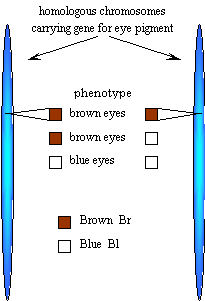 Each chromosome has a partner chromosome, so that each gene site on one chromosome has an equivalent gene on the other chromosome. Such paired chromosomes are called homologous chromosomes because they look after the same processes. For example on one chromosome there is a gene which may determine pigment for the iris of an eye. At the same site on the homologous chromosome, is also a gene for eye pigment.
In sexually reproduced species, one homologous chromosome comes from the female parent and the other from the male. In other words, each parent contributes a complete set of genes, but on half the normal number of chromosomes. When the sperm enters the egg, with both sperm and egg each carrying half the normal number of chromosomes, the full set of chromosomes is made and the fertilized egg begins to grow and divide and redivide, creating a new living organism.
Eye color
If both parents are blue-eyed then their child will have blue eyes.
Blue-eyes are blue because the eye's iris is blue. (The iris is the colored circle around the black pupil. The black pupil is the open circle through which light enters our eye.)
All irises are made blue. A brown eye begins with the same blue iris but adds brown pigment. (Similarly, all cotton for our clothes, is white but color is added to make a brown shirt or green shirt.)
A blue eye has no pigment. A brown eye has brown pigment. The brown pigment abosrbs sunlight. The blue-eye's lack of pigment to absorb sunlight, makes the eye more susceptible to the burning of the retina in the tropics especially in deserts or on beaches, or on snow fields, where sunlight or reflection is extra-strong.
Genes come in pairs, say Eye-colorMother from the mother and Eye-colorFather from the father.
If Eye-colorMother is blue, it says: No-pigment.
If Eye-colorFather is blue, it says: No-pigment.
If both say No-pigment, then the iris remains blue.
If either one says Brown-pigment, then brown pigment is made and the iris is dyed brown.
It does not matter if one gene says No-pigment, because the other gene says Brown-pigment and makes brown pigment. The Brown-pigment has its own way and so is called a dominant gene, while the No-pigment gene is over-ruled and so is called a recessive gene.
Ear-lobes
Let us call the genes Ear-LOBE and Ear-NO-lobe.
If both EarMother = Ear-LOBE
EarFather = Ear-LOBE
then the fetus makes an ear-lobe for each ear.
If both EarMother = Ear-NO-lobe
and EarFather = Ear-NO-lobe
then the fetus makes lobe-less ear.
If EarMother = Ear-LOBE
BUT EarFather = Ear-NO-lobe
then the fetus makes 'half' an ear-lobe, that is, a reduced ear-lobe.
Since both genes make a contribution to the phenotype, neither is dominant or recessive.
Of course, the same thing will happen if the conribution from the parents is reversed.
If EarMother = Ear-NO-lobe
BUT EarFather = Ear-LOBE
then the fetus makes 'half' an ear-lobe, that is, a reduced ear-lobe.
Other genotypes
When people interlock the fingers of both hands, some cross left-thumb over right-thumb, and others do the opposite. This is genetically determined, which is why you always do it the same way.
Not everything is so simple. Height is due to many factors, so some genes will tend to make us tall, while others tend to make us not-tall. A mixture of genes will bring us in between. Similarly eye-color ranges from blue, through grey, blue-green, green-brown, to brown; and some eyes might be green with patches of reddish-brown; because several genes contribute to eye-color.
When we come to skin-color, the flood-gates open. Color ranges from the white of an albino to the black of a Tiwi Islander, with every shade in between because there are several genes involved.
Applications
If there is only one gene A that can go in one particular location on a chromosome, that gives a combination of only AA, that is, only 1 choice.
Two genes A & B in one chromosome location gives the possibilities of AA, BB || AB = 2 + 1 choices = 3 choices. (Notice how the vertical lines are used to group them, so none are forgotten)
Three genes A, B & C in one chromosome location gives AA, BB, CC || AB, AC || BC = 3 + 2 + 1 choices = 6 choices
Four genes A, B, C & D in one chromosome location gives AA, BB, CC, DD || AB, AC, AD || BC, BD || CD = 4 + 3 + 2 + 1 choices = 10 choices
By now you will have worked out the sequence. How many choices are there if 10 genes can occupy the one chromosome location ?
Suppose there are 2 chromosome-locations, (1) & (2), influencing a phenotype.
Suppose only gene A can occupy (1) and gene N can occupy (2).
Number of choices = AA, NN = 2 choices.
Suppose genes A, B can occupy (1) and gene N, O can occupy (2).
Number of choices = AA, BB, AB, NN, OO, NO = (2 + 1) + (2 + 1) = 2 x 3 = 6 choices.
By now you have worked out the total number of combinations if 2 genes can occupy each of 5 locations = ??
Equals five times the combination at one location.
If in each location, one gene is white and one is black, how many shades of color would be possible ?
If there were 4 genes for each of 5 locations, A for white, B for light brown, C for dark brown, D for black, how many shades would be possible ?
Proportion
Let us return to Ear-lobes.
Exercize 1: Let the phenotype of the mother be full LOBE and the phenotype of the father be NO-lobe.
Write the genotype of each parent.
Then draw a grid.
| Mother | Father |
|---|
Phenotype
LOBE | Phenotype
NO-lobe |
|---|
Genotype
LOBE-LOBE | Genotype
NO-NO |
|---|
| Genes in sperm/egg | NO | NO |
|---|
| LOBE L |
L - N |
L - N |
| LOBE L | L - N | L - N |
|---|
Each pair of genes for the offspring is made of one LOBE and one NO-lobe. The combination gives LOBE-NOlobe for each offspring. For this genotype, the phenotype is a half-lobe.
Exercize 2
Repeat the process for a half-lobed mother and lobed father. What would the phenotypes of the offspring be ? If they had 12 children, how any lobed and how many half-lobed children might you expect ? (The best estimate is the average. With only 12 children the actual result might be very different, but with, say, 400 offspring in an insect breeding program, the answer would, on average, be about 200 of each phenotype.)
Exercize 3
Repeat Exercize 2 but for both parents having half-lobes. Answers are at the end of the chapter.
Exercize 4
Repeat procedure for a mother having blue eyes and a father being homozygous for brown eyes.
Homozygous: both genes in one pair are the same.
Alleles: different genes destined for the same chromosome location.
Answers are at the end of the chapter.
Exercize 5
Repeat procedure for both parents have the brown-eyed phenotype but are heterozygous in eye-color.
Heterozygous: alleles are different, in this case one allele is brown-eye, and the other blue-eye. BROWN - BROWN and BLUE - BLUE are homozygous, but BROWN - BLUE is heterozygous.
Cell division
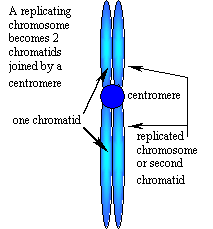 Before a cell divides, each chromosome replicates itself. These two copies are called chromatids, and are held together by a centromere. In a dividing human cell, the nuclear membrane dissolves and the 46 chromosomes produce 46 pairs of chromatids. One of each pair move to one end of the cell while the other of each pair move to the other end. A new nucleus membrane forms around each set of 46 chromosomes, then the cell divides between the two groups. The chromosomes unravel and continue their work of sending mRNA messages to the ribosomes.
***************************************************************************
Answer for Exercize 2: The phenotypes would be half-lobed and no-lobes. We would expect half the children, 6 out of 12, to be half-lobed and half no-lobed.
Answer for Exercize 3: For both parents being half-lobed, we have:
| Mother | Father |
|---|
Phenotype
HALF-lobe | Phenotype
HALF-lobe |
|---|
Genotype
LOBE-NO | Genotype
LOBE-NO |
|---|
| Genes in egg/sperm | LOBE | NO |
|---|
| LOBE L | L - L | L - N |
| NO | N - L | N - N |
|---|
Half-lobe phenotypes indicate an heterozygous genotype, that is, the alleles are different, one for lobes one for no-lobes.
On average, in every 4 offspring, the genotypes will be:
- 1 x LOBE - LOBE
- 2 x LOBE - NO
- 1 x NO - NO
The genotype LOBE - NO has the same effect as the genotype NO - LOBE.
In every 4 offspring on average, there will be one fully lobed, 2 half-lobed and one without a lobe.
Exercize 4
Since both parents are homozygous, the mother for blue-eyes and the father for brown-eyes, all the ofspring will be a combination Brown - Blue, expressed as the phenotype, Brown-eyes.
Answer for Exercize 5:
Since both parents are heterozygous, they both have BROWN - BLUE genotype, similar to the heterozygous LOBE - NO-lobe exercize illustrated in Exercize 3 above.
In every 4 offspring on average, there will be one blue-eyed, 2 heterozygous and one homozygous brown-eyed. The 2 heterozygous BROWN - BLUE will have the phenotype brown-eye. So, on average, the offspring will be 3 brown to one blue.
Answer for Exercize 6:
Answer for Exercize 7: