Genes - technical
Karyotype
A person's karyotype is the full set of that person's chromosomes, as stained, photographed and arranged in numbered homologous pairs. Of these homologous pairs, one pair determines the sex of the 'owner'. Of this pair of sex chromosomes, one is long and labelled 'X' and the other is much shorter and labelled 'Y'. If a person has 2 X (homologous) chromosomes they will be female, while if they have one X and one Y, they will be male. It is not possible to have 2 Y chromosomes, because the female never has a Y chromosome to pass on. A male can pass on either one X or one Y chromosome. The female can pass on only an X. When the father passes on an X, the offspring will have 2 Xs and become a female. If the father passes on a Y, then the offspring will have XY, and become a male.
The human foetus initially develops as a female because the Y chromosome does not begin work immediately. It begins late in the pregnancy, and only then does the foetus begin to develop male characteristics. If the Y-chromosome clicks in very late, the child may not develop fully or decisively as a male.
Proteins
Genes control the manufacture of proteins.
Proteins are:
- chemical carriers
haemoglobin carries O2 & CO2
- enzymes
acting as catalysts to speed up chemical reactions
protease aids digestion of proteins in the stomach; enzymes break up starch molecules into glucose.
- structural
hair, nails, feathers from keratin; strong elastic tendons from collagen; spider's web)
- hormones
- antibodies
- nutrient stores
gluten in wheat grain; albumin or egg white.
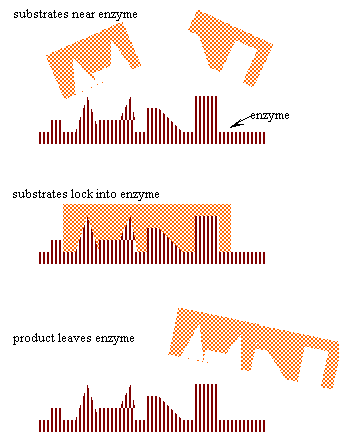
As enzymes, proteins act as catalysts to speed up chemical reactions. They act as a template into which substrates, the molecules in the reaction, fit and lock with the adjacent substrate to form a new molecule. This completed molecule then leaves the enzyme intact to process another.
Each protein is a very large chain of amino acids connected in specific sequence for the job it does, folded in a special way that determines how the protein works.
Amino acids are organic acids which contain an amino NH3 group. There are only 20 different kinds of amino acids, but these can be arranged in different sequences, some millions of them, so the number of possible proteins is enormous. Humans can make 10 of these 20 amino acids; the other 10 must be eaten, and so are called essential amino acids.
A peptide bond is formed between two amino acids when each loses a hydrogen atom, thus freeing two carbon atoms to bond across the two amino acids. A polypeptide is a molecule of 40 to 50 peptide bonds.
Proteins vary from polypeptides to molecules of millions of atoms. The sequence of amino acids is called its primary structure. The amino groups create side-links to other molecules and even itself, causing parts of the protein molecule to fold into particular shapes, called its secondary structure. The shape of the whole protein molecule is called its tertiary structure.
This structure can be changed by heat and chemicals (heating eggs or adding salt or vinegar, turns the protein albumin white).
Nucleic acids
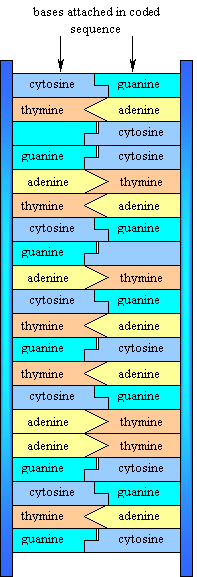 Nucleic acids is the phosphate between the sugar and the base
A nucleic acid is a polymer of nucleotides.
A nucleotide = phosphate + sugar + base.
The sugar is called deoxyribose. The sugars link these nucleotides into a chain. This chain then links to its complementary chain by linking the bases. The whole DNA molecule (a double chain about 2 metres long) is spiralled, and spiralled again. These spirals compact it to fit inside the nucleus.
There are 3 kinds of nucleic acid:
- DNA deoxyribonucleic acid
carries sequences of genes
Has a backbone of phosphate-sugar polyester; phosphoric acid = 3 acidic hydroxyl groups of which 2 have ester linkages with the hydroxyl groups of adjacent sugar molecules. The polymer is acidic and forms salts because of the 3rd hydroxyl group.
Bases are adenine with thymine and guanine with cytosine
- RNA ribonucleic acid
Bases are adenine with uracil and guanine with cytosine
there are two types of RNA:
- mRNA or messenger RNA
This is a copy of part of the DNA molecule
- tRNA or transfer RNA
This copies information from the mRNA, to use in the making of amino acids. There is a tRNA for each amino and many more for the stringing together of amino acids to form proteins..
- mitochondrial DNA
These are small circular molecules of DNA in the mitochondria (similar to bacterial DNA).
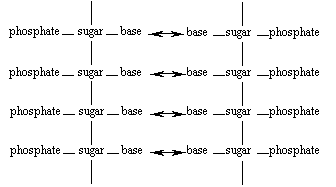
DNA molecules
DNA molecules reproduce.
Imagine the attached bases unzipping down the middle, leaving them free to attach to other molecule: for example, an adenine detaches from a thymine on the other sugar chain. It is then free to attach to another thymine of another nucleotide floating in the nucleus. If the bases adjacent to the first adenine, also detach and do likewise, then opposite them is built up a series of nucleotides which can join along their sugars to form another chain. Extend this the full length of the sugar polymer, and a new DNA molecule is created. This is done with the enzyme DNA polymerase.
When a whole DNA molecule reproduces itself, the cell will divide into two cells, whereas when a small part of the DNA is unravelled, it produces mRNA, which moves away allowing the DNA molecule to zip up again. This mRNA then move out of the nucleus into the cytoplasm where it finds the granular ribosomes. The ribosomes 'read' the codons in the mRNA, and with the help of tRNA, make protein molecules.
The basic unit in genetic code is the codon, 3 bases long, and determines the amino acid formed. There are 64 ways of arranging 4 bases, 3 at a time when allowing duplication (4x4x4). Genes consist of a number of codons. The number of genes in human DNA approaches 100,000. Genes determines which proteins are made and when. Some genes make proteins which switch off other genes.
In the cell these DNA molecules are stored in chromosomes. The DNA molecule is normally unwound but it can condense, that is, it spirals, then loops around groups of spherical histones to form a string of balls of DNA, which spirals again to form a chromatin strand. This in turn, coils back and forth to form an amazingly short thick chromatid. This occurs when the cell is ready to divide.
Each chromosome has a partner chromosome, so that each gene site on one chromosome has an equivalent gene on the other chromosome. Such paired chromosomes are called homologous chromosomes because they look after the same processes. For example on one chromosome there is a gene which may determine pigment for the iris of an eye. At the same site on the homologous chromosome, is also a gene for eye pigment. In sexually reproduced species, one homologous chromosome comes from the female parent and the other from the male. In other words, each parent contributes a complete set of genes, but on half the normal number of chromosomes. When the sperm enters the egg, with both sperm and egg each carrying half the normal number of chromosomes, the full set of chromosomes is made and the fertilized egg begins to grow and divide and redivide, creating a new living organism.
When the same gene location on the two homologous chromosomes, carries different genes, these variations are call alleles. For example, one allele may make brown eye pigment, while another may make no pigment. When there is no pigment in the iris, the eye appears blue. This lack of pigment to absorb sunlight, makes the eye more susceptible to the burning of the retina in the tropics or on snow fields, where sunlight is extra-strong.
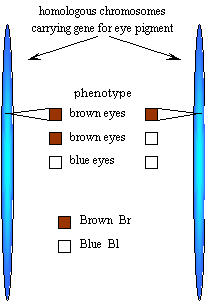
If one allele is saying 'Produce no pigment' while the other allele says "Produce brown pigment', then brown pigment is produced, making the eyes brown. Only when both alleles say 'No pigment'
will the eyes have no pigment and so appear blue. Because 'brown' wins over 'no pigment', the brown allele is said to be dominant, while the no-pigment allele is submissive.
If Br = brown allele and Bl = blue allele, then the genotype to produce brown eyes can be either BrBr or BrBl while the genotype for blue eyes is only BlBl. The phenotype is the physical expression of the genotype. The genotype BlBl has the phenotype Blue Eyes. The genotypes BrBr and BrBl have the single phenotype Brown Eyes.
Obviously eyes assume more colors than brown and blue, but this is because more than one gene site is involved. The explanation has been kept simple but the concept is correct.
The alleles for ear lobes works slightly differently. Let:
- L = the allele for a full ear lobe
- l = the allele for no ear lobe.
Then:
- LL produces a full ear lobe
- ll produces no ear lobe
- Ll produces a half-lobe, that is, a reduced lobe, indicating that you need two L-alleles working to get a full lobe.
Interlock your hands. Do you naturally place left thumb over right? Or right over left? This is determined by your genes. Genes can also determine susceptibility to disease, to alcoholism, and so on. Many diseases are genetic because genes fail to produce immunity, fail to produce the necessary chemicals for healthy living, or do not build our organs perfectly.
However, do not think that, if a child is borne with problems, that the parent has defective genes. Such problems can be caused by more than genes. If during the first 12 weeks of pregnancy, the mother's body is contaminated by aerial spraying of chemicals, or disease such as German measles, or vaccinations, or certain 'foods' such as thalidomide in headache powders, alcohol and other drugs, or certain parasites such as Plasmodium from cats, the foetus' development can be seriously distorted. Testing for genetic problems is best left to an experienced doctor to decide.
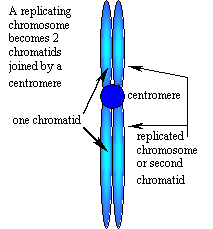
Before a cell divides, each chromosome replicates itself. These two copies are called chromatids, and are held together by a centromere. In a dividing human cell, the nuclear membrane dissolves and the 46 chromosomes produce 46 pairs of chromatids. One of each pair move to one end of the cell while the other of each pair move to the other end. A new nucleus membrane forms around each set of chromosomes, then the cell divides between the two groups. The chromosomes unravel and continue their work of sending mRNA messages to the ribosomes.
Mitosis
Mitosis is the process of cell division in which 'daughter' cells contain 2 sets of chromosomes; in which each chromosome in one set has an homologous chromosome in the other set. The cell is a diploid cell (di = 2). Human diploid cells carry 46 chromosomes.
Meiosis
For sexual reproduction, sex cells (gametes) are produced carrying only one set of chromosomes, that is, one chromosome from each pair of homologous chromosomes or homologues.
If they did not, if sex cells carried 2 sets of chromosomes, then when the sperm entered the egg, there would be 4 sets of chromosomes instead of two, and with every reproduction, the sets would double. The solution to this problem, is for sex cells to receive only one set of chromosomes. Such cells are called haploid.
Haploid cells carry only one set of chromosomes. Human gametes or haploid cells, carry 23 chromosomes.
For humans, when sperm fertilizes an egg, the chromosome number returns to 46 for the diploid cell.
During meiosis, homologous chromosomes pair up, during which time they can switch pieces. Sometimes, 'mistakes' are made, leading to a change in or a mutation of, a gene. If a mutation occurs in a gamete (sex cell) it sometimes helps the new offspring survive by giving an advantage over its fellow species, such as faster running, more blood cells, finer features. Chemicals like 2,4,5T and Agent Orange in defoliants, and fallout from US radioactive missiles (bunker busters and 'depleted' uranium missiles), can also cause mutations. The mutant fetuses of US soldiers affected by contaminants will usually be aborted so the the effects will not be public. (At least one TV documentary verifying this has been released in Australia. Such films fail to be shown in the US. In 2005 (?) Major Roche lectured on this, relating how 13 of his 22 men had already died of cancer, and more were on the way, including himself. He also explained how the US military was destroying the medical evidence.)