Genes advanced
Nucleic acids
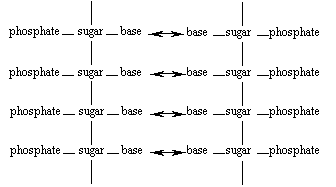 Nucleotide is a molecule consisting of a base joined to a sugar joined to a phosphate.
A nucleic acid is a polymer of nucleotides, that is, a string of nucleotides joined together by the sugars.
A nucleotide = phosphate + sugar + base.
The sugar is called deoxyribose. The sugars link these nucleotides into a chain. This chain then links to its complementary chain by linking the bases. The whole DNA molecule (a double chain about 2 metres long) is spiralled, and spiralled again. These spirals compact it to fit inside the nucleus.
There are 3 kinds of nucleic acid:
- DNA
deoxyribonucleic acid carries sequences of genes.
Has a backbone of phosphate-sugar polyester; phosphoric acid = 3 acidic hydroxyl groups of which 2 have ester linkages with the hydroxyl groups of adjacent sugar molecules. The polymer is acidic and forms salts because of the 3rd hydroxyl group.
Bases are adenine with thymine and guanine with cytosine
- RNA
Ribonucleic acid which uses ribose sugar.
Bases are adenine with uracil and guanine with cytosine
There are two types of RNA:
- mRNA or messenger RNA
This is a copy of part of the DNA molecule
- tRNA or transfer RNA
This copies information from the mRNA, to use in the making of amino acids. There is a tRNA for each amino and many more for the stringing together of amino acids to form proteins.
- mitochondrial DNA
These are small circular molecules of DNA in the mitochondria (similar to bacterial DNA).
A nucleic acid is a polymer of nucleotides.
A nucleotide = phosphate + sugar + base.
The sugar is called deoxyribose. The sugars link these nucleotides into a chain. This chain then links to its complementary chain by linking the bases. The whole DNA molecule (a double chain about 2 metres long) is spiralled, and spiralled again. These spirals compact it to fit inside the nucleus.
DNA molecules reproduce
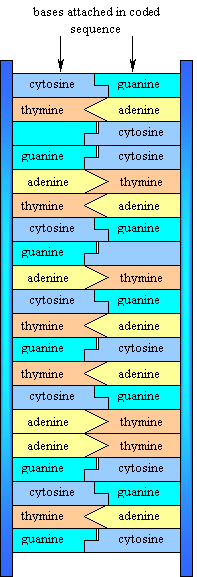 Imagine the attached bases unzipping down the middle, leaving them free to attach to other molecule: for example, an adenine detaches from a thymine on the other sugar chain. It is then free to attach to another thymine of another nucleotide floating in the nucleus. If the bases adjacent to the first adenine, also detach and do likewise, then opposite them is built up a series of nucleotides which can join along their sugars to form another chain. Extend this the full length of the sugar polymer, and a new DNA molecule is created. This is done with the enzyme DNA polymerase.
When a whole DNA molecule reproduces itself, the cell will divide into two cells, whereas when a small part of the DNA is unravelled, it produces mRNA, which moves away allowing the DNA molecule to zip up again. This mRNA then move out of the nucleus into the cytoplasm where it finds the granular ribosomes. The ribosomes 'read' the codons in the mRNA, and with the help of tRNA, make protein molecules.
The basic unit in genetic code is the codon, 3 bases long, and determines the amino acid formed. There are 64 ways of arranging 4 bases, 3 at a time when allowing duplication (4x4x4). Genes consist of a number of codons. The number of genes in human DNA approaches 100,000. Genes determines which proteins are made and when. Some genes make proteins which switch off other genes.
The vast majority of living organisms encode their genes in long strands of DNA. DNA consists of a chain made from four types of nucleotide subunits:
Remember as GACT, with bonding 1st with 3rd, and 2nd with 4th, as in:
- guanine ≡ cytosine
- adenine = thymine
where each line specifies one hydrogen bond.
Each pair contains one purine and one pyrimidine.
Each nucleotide subunit consists of three components: a phosphate group, a deoxyribose sugar ring, and a nucleobase. Thus, nucleotides in DNA or RNA are typically called 'bases'; as a consequence, they are commonly referred to simply by their purine or pyrimidine original base components adenine, cytosine, guanine, thymine. The most common form of DNA in a cell is in a double helix structure, in which two individual DNA strands twist around each other in a right-handed spiral.
The two strands in a double helix must therefore be complementary, that is, their bases must align such that the adenines of one strand are paired with the thymines of the other strand, and so on.
Due to the chemical composition of the pentose residues of the bases, DNA strands have directionality. One end of a DNA polymer contains an exposed hydroxyl group on the deoxyribose; this is known as the 3' end of the molecule. The other end contains an exposed phosphate group; this is the 5' end. The directionality of DNA is vitally important to many cellular processes, since double helices are necessarily directional (a strand running 5'-3' pairs with a complementary strand running 3'-5'), and processes such as DNA replication occur in only one direction. All nucleic acid synthesis in a cell occurs in the 5'-3' direction, because new monomers are added via a dehydration reaction that uses the exposed 3' hydroxyl as a nucleophile.
The expression of genes encoded in DNA begins by transcribing the gene into RNA, a second type of nucleic acid that is very similar to DNA, but whose monomers contain the sugar ribose rather than deoxyribose. RNA also contains the base uracil in place of thymine.
RNA molecules are less stable than DNA and are typically single-stranded. Genes that encode proteins are composed of a series of three-nucleotide sequences called codons, which serve as the words in the genetic language. The genetic code specifies the correspondence during protein translation between codons and amino acids. The genetic code is nearly the same for all known organisms.
RNA genes and genomes
RNA may be:
- an intermediate product in the process of manufacturing proteins from genes
- the actual functional products.
For example, RNAs known as ribozymes are capable of enzymatic function, and miRNAs have a regulatory role. The DNA sequences from which such RNAs are transcribed are known as RNA genes.
Some viruses store their entire genomes in the form of RNA, and contain no DNA at all. Because they use RNA to store genes, their cellular hosts may synthesize their proteins as soon as they are infected and without the delay in waiting for transcription.
On the other hand, RNA retroviruses, such as HIV, require the reverse transcription of their genome from RNA into DNA before their proteins can be synthesized. While RNA is common as genetic storage material in viruses, in mammals RNA inheritance has been observed very rarely.
Functional structure of a gene
Promoters and enhancers determine what portions of the DNA will be transcribed into the precursor mRNA (pre-mRNA). The pre-mRNA is then spliced into messenger RNA (mRNA) which is later translated into protein.
All genes have regulatory regions in addition to regions that explicitly code for a protein or RNA product. A regulatory region shared by almost all genes is known as the promoter, which provides a position that is recognized by the transcription machinery when a gene is about to be transcribed and expressed.
A gene can have more than one promoter, resulting in RNAs that differ in how far they extend in the 5' end. Although promoter regions have a consensus sequence that is the most common sequence at this position, some genes have "strong" promoters that bind the transcription machinery well, and others have "weak" promoters that bind poorly.
These weak promoters usually permit a lower rate of transcription than the strong promoters, because the transcription machinery binds to them and initiates transcription less frequently.
Other possible regulatory regions include enhancers, which can compensate for a weak promoter. Most regulatory regions are "upstream", that is, before or toward the 5' end of the transcription initiation site. Eukaryotic promoter regions are much more complex and difficult to identify than prokaryotic promoters.
Many prokaryotic genes are organized into operons, or groups of genes whose products have related functions and which are transcribed as a unit. By contrast, eukaryotic genes are transcribed only one at a time, but may include long stretches of DNA called introns which are transcribed but never translated into protein (they are spliced out before translation). Splicing can also occur in prokaryotic genes, but is less common than in eukaryotes.
Chromosomes
Genome: all the genes in an organism or cell.
The region of the chromosome at which a particular gene is located is called its locus. A chromosome consists of a single, very long DNA helix on which thousands of genes are encoded.
Prokaryotes (bacteria and archaea) typically store their genomes on a single large, circular chromosome, sometimes supplemented by additional small circles of DNA called plasmids, which usually encode only a few genes and are easily transferable between individuals. For example, the genes for antibiotic resistance are usually encoded on bacterial plasmids and can be passed between individual cells, even those of different species, via horizontal gene transfer.
Although some simple eukaryotes also possess plasmids with small numbers of genes, the majority of eukaryotic genes are stored on multiple linear chromosomes, which are packed within the nucleus in complex with storage proteins called histones. The manner in which DNA is stored on the histone, as well as chemical modifications of the histone itself, are regulatory mechanisms governing whether a particular region of DNA is accessible for gene expression.
The ends of eukaryotic chromosomes are capped by long stretches of repetitive sequences called telomeres, which do not code for any gene product but are present to prevent degradation of coding and regulatory regions during DNA replication. The length of the telomeres tends to decrease each time the genome is replicated in preparation for cell division; the loss of telomeres has been proposed as an explanation for cellular senescence, or the loss of the ability to divide, and by extension, for the aging process in organisms.
Whereas the chromosomes of prokaryotes are relatively gene-dense, those of eukaryotes often contain so-called "junk DNA", or regions of DNA that serve no obvious function. Simple single-celled eukaryotes have relatively small amounts of such DNA, whereas the genomes of complex multicellular organisms, including humans, contain an absolute majority of DNA without an identified function. However it now appears that, although protein-coding DNA makes up barely 2% of the human genome, about 80% of the bases in the genome may be being expressed, so the term "junk DNA" may be a misnomer.
Gene expression
In all organisms, there are two major steps separating a protein-coding gene from its protein: First, the DNA on which the gene resides must be transcribed from DNA to messenger RNA (mRNA); and, second, it must be translated from mRNA to protein. RNA-coding genes must still go through the first step, but are not translated into protein. The process of producing a biologically functional molecule of either RNA or protein is called gene expression, and the resulting molecule itself is called a gene product.
Genetic code
The genetic code is the set of rules by which a gene is translated into a functional protein. Each gene consists of a specific sequence of nucleotides encoded in a DNA (or sometimes RNA) strand; a correspondence between nucleotides, the basic building blocks of genetic material, and amino acids, the basic building blocks of proteins, must be established for genes to be successfully translated into functional proteins.
Sets of three nucleotides, known as codons, each correspond to a specific amino acid or to a signal; three codons are known as "stop codons" and, instead of specifying a new amino acid, alert the translation machinery that the end of the gene has been reached. There are 64 possible codons (four possible nucleotides at each of three positions, hence 43 possible codons) and only 20 standard amino acids; hence the code is redundant and multiple codons can specify the same amino acid. The correspondence between codons and amino acids is nearly universal among all known living organisms.
Transcription
The process of genetic transcription produces a single-stranded RNA molecule known as messenger RNA, whose nucleotide sequence is complementary to the DNA from which it was transcribed. The DNA strand whose sequence matches that of the RNA is known as the coding strand and the strand from which the RNA was synthesized is the template strand. Transcription is performed by an enzyme called an RNA polymerase, which reads the template strand in the 3' to 5' direction and synthesizes the RNA from 5' to 3'. To initiate transcription, the polymerase first recognizes and binds a promoter region of the gene. Thus a major mechanism of gene regulation is the blocking or sequestering of the promoter region, either by tight binding by repressor molecules that physically block the polymerase, or by organizing the DNA so that the promoter region is not accessible.
In prokaryotes, transcription occurs in the cytoplasm; for very long transcripts, translation may begin at the 5' end of the RNA while the 3' end is still being transcribed. In eukaryotes, transcription necessarily occurs in the nucleus, where the cell's DNA is sequestered; the RNA molecule produced by the polymerase is known as the primary transcript and must undergo post-transcriptional modifications before being exported to the cytoplasm for translation. The splicing of introns present within the transcribed region is a modification unique to eukaryotes; alternative splicing mechanisms can result in mature transcripts from the same gene having different sequences and thus coding for different proteins. This is a major form of regulation in eukaryotic cells.
Translation
Translation is the process by which a mature mRNA molecule is used as a template for synthesizing a new protein. Translation is carried out by ribosomes, large complexes of RNA and protein responsible for carrying out the chemical reactions to add new amino acids to a growing polypeptide chain by the formation of peptide bonds.
The genetic code is read three nucleotides at a time, in units called codons, via interactions with specialized RNA molecules called transfer RNA (tRNA). Each tRNA has three unpaired bases known as the anticodon that are complementary to the codon it reads; the tRNA is also covalently attached to the amino acid specified by the complementary codon.
When the tRNA binds to its complementary codon in an mRNA strand, the ribosome ligates its amino acid cargo to the new polypeptide chain, which is synthesized from amino terminus to carboxyl terminus. During and after its synthesis, the new protein must fold to its active three-dimensional structure before it can carry out its cellular function.
DNA replication and inheritance
The growth, development, and reproduction of organisms relies on cell division, or the process by which a single cell divides into two usually identical daughter cells. This requires first making a duplicate copy of every gene in the genome in a process called DNA replication. The copies are made by specialized enzymes known as DNA polymerases, which "read" one strand of the double-helical DNA, known as the template strand, and synthesize a new complementary strand.
Because the DNA double helix is held together by base pairing, the sequence of one strand completely specifies the sequence of its complement; hence only one strand needs to be read by the enzyme to produce a faithful copy. The process of DNA replication is semiconservative; that is, the copy of the genome inherited by each daughter cell contains one original and one newly synthesized strand of DNA.
After DNA replication is complete, the cell must physically separate the two copies of the genome and divide into two distinct membrane-bound cells. In prokaryotes - bacteria and archaea - this usually occurs via a relatively simple process called binary fission, in which each circular genome attaches to the cell membrane and is separated into the daughter cells as the membrane invaginates to split the cytoplasm into two membrane-bound portions.
Binary fission is extremely fast compared to the rates of cell division in eukaryotes. Eukaryotic cell division is a more complex process known as the cell cycle; DNA replication occurs during a phase of this cycle known as S phase, whereas the process of segregating chromosomes and splitting the cytoplasm occurs during M phase. In many single-celled eukaryotes such as yeast, reproduction by budding is common, which results in asymmetrical portions of cytoplasm in the two daughter cells.
Molecular inheritance
The duplication and transmission of genetic material from one generation of cells to the next is the basis for molecular inheritance, and the link between the classical and molecular pictures of genes. Organisms inherit the characteristics of their parents because the cells of the offspring contain copies of the genes in their parents' cells. In asexually reproducing organisms, the offspring will be a genetic copy or clone of the parent organism.
In sexually reproducing organisms, a specialized form of cell division called meiosis produces cells called gametes or germ cells that are haploid, or contain only one copy of each gene. The gametes produced by females are called eggs or ova, and those produced by males are called sperm. Two gametes fuse to form a fertilized egg, a single cell that once again has a diploid number of genes—each with one copy from the mother and one copy from the father.
During the process of meiotic cell division, an event called genetic recombination or crossing-over can sometimes occur, in which a length of DNA on one chromatid is swapped with a length of DNA on the corresponding sister chromatid. This has no effect if the alleles on the chromatids are the same, but results in reassortment of otherwise linked alleles if they are different.
The Mendelian principle of independent assortment asserts that each of a parent's two genes for each trait will sort independently into gametes; which allele an organism inherits for one trait is unrelated to which allele it inherits for another trait. This is in fact only true for genes that do not reside on the same chromosome, or are located very far from one another on the same chromosome. The closer two genes lie on the same chromosome, the more closely they will be associated in gametes and the more often they will appear together; genes that are very close are essentially never separated because it is extremely unlikely that a crossover point will occur between them. This is known as genetic linkage.
Mutation
DNA replication is for the most part extremely accurate, with an error rate per site of around 10-6 to 10-10 in eukaryotes. Rare, spontaneous alterations in the base sequence of a particular gene arise from a number of sources, such as errors in DNA replication and the aftermath of DNA damage. These errors are called mutations.
The cell contains many DNA repair mechanisms for preventing mutations and maintaining the integrity of the genome; however, in some cases—such as breaks in both DNA strands of a chromosome — repairing the physical damage to the molecule is a higher priority than producing an exact copy.
Due to the degeneracy of the genetic code, some mutations in protein-coding genes are silent, or produce no change in the amino acid sequence of the protein for which they code; for example, the codons UCU and UUC both code for serine, so the U↔C mutation has no effect on the protein. Mutations that do have phenotypic effects are most often neutral or deleterious to the organism, but sometimes they confer benefits to the organism's fitness.
Mutations propagated to the next generation lead to variations within a species' population. Variants of a single gene are known as alleles, and differences in alleles may give rise to differences in traits. Although it is rare for the variants in a single gene to have clearly distinguishable phenotypic effects, certain well-defined traits are in fact controlled by single genetic loci. A gene's most common allele is called the wild type allele, and rare alleles are called mutants. However, this does not imply that the wild-type allele is the ancestor from which the mutants are descended.
Chromosomal organization
The total complement of genes in an organism or cell is known as its genome. In prokaryotes, the vast majority of genes are located on a single chromosome of circular DNA, while eukaryotes usually possess multiple individual linear DNA helices packed into dense DNA-protein complexes called chromosomes.
Genes that appear together on one chromosomes of one species may appear on separate chromosomes in another species. Many species carry more than one copy of their genome within each of their somatic cells.
Cells or organisms with only one copy of each chromosome are called haploid; those with two copies are called diploid; and those with more than two copies are called polyploid. The copies of genes on the chromosomes are not necessarily identical. In sexually reproducing organisms, one copy is normally inherited from each parent.
For those who are impressed by DNA testing to catch the latest murderer, they test only a short span of code. Then guess a probability of likeness. And this from a trace of cells which might have been transferrd by a handshake to the scene of the crime. Just how reliable is DNA testing ?
Number of genes
Following the sequencing of the human genome and other genomes, it has been found that rather few genes (~20 000 in human, mouse and fly, ~13 000 in roundworm, >46 000 in rice) encode all the proteins in an organism.
These protein-coding sequences make up 1-2% of the human genome, that is, 20,000 out of 100,000 genes. Most of the genome gives rise to RNA products however, but not much is known about the function of these non-coding RNAs.
Genetic and genomic nomenclature
Gene nomenclature has been established by the HUGO Gene Nomenclature Committee (HGNC) for each known human gene in the form of an approved gene name and symbol (short-form abbreviation). All approved symbols are stored in the HGNC Database.
Each symbol is unique and each gene is only given one approved gene symbol. It is necessary to provide a unique symbol for each gene so that people can talk about them. This also facilitates electronic data retrieval from publications. In preference each symbol maintains parallel construction in different members of a gene family and can be used in other species, especially the mouse.
Gene targeting and implications
Gene targeting is commonly referred to techniques for altering or disrupting mouse genes and provides the mouse models for studying the roles of individual genes in embryonic development, human disorders, aging and diseases. The mouse models, where one or more of its genes are deactivated or made inoperable, are called knockout mice.
Since the first reports in which homologous recombination in embryonic stem cells was used to generate gene-targeted mice, gene targeting has proven to be a powerful means of precisely manipulating the mammalian genome, producing at least ten thousand mutant mouse strains and it is now possible to introduce mutations that can be activated at specific time points, or in specific cells or organs, both during development and in the adult animal.
Gene targeting strategies have been expanded to all kinds of modifications, including point mutations, isoform deletions, mutant allele correction, large pieces of chromosomal DNA insertion and deletion, tissue specific disruption combined with spatial and temporal regulation and so on.
It is predicted that the ability to generate mouse models with predictable phenotypes will have a major impact on studies of all phases of development, immunology, neurobiology, oncology, physiology, metabolism, and human diseases. Gene targeting is also in theory applicable to species from which totipotent embryonic stem cells can be established, and therefore may offer a potential to the improvement of domestic animals and plants.
Changing concept
The concept of the gene has changed considerably (see history section). From the original definition of a "unit of inheritance", the term evolved to mean a DNA-based unit that can exert its effects on the organism through RNA or protein products. It was also previously believed that one gene makes one protein; this concept was overthrown by the discovery of alternative splicing and trans-splicing.
The definition of a gene is still changing. The first cases of RNA-based inheritance have been discovered in mammals. Evidence is also accumulating that the control regions of a gene do not necessarily have to be close to the coding sequence on the linear molecule or even on the same chromosome. Spilianakis and colleagues discovered that the promoter region of the interferon-gamma gene on chromosome 10 and the regulatory regions of the T(H)2 cytokine locus on chromosome 11 come into close proximity in the nucleus possibly to be jointly regulated.
The concept that genes are clearly delimited is also being eroded. There is evidence for fused proteins stemming from two adjacent genes that can produce two separate protein products. While it is not clear whether these fusion proteins are functional, the phenomena is more frequent than previously thought.
Even more ground-breaking than the discovery of fused genes is the observation that some proteins can be composed of exons from far away regions and even different chromosomes. This new data has led to an updated, and probably tentative, definition of a gene as "a union of genomic sequences encoding a coherent set of potentially overlapping functional products." This new definition categorizes genes by functional products, whether they be proteins or RNA, rather than specific DNA loci; all regulatory elements of DNA are therefore classified as gene-associated regions.
The DNA Helix
Despite what you may have seen in some textbooks, DNA is not built like a twisted ladder. The helix, or spiral, is an inherent feature of the DNA molecule. The paired bases in the center meet each other at an angle.
DNA is a very large molecule; the image here shows only a tiny fraction of the typical molecule. If an entire molecule of DNA from the virus "bacteriophage lambda" were shown at this scale, the image would be 970 meters high. For the bacterium Escherichia coli, the image would be 80 kilometers long. And for a typical piece of DNA from a eukaryote cell, the image would stretch for 1600 kilometers. Obviously such a large molecule is not fully stretched out inside the cell, but is wound around proteins called histones which protect the DNA.
The two halves do not quite come in contact, but are held together by hydrogen bonds, a sort of electrical attraction between partially negative atoms on the base of one side with the partially positive atoms on the other. Both sides have positive and negative charges. A single such pairing would not hold the molecule together well, but several million such bonds are quite effective. This also has the advantage that little effort is required to pull the two halves apart for replication, when the DNA is copied, and for transcription, when the DNA message is read. The message of DNA is the information from which the cell and its components are built.