Mitochondria
Contents:
- Cellular respiration
- Mitochondria
- Outer membrane
- Inner membrane
- Mutations in mtDNA
- Mitochondria's genome
- The Matrix
- Citric Acid Cycle
- Summary
- Electron Transport Chain
- Chemiosmosis in Mitochondria
- Why do mitochondria have their own genome?
- How many ATPs?
- Mitochondrial DNA (mtDNA)
Cellular respiration
Cellular respiration is the process of oxidizing food molecules, like glucose, to carbon dioxide and water. The energy released is trapped in the form of ATP for use by all the energy-consuming activities of the cell.
The process occurs in two phases:
- glycolysis, the breakdown of glucose to pyruvic acid
- the complete oxidation of pyruvic acid to carbon dioxide and water.
In eukaryotes, glycolysis occurs in the cytosol. The remaining processes take place in mitochondria.
Mitochondria
Mitochondria have:
- an outer membrane that encloses the entire structure
- an inner membrane that encloses a fluid-filled matrix
- between the two is the intermembrane space
- the inner membrane is elaborately folded with shelflike cristae projecting into the matrix
- a small number (some 5–10) circular molecules of DNA.
The number of mitochondria in a cell can:
- increase by their fission (e.g. following mitosis)
- decrease by their fusing together.
Defects in either process can produce serious, even fatal, illness.
The Outer Membrane
The outer membrane contains many complexes of integral membrane proteins that form channels through which a variety of molecules and ions move in and out of the mitochondrion.
The Inner Membrane
The inner membrane contains 5 complexes of integral membrane proteins:
- NADH dehydrogenase (Complex I)
- succinate dehydrogenase (Complex II)
- cytochrome c reductase (Complex III; also known as the cytochrome b-c1 complex)
- cytochrome c oxidase (Complex IV)
- ATP synthase (Complex V)
The human mitochondrion contains 5–10 identical, circular molecules of DNA. Each consists of 16,569 base pairs carrying the information for 37 genes which encode:
- ribosomal RNA (rRNA): 2 different molecules of
- transfer RNA (tRNA): 22 different molecules of (at least one for each amino acid)
- 13 polypeptides:
The rRNA and tRNA molecules are used in the machinery that synthesizes the 13 polypeptides.
The 13 polypeptides participate in building several protein complexes embedded in the inner mitochondrial membrane:
- 7 subunits: that make up the mitochondrial NADH dehydrogenase
- 3 subunits: of cytochrome c oxidase
- 2 subunits: of ATP synthase
- cytochrome b:
Each of these protein complexes also requires subunits that are encoded by nuclear genes, synthesized in the cytosol, and imported from the cytosol into the mitochondrion. Nuclear genes also encode ~900 other proteins that must be imported into the mitochondrion.
Mutations in mtDNA
Mutations in mtDNA cause human diseases.
A number of human diseases are caused by mutations in genes in our mitochondria:
- cytochrome b:
- 12S rRNA:
- ATP synthase :
- subunits of NADH dehydrogenase:
- several tRNA genes:
Although many different organs may be affected, disorders of the muscles and brain are the most common. Perhaps this reflects the great demand for energy of both these organs. (Although representing only ~2% of our body weight, the brain consumes ~20% of the energy produced when we are at rest.)
Some of these disorders are inherited in the germline. In every case, the mutant gene is received from the mother because none of the mitochondria in sperm survives in the fertilized egg.
Other disorders are somatic; that is, the mutation occurs in the somatic tissues of the individual.
Example: exercise intolerance
A number of humans who suffer from easily-fatigued muscles turn out to have a mutations in their cytochrome b gene. Curiously, only the mitochondria in their muscles have the mutation; the mtDNA of their other tissues is normal. Presumably, very early in their embryonic development, a mutation occurred in a cytochrome b gene in the mitochondrion of a cell destined to produce their muscles.
The severity of mitochondrial diseases varies greatly. The reason for this is probably the extensive mixing of mutant DNA and normal DNA in the mitochondria as they fuse with one another. A mixture of both is called heteroplasmy. The higher the ratio of mutant to normal, the greater the severity of the disease. In fact by chance alone, cells can on occasion end up with all their mitochondria carrying all-mutant genomes, a condition called homoplasmy (a phenomenon resembling genetic drift).
Mitochondria's genome
Why do mitochondria have their own genome?
Many of the features of the mitochondrial genetic system resemble those found in bacteria. This has strengthened the theory that mitochondria are the evolutionary descendants of a bacterium that established an endosymbiotic relationship with the ancestors of eukaryotic cells early in the history of life on earth. However, many of the genes needed for mitochondrial function have since moved to the nuclear genome.
The recent sequencing of the complete genome of Rickettsia prowazekii has revealed a number of genes closely related to those found in mitochondria. Perhaps rickettsias are the closest living descendants of the endosymbionts that became the mitochondria of eukaryotes.
The Matrix
The matrix is where it all happens. The matrix contains a complex mixture of soluble enzymes that catalyze the respiration of pyruvic acid and other small organic molecules.
Here pyruvic acid is:
- oxidized by NAD+ producing NADH + H+
- decarboxylated producing a molecule of:
- carbon dioxide (CO2) and
- a 2-carbon fragment of acetate bound to coenzyme A forming acetyl-CoA
Citric Acid Cycle
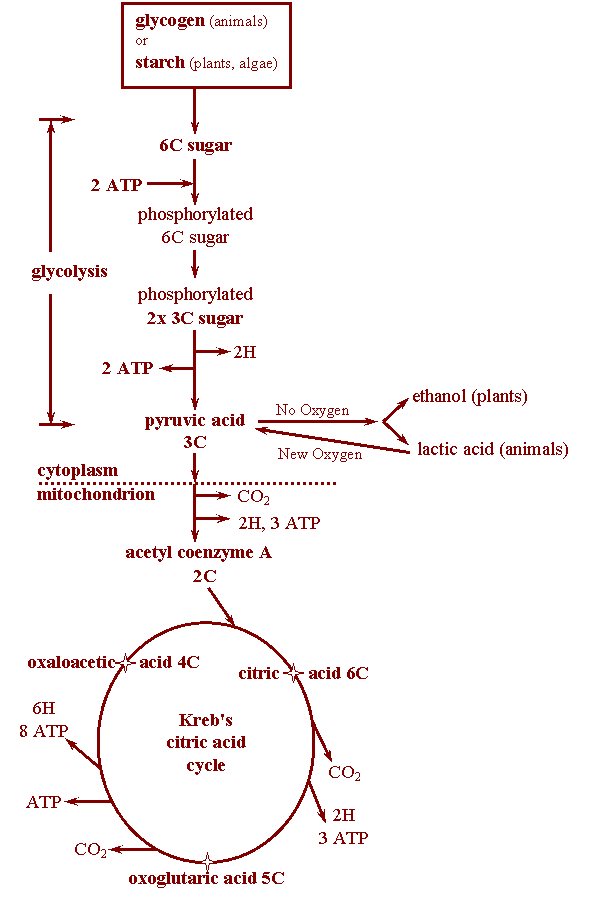 The Citric Acid Cycle:
- This 2-carbon fragment is donated to a molecule of oxaloacetic acid.
- The resulting molecule of citric acid (which gives its name to the process) undergoes the series of enzymatic steps.
- The final step regenerates a molecule of oxaloacetic acid and the cycle is ready to turn again.
Summary
Summary:
- Each of the 3 carbon atoms present in the pyruvate that entered the mitochondrion leaves as a molecule of carbon dioxide (CO2).
- At 4 steps, a pair of electrons (2e-) is removed and transferred to NAD+ reducing it to NADH + H+.
- At one step, a pair of electrons is removed from succinic acid and reduces FAD to FADH2.
The electrons of NADH and FADH2 are transferred to the electron transport chain.
The Electron Transport Chain
The electron transport chain consists of :
- 3 complexes of integral membrane proteins:
- the NADH dehydrogenase complex (I)
- the cytochrome c reductase complex (III)
- the cytochrome c oxidase complex (IV)
- and two freely-diffusible molecules :
The electron transport chain accomplishes:
- the stepwise transfer of electrons from NADH (and FADH2) to oxygen molecules to form (with the aid of protons) water molecules (H2O);
(Cytochrome c can only transfer one electron at a time, so cytochrome c oxidase must wait until it has accumulated 4 of them before it can react with oxygen.)
- harnessing the energy released by this transfer to the pumping of protons (H+) from the matrix to the intermembrane space
- Approximately 20 protons are pumped into the intermembrane space as the 4 electrons needed to reduce oxygen to water pass through the respiratory chain.
- The gradient of protons formed across the inner membrane by this process of active transport forms a miniature battery.
- The protons can flow back down this gradient, reentering the matrix, only through another complex of integral proteins in the inner membrane, the ATP synthase complex
Chemiosmosis in mitochondria
The energy released as electrons pass down the gradient from NADH to oxygen is harnessed by three enzyme complexes of the respiratory chain (I, III, and IV) to pump protons (H+) against their concentration gradient from the matrix of the mitochondrion into the intermembrane space (an example of active transport).
As their concentration increases there (which is the same as saying that the pH decreases), a strong diffusion gradient is set up. The only exit for these protons is through the ATP synthase complex. As in chloroplasts, the energy released as these protons flow down their gradient is harnessed to the synthesis of ATP. The process is called chemiosmosis and is an example of facilitated diffusion.
It is tempting to try to view the synthesis of ATP as a simple matter of stoichiometry (the fixed ratios of reactants to products in a chemical reaction). But (with 3 exceptions) it is not.
Most of the ATP is generated by the proton gradient that develops across the inner mitochondrial membrane. The number of protons pumped out as electrons drop from NADH through the respiratory chain to oxygen is theoretically large enough to generate, as they return through ATP synthase, 3 ATPs per electron pair (but only 2 ATPs for each pair donated by FADH2).
With 12 pairs of electrons removed from each glucose molecule:
- 10 by NAD+ (so 10x3=30)
- 2 by FADH2 (so 2x2=4)
This could generate 34 ATPs. To these 34 ATPs, add 4 ATPs from 3 exceptions, to make 38 ATPs.
But:
- The energy stored in the proton gradient is also used for the active transport of several molecules and ions through the inner mitochondrial membrane into the matrix.
- NADH is also used as reducing agent for many cellular reactions.
So the actual yield of ATP as mitochondria respire varies with conditions. It probably seldom exceeds 30.
The three exceptions
A stoichiometric production of ATP does occur at:
- one step in the citric acid cycle yielding 2 ATPs for each glucose molecule. This step is the conversion of alpha-ketoglutaric acid to succinic acid.
- at two steps in glycolysis yielding 2 ATPs for each glucose molecule.