Lamellae
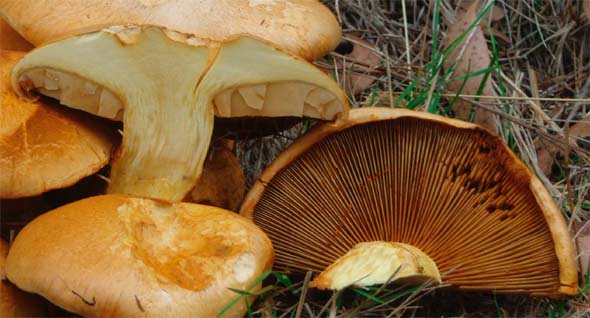
At the microscopic level the basidiospores are shot off of basidia and then fall between the gills in the dead air space. As a result, for most mushrooms, if the cap is cut off and placed gill-side-down overnight, a powdery impression reflecting the shape of the gills (or pores, or spines, etc.) is formed when the fruitbody is sporulating. The color of the powdery print, called a spore print, is used to help classify mushrooms and can help to identify them. Spore print colors include white (most common), brown, black, purple-brown, pink, yellow, and cream, but almost never blue, green, or red.
While modern identification of mushrooms is quickly becoming molecular, the standard methods for identification are still used by most and have developed into a fine art harking back to medieval times and the Victorian era, combined with microscopic examination. The presence of juices upon breaking, bruising reactions, odors, tastes, shades of color, habitat, habit, and season are all considered by mycologists, amateur and professional alike. Tasting and smelling mushrooms carries its own hazards because of poisons and allergens. Chemical tests are also used for some genera.