Hydrocarbons

Frames for learning

A good frame for learning hydrocarbons is:


Why is this a good frame ?
This frame shows that:
Let us now expand the previous frame for more detail.

Saturated aliphatics

The alkanes and cycloalkanes are saturated because they have only single bonds between the carbons in the chain. This makes them fairly unreactive, and unable to undergo addition reactions. They are unaffected by acids and alkalis, but do undergo substitution reactions especially with the halogens in ultraviolet light.

CH4+Cl2→CH3Cl+HCl
methanewithchlorine giveschloromethaneandhydrogen chloride

Each cycloalkane has the chain of the corresponding alkane looped around so the tail joins the head. Being so similar they have similar properties, and this is why I prefer to learn them as a subset of the aliphatics (Gk: aleiphat = unguent, fat); the cyclics are aliphatics turned into circles.

Basic structural components of alkanes are:

You can now see why the general formula is CnH2n+2.

Unsaturated aliphatics

Since the alkenes and alkynes have at least one unsaturated bond, the smallest molecule has two carbons.

Alkenes are much more reactive than the alkanes due to the C=C bond, and are also more reactive than the alkynes. The characteristic reaction of an alkene is an addition reaction, that is, to add an atom to each of the carbons on the double bond to convert it to a single bond.

The main types of addition reactions are:
Unsymmetrical reagents like HCl or HOH, added to unsymmetrical alkenes, predominantly give the product in which the H attaches to the carbon atom which already has most hydrogen atoms attached. (Markovnikoff's rule). Non-hydrogen atoms usually attach to the carbon with fewer hydrogen atoms.

Symmetrical reagents on asymmetrical alkenes or asymmetrical reagents on symmetrical alkenes, obviously give only one product.

Alkenes with 2 double bonds are dienes as in butadiene, and with 3 double bonds are trienes as in octatriene.

Alicyclics

These examples show the 3 types of alicyclics, parallel to the 3 aliphatics hexane, hexene and hexyne.
Alicyclics have similar properties to the corresponding straight-chain aliphatics.
The alkenes and cycloalkenes are unsaturated because they all have at least one double bond in the carbon chain. The alkynes and cycloalkynes have at least one triple bond.

Aromatics

The aromatics are so called because of their pleasant odors. They are constructed of benzene rings.
The benzene derivatives are markedly different from the aliphatics because:

Benzene and benzene derivatives have substitution reactions in which a hydrogen atom attached to a carbon atom in the ring, is replaced by a substituent group. Note that since each ring carbon has already used 3 bonds, those carbons can attach to only those atoms or groups of atoms, which need single covalent bonds.

Benzene does not easily undergo addition reactions like the similarly unsaturated alkenes and alkynes. Like other hydrocarbons, the aromatics have relatively low melting and boiling points and are insoluble in water, because the intermolecular forces being weak dispersion forces.

Benzene and its derivatives undergo substitution reactions whereby a hydrogen is replaced:

Properties of aliphatic hydrocarbons

Table 12 - 1: Properties of aliphatics

PropertyAlkanesAlkenesAlkynes
General formulaCnH2n+2CnH2nCnH2n−2
Family name-ane-ene-yne
Stem namedepends on length of main carbon chain
Shortest membermethane CH4ethene CH2CH2ethyne CHCH
Common namemethaneethyleneacetylene
Reactivityfairly unreactive;
substitution reactions
with halogens
very reactive;
Br, H, steam will add
across C=C bond
fairly reactive
Characteristic reactionsubstitutionadditionaddition
With oxygencombust to form carbon dioxide and water
Solubility in waterall aliphatics are virtually insoluble
Melting Pt/Boiling Pt/ Densityrelatively low; increase with molecular mass

Functional groups

A functional group is a group of atoms which can:
Each functional group thus defines an homologous series.
Example: An alkyl group R is an aliphatic with one of its hydrogen atoms removed.

Table 12 - 2: Characteristics of different functional groups

ClassFunctional groupGeneral formulaWritten asPrefixSuffixMain intermolecular forcesSolubility *Boiling point
haloalkanes-F,
-Cl,
-Br,
-I
R-XRXfluoro-, chloro-, bromo-, iodo- -dispersiongood solvent for fats, oils, waxeslow
alcohols-OHR-OHROHhydroxy- -(an)olstrong H bondingsoluble in waterrelatively high
aldehydesRC(O)H- -(an)aldipole-dipoleslightly soluble in waterlower than alcohols, higher than HCs, ethers, haloalkanes
ketonesRC(O)R'- -(an)onedipole-dipoleslightly soluble in watersimilar to aldehydes
carboxylic acidsRCOOH- -(an)oic acidstrong H bondingsoluble in waterrelatively high
ethers-O-R'R-O-R'ROR'alkoxy- -dipole-dipoleslightly soluble in waterhigher than alkanes
amines-NH2RNH2- -(an)amineH bondingsoluble in waterlower than alcohols
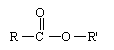
estersRC(O)OR'alkyl -(an)oatedipole-dipoleslightly soluble in waterlower than alcohol, carboxylic acids
amidesRC(O)NH2H bonding -(an)amidedipole-dipolesoluble in watersimilar to carboxylic acids
amino acids (20)NH2RC(O)OH- ----
* Dipole-dipole forces between organic compounds and water, assist solubility.
There are more groups, such as silicon and sulfide groups, but these go beyond our needs.

Naming carbon compounds

Naming requires:

Examples

Some examples of naming are:

Table 12 - 3: Naming aliphatic compounds

Number of CStemAlkylAlkaneAlkeneAlkyneExamples
1meth-methylmethane--methane CH4
2eth-ethylethaneetheneethynedichloroethene
CCl2=Ch3 or CHCl=CHCl
3prop-propylpropanepropenepropynepropyne
CH=C-CH3
4but-butylbutanebutenebutyne3-methyl-1-butene
Ch3=CH-CH-(CH3)2
5pent-pentypentanepentenepentyne2-pentyne
CH3-C=C-Ch3-CH3
6hex-hexylhexanehexenehexyne2,2-dimethylhexane
CH3-C(CH3)2-Ch3-Ch3-CH3
7hept-heptylheptanehepteneheptyne5,6-diethane-2-heptyne
8oct-octyloctaneocteneoctyne2-methyl-6-ethyl-4-octyne
9non-nonylnonanenonenenonyneTry 3 functional groups on an alkene
10dec-decyldecanedecenedecyneTry 3 functional groups on an alkyne

In 4-methylpentane, think of 4-methyl as:
'methane joined to the 4th carbon of a 5-carbon main chain'.

In 2-methoxy-4-methylpentane, think of 2-methoxy and 4-methyl as:
'methane joined through oxygen to the 2rd carbon of a 5-carbon main chain;
while another methane is joined to the 4th carbon'.

End of the Hydrocarbons

When you have mastered these two chapters, able to replicate all diagrams and structures without looking, you will have the essence of Carbon Chemistry.