Oceans of seawater which consists of:
- chemicals
Rainwater seeping through the ground, dissolves chemicals in the soil, both natural and man-made, to be carried by rivers into our oceans:- salts of sodium, potassium
which all animals need to build cells and nervous systems - salts of calcium, magnesium
which animals extract to build skeletons or coral homes - silicates
used by plants and animals to make steel-hard needles or skeletons - many, many others
- salts of sodium, potassium
- gases
As storms spray water through the air, the gases in the air are absorbed and dissolved. Lightning causes nitrogen and oxygen to combine into nitrogen oxides and these are dissolved by the rain which is caught by the oceans.:- oxygen
which all animals and plants need for respiration - carbon dioxide
which is combined with calcium to make calcium carbonate to build skeletons and coral;
carbon dioxide absorbed by the oceans lessens the effect of global warming. - nitrogen and its oxides
- methane
methane absorbed by oceans lessens its effect on global warming (methane is 30 times more damaging than carbon dioxide)
- oxygen
- animals:
- big fish which eat little fish
- fish which eat krill
- krill which eats krill and plankton
- animals which extract calcium salts to build coral homes or delicate skeletons
- dead animals forming sediment
- sediments
perhaps 5 km thick, which with converging plates may be scraped off to pile up in the trench at the plate margin:- minerals, waiting for the technology which can mine them profitably
- organic sediments
- calcium and magnesium carbonates from skeletons and coral, which with sufficiently heavy sediments on top, will be compressed into chalk and limestone sedimentary rock.
- sleeping ships
- dense garbage
- lava
exuding magma along divergent plate margins, providing a home for:- smokers, or tall 'chimneys' housing life, but as the plates continue to diverge and a particular smoker cools, the animal within dies.
- bacteria using sulfur and heat to maintain life processes; able to survive high temperatures because high water pressure prevents boiling.
- pollution
oil, detergents, garbage, plastics, man-made chemicals - water
oh, yes, let's not forget the water; floating on denser basaltic rock which forms a continuous skin over the planet, under both oceans and continents. Remember that water forms ice and there is enough ice at the poles, on melting, to drown the coastal farmlands of our continents, causing massive starvation.
comprising of:
- granitic rock (called sial = Silica + Aluminium/aluminum)
a raft of granite-like rock floating on denser basaltic rock. This basalt-like rock (called sima = Silica + Magnesium) forms a continuous skin over the planet, under both oceans and continents.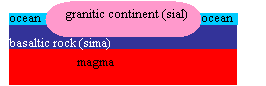 The granitic continents float on the basaltic layer. If the weight of the continent increases during an ice age because of thick sheets of ice, then the continent sinks deeper into the underlying basaltic rock
All igneous rock contains silica. Those with little silica are basic and dark-colored; those with a lot of silica are acidic and light-colored. There are over 600 types of igneous rock, all differing in mineral composition and grain size. Granitic rock is not uniform. If one uniform blob of magma is extruded along a sill, as it contacts the cool surrounding rock, it cools allowing some minerals to crystallize first and some of them to be left behind, causing the lava to change in composition. The longer the lava takes to cool, the bigger the crystals. Therefore the same uniform blob of magma will produce different rock.
Different magma can have different composition. Multiply the two and there becomes a vast array of compositions for what is basically, the same light-colored acidic igneous rock. Here are 5 variations of granite, differentiated by crystal size:- white granite
large grains because of slow cooling, having formed deep within the crust - quartz porphyry
medium-grained - rhyolite
light-colored fine-grained equivalent of granite, containing 30% orthoclase feldspar, 28% quartz, 20% plagioclase feldspar, small amounts of mica and biotite. - pitchstone
very-fine grained, dark green and glassy - obsidian
with micro-fine crystals, obsidian looks like black glass - igneous rocks are mainly silicates, with granitic rocks being silica-rich and thus acidic and light-colored while basaltic rocks have less silica, and thus dark and basic. The silicates include:
- orthoclase feldspar
- plagioclase feldspar
- quartz, crystallizes at 8500C
- biotite mica
- olivine, crystallizes at 12000C
- amphibole
- pyroxene
- white granite
- covered in debris:
- Granitic rafts that have sunk a little temporarily, allowing the seas to wash across them only to become trapped when the raft rose once more. These shallow seas then evaporated leaving beds of rock salt. Elsewhere the sediments of the ocean bed, containing chalk or limestone, became exposed.
- Volcanoes allow the magma from the asthenosphere to spurt over over the continent, carrying with it basaltic rock melted on the way. Thus minerals that sank to the depths when the earth was molten, are being returned to the surface.
- All rock, whether from the granitic raft, from the lithosphere or from the asthenosphere, once they readh the surface, are subjected tot he weathering processes of the atmosphere, and broken down and decomposed to release their minerals as sand ,clay, silt and so on.
- The sand, clay, silt, chalk, etcetera, have been covered, compressed and cemented into sandstone, argillaceous rocks, shale, mudstone, siltstone, conglomerate, limestone, etc, then metamorphosed into metaquartzite, gneiss, schist, slate, through to marble, to give all the variations of rock we find today. All sitting on this highly varied granitic raft, floating between oceans, on our Planet's skin of basaltic rock.
Oxygen, carbon dioxide, nitrogen oxides, rain, hail, snow, and ice are as much components of the surface of the planet as are rocks, and cause more change, albeit subtle, than the spectacular volcanoes.
We cannot chip and label radiation like we do rocks, but the presence or absence of radiation, its absorption or reflection, transforms the rocks upon which we stand and, as our grandchildren will see, the oceans.


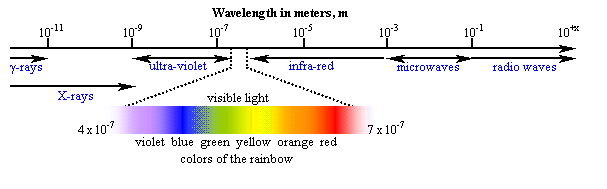 The visible light spectrum has a different color for each wavelength. When elements are heated they give of visible light which can be separated into the different wavelengths (of different colors). These can be used to identify the element. This technique is used for identifying the elements on stars and planets.
