Tropical storms
Growth Tropical Storms and Hurricanes
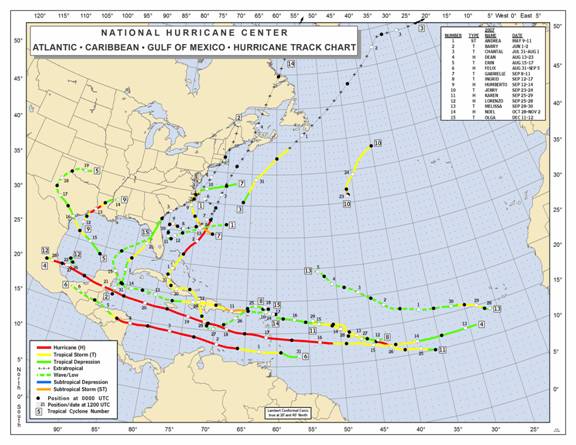
This map of US hurricanes and storms will require zooming in to 200%.
Stages of formation:
- tropical change: atmospheric pressure begins dropping, with clouds forming along a warm front
- tropical wave: random showers and thunderstorms
- tropical disturbance: an organized area of showers and thunderstorms, with clouds beginning to show a spiral
- tropical depression:
- organized area of tropical low pressure
- wind speed <e; &elt;62 km/hr when averaged over one minute, measured at 10 meters above the surface
- cyclonic/rotating winds (counter-clockwise in the Northern Hemisphere and clockwise in the Southern Hemisphere)
- tropical depressions are numbered (ex: Tropical Depression 3, 2004)
- tropical storm:
- average winds >e; 63 km/hr
- cyclonic/rotating winds
- given preselected names issued alphabetically
- hurricane:
- average winds >e; 119 km/hr
- cyclonic/rotating winds
- given preselected names issued alphabetically
There are approximately 80-100 tropical storms annually and about half of these storms become full-fledged hurricanes.
At 119 km/hr a tropical storm becomes a hurricane.
Hurricanes can be from 100 to almost 1700km wide. They vary widely in intensity; their strength is measured on the Saffir-Simpson scale from a weak category 1 storm to a catastrophic category 5 storm. There were only two category 5 hurricanes with winds over 260kph and a pressure of less than 920 mb (the world's lowest pressures ever recorded were caused by hurricanes) that struck the United States in the 20th century. The two were a 1935 hurricane that struck the Florida Keys and Hurricane Camille in 1969. Only 14 category 4 storms hit the U.S. and these included the nation's deadliest hurricane - the 1900 Galveston (Texas) hurricane and Hurricane Andrew which hit Florida and Louisiana in 1992.
Hurricanes
The birth of a hurricane starts as a low pressure zone and builds into a tropical wave of low pressure.
Hurricanes require:
- a disturbance in the tropical ocean water (an organized area of showers and thunderstorms)
- warm ocean waters above 27oC down to 50 meters below sea level
- light upper level winds
- the Coriolis effect to provide their spin.
Needing the Coriolis effect to provide their spin, hurricanes cannot form between 5oC north and south of the equator where there is not enough rotary motion.
These conditions are provided by the regions from 5oC to 20oC north and south of the equator. These regions are the belts where hurricanes can form.
The aliases of 'hurricane' are:
- hurricane:
- Caribbean, Gulf of Mexico: June 1 – November 30
- Central Pacific: June 1 – November 30
- Eastern Pacific: May 15 – November 30
- cyclone:
- Bay of Bengal
- Arabian Sea
- Australia: December – March
- typhoon: China Sea, Pacific Ocean north of the equator and west of the International Dateline.
Hurricanes are named for Huracan, the Carib god of evil, who blows 40 to 50 times worldwide each year.
Hurricane Katrina of 2005, achieved notoriety because its surging seas blocked the rising waters of the Mississippi, causing levies to break and flood lower New Orleans. While only a minor event compared to annual devastation of Asian floods, the US was shocked by some loss of life and the incompetent national response, particularly by President Bush who continued to holiday on his ranch.
Hurricanes are generated over seas whose temperature is above 27oC. When they cross the coast and go inland they rapidly lose their energy and force.
In the US, hurricanes form over the central Atlantic and generally move westward over the Caribbean. In Australia the cyclones generally move eastwards, although along Queensland, for obvious reasons they have to move westward to cross the coast. Cyclones striking the Western Australia coast around Karatha-Broome, bring rains which carry across the deserts, sometimes going as far as the east coast of Australia. It follows that cyclones form an essential part of Australia's ecosystem, the bigger cyclone the more rain, the better it is.
Hurricane damage results from three primary causes:
- Storm Surge. Approximately 90% of all hurricane deaths can be attributed to the storm surge, the dome of water created by the low pressure center of a hurricane. This storm surge quickly floods low-lying coastal areas with anywhere from 3 feet (one meter) for a category one storm to over 19 feet (6 meters) of storm surge for a category five storm. Hundreds of thousands of deaths in countries such as Bangladesh have been caused by the storm surge of cyclones.
- Wind Damage. The strong, at least 74 mph or 119 km/hr, winds of a hurricane can cause widespread destruction far inland of coastal areas, destroying homes, buildings, and infrastructure.
- Freshwater Flooding. Hurricanes are huge tropical storms and dump many inches of rain over a widespread area in a short period of time. This water can engorge rivers and streams, causing hurricane-induced flooding.
Unfortunately, polls find that about half of Americans living in coastal areas are unprepared for a hurricane disaster. Anyone living along the Atlantic Coast, the Gulf Coast and the Caribbean should be prepared for hurricanes during hurricane season.
Fortunately, hurricanes ultimately diminish, reverting to tropical storm strength and then into a tropical depression when they move over cooler ocean water, move over land, or reach a position where the upper level winds are too strong and are thus unfavorable.