Global warming

Understanding heat

What is the difference between heat, radiation, temperature and hot/cold ?
Heat is not radiation, nor is radiation heat. Heat is atomic and molecular vibration. The more heat an object, a gas, or a person has, the faster its atoms and molecules vibrate. In a vacuum, there are no molecules to vibrate and therefore no heat.

However, radiation will pass through it unhampered. When you touch something hot, the warming of your hand is nothing more than increased molecular vibration. Put your hand in front of a fire or radiator and the radiation penetrates your skin, and is absorbed by the molecules, causing those molecules to vibrate faster. Your 'heat' nerves sense this increased vibration, sending signals to your brain.

Temperature does not exist. It is a figment of our imagination, but a very useful one. In one sense it is merely man's meazure of the relative vibration of atoms and molecules. We can illustrate this by seeing how a thermometer is made. Take an empty thermometer glass with a hollow bulb at one end of a hollow glass tube. Put (liquid) mercury or colored alcohol in it. Suck the air out of the top of the tube and seal the glass end. This will be our themometer.

[Series of Diagrams]
Place the bulb in pure water. Firstly put ice in it, wait till the mercury column stops shrinking and mark the level of mercury as 0. Then bring the water to the boil and allow the mercury to expand fully. Mark this new level as 100. Divide the length between 0 and 100 into 100 units. Call this thermometer a Celsius thermometer.

Now repeat this process with another thermometer tube but instead of using pure water, we can use iced salt water for zero and an oven set to roast beef for 400. Divide this scale into 400 units. Call this thermometer a Fahrenheit thermometer. These two thermometers, Celsius and Fahrenheit, give us different numbers for the same temperature, but each will be consistent in comparing temperatures of objects.

For example, iced pure water will always give 0oC on the Celsius scale while the Fahrenheit will always give 32oF. If water is boiled (at sea level the air pressure is 1 atmosphere) the Celsius scale will always read 100oC and the Fahrenheit 212oF. Each will provide a consistent comparative meazure of the speed of vibration of molecules, without actually telling us what that speed is.

For a further example, if we take an aluminium cup and a stainless steel cup, filling them both with tea an immersing them in the same hot water bath, they would eventually have the same temperature. The Celsius thermometer would show that the two cups had the same temperature. We would find that the Fahrenheit thermometer shows a different number of degrees because it uses a different scale, but that the reading would also be the same for each cup.

This shows that temperature is an artificial meazure of some quality which causes the expansion of mercury in each thermometer. That quality, we now know, is the vibration of molecules. The faster the molecules of mercury vibrate, the longer the column of mercury in each thermometer.

If we took the two cups out of the water bath, still at the same equal temperature, and held them in our hands, we would say that the aluminium cup was hotter than the stainless steel cup. The former might burn our lips, while the other would allow us to drink the tea comfortably.

The aluminium cup is hotter because it transfers the heat from the tea to our lips more quickly than does the stainless steel. Because more 'heat' goes into our lips, the molecules in our lips vibrate more quickly, thus the signal sent by our 'heat' nerves is read by the brain as 'burning lips'.

You might like to ponder on these differences until you understand them fully.

The two temperature scales, Celsius and Kelvin, have the same divisions but different zeros.
Each Celsius degree 1oC = 1oK
But while the zero for Celsius was given to the freezing point of water, the zero for Kelvin is absolute zero, the temperature at which no gas exists because everything is solid, and the temperature at which all atomic and molecular vibration ceases. Objects at absolute zero do not radiate. All other objects do.
Freezing point of water 0oC = 273oK
Absolute zero 0oK = –273oC
Boiling point of water 100oC = 373oK

[Graph of Kelvin, Celsius and Fahrenheit scales in comparison.]

Do not bother further with the Fahrenheit scale. Being clumsy to use, it has been abandoned by all but the US, along with the imperial and US meazuring systems.

Abbreviations
nanometres (nano = 10–9 or one billionth of a metre)

Radiation

What is radiation ?
We do not know what radiation is - we cannot capture it in a bottle and observe it under a microscope. We can, however, see how our meazuring equipment interacts with it. Such equipment tells us that radiation sometimes appears like continuous electromagnetic waves and sometimes like tiny pulses of energy, called photons. Which of these qualities it takes, depends on the type of equipment used to meazure it.

When our equipment meazures radiation as electromagnetic waves, that radiation includes X-rays with very very short wavelengths, ultraviolet light, light, infrared rays, and radiowaves to radiation having wavelengths kilometers long. They all travel at the same speed, called the speed of light, nearly 300 million metres per second (300 x 106 m/s).

[Table of frequencies: wavelength, frequency, name of range eg X-rays]

The light we see by, is not in the middle of these frequencies, but is across the peak intensity of the Sun's radiation frequencies. Our eyes evolved in response to the maximum intensity of the Sun's radiation. So did photosynthesis - which is why grass is green - for green has the frequency

[Graph]

The surface temperature of the Sun is 5800oC, which gives its peak radiation intensity between frequencies of 750 to 400 x 1012 Hertz. Because the velocity of light equals frequency times wavelength, given as c = f.λ, divide this frequency range into the speed of light to find that the wavelengths of visible light cover:
Range of wavelengths λ = 400 - 750 nanometres (nano = 10–9 or one billionth).

4 major factors

The four main contributors to the Earth's surface temperature are:
[Diagrams]

2 minor factors

Two more lesser contributors are:
VolcanoLocationYearTemperature drop
PintuboPhilippines1991Over 1/2oC
Krakatauwest of Java1883The Globe was cooler for 5 years: 1883-88
TamboraIndonesia1815Europe in 1816 recorded "a year without a summer"
? ?1601 ?

Ice ages

An ice ages follows each Milankovitch cycle which is determined by the solar radiation on Earth at any location as determined by:
Warmer temperatures occurred about 103,000 years ago, then 82,000, 60,000, 35,000, and 11,000 years ago. On top of the Milankovitch cycles are imposed other fluctuations.

Nonetheless, since the last one, that is, for the last 10,000 years the temperature has been relatively stable, although Greenland ice shows that it has had more than 20 abrupt temperature changes of +/- 20oC, with such changes occurring in as little as decades and less.

Between 1100 and 1250 CE, the northern hemisphere was warm enough for the Vikings to grow crops in Greenland, but this was followed by a Little Ice Age, from 1400 to 1800, with Global temperatures dropping about 1oC. Within this period, from 1645 to 1715, Sun spots almost disappeared, giving 6 of the 7 minimum number of spots over the past 5000 years. This coincides with intervals of colder climate, although any causal relationship is not understood.

The causes are unknown but may have been due to changes in the ocean currents.
[Diagrams]
One such current is El Nino (pronounced el ninyo), a warm surface ocean current flowing from the western Pacific near New Guinea and flowing across to Peru. It occurs every 3 - 7 years and lasts 12 - 18 months. bringing warm water to Peru. When it occurs, heavy rains and storms ensue, from Peru to Mexico, often with devastating effect; while droughts occur in the countries around the Indian Ocean. Air pressure and trade winds change; and there is a general atmospheric East to West flow over the Pacific, carrying warm moist air to the western Pacific. El Nino's temperatures are coupled to airflow patterns which amplify El Nino in its early stage, but eventually bring it to an end, and El Nino decays into El Nina. El Nina is the cold cycle of the Pacific Ocean.
[Map]
But that is not all. El Nino is part of the El Nino Southern Oscillation (ENSO), where the Southern Oscillation is the inverse relationship between atmospheric pressures in Darwin and in Tahiti. As pressure in Darwin goes up, it goes down in Tahiti, and vice versa.

The greenhouse effect

What is a Greenhouse ?
A Greenhouse is not green. It is a hut made of glass in a metal frame. It used in cool climates to give plants a warm environment so they do not suffer damage from frost, grow faster and germinate earlier.

How does it work ? The Sun's radiation is most intense in the visible light range. This enters freely through the glass where some is reflected back out, but the rest is absorbed by the soil and plants, causing their molecules to vibrate faster. These faster molecules will also give off radiation. When they give off radiation they themselves slow down. (We meazure this slowing down as falling temperature.)

Some of this re-radiation from plants and soil, is in the range of visible light (thus we see the soil as brown and plants as green) but mostly this new radiation is in the range of longer wavelength, particularly infrared. These longer infrared wavelengths tend to be reflected by the glass, sending them back to the plants. In this way the plant molecules become faster and faster (meazured as rising temperature).

To prevent the plants from over-heating, the greenhouse or glasshouse has adjustable vents in the roof which can be opened to allow hot air to escape. Not so the Earth.

The Earth's atmosphere is viewed as a Greenhouse, with the atmosphere acting as the glass, allowing the Sun's radiation free entry but when the Earth's surface radiates, the atmosphere reflects it back. This causes heat to build up and the Earth's surface temperature to rise.

This is an oversimplification. We do not understand all the processes involved, and do not fully know how these processes interact; nor how much they reinforce or counteract For example, as the air temperature increases globally, the water temperature also increases. This increases evaporation which, with condensation in the upper atmosphere, increase cloud cover. Clouds reflect the Sun's radiation back into space, casting shadows on the Earth's surface, which, as you know, has a cooling effect, thus reducing the air's temperature. Thus an increase in air temperature, after a time lag, decreases air temperature, returning it to normal. (This tendency to return to normal is sometimes labelled "homeostasis" altho homeostasis is usually an active process specifically designed to return to normal, whereas this proces just mentioned appears accidental.)

Low clouds are formed of water droplets, while high clouds are tiny ice crystals.
Both initially form on very fine particles like pollen and dust.
This leads to the theory that reducing dust from coal-burning power stations, instead of carbon dioxide, is accelerating global warming. Dust produces clouds which reflect heat back into space, thus lowering planet temperature.

But some processes can reinforce each other, preventing a return to normal. Some processes might accelerate other processes. While we partially understand many processes, we have usually studied them in isolation - processes are more easily understood by eliminating any external influences. Hence we are not in a position to accurately predict the future course of the Earth's surface temperature.

We do know:
We do not know if the 'greenhouse gases' are now causing the Earth's surface temperature to rise further. If we do not know, why are we worried ? We are worried because, if it does occur, by the time we will find out, it will be too late to reverse it.

[SBS news April 1, 2005 (not an April fool's joke) showed graphs of CO2 levels for each year from 1954 to 2005. Along with marked seasonal fluctuations, the trend shows a consistent annual increase for every year of the record. From US research center in Hawaii.]

Effect of global rise

A small rise in temperature will melt the Antarctic ice cap, causing a rise in the level of the oceans which would lead to the drowning of Pacific islands, the permanent flooding of Bangladesh, the more frequent flooding of China's great rivers, the drowning of a significant portion of the globe's agricultural land. All this would lead to massive starvation and death. How could we handle even the refugee problem ? No person on this planet will escape the economic, social and political consequences. And instead of signing the Kyoto Protocol, George W Bush played golf.

Watching 6 billion of us spreading like a cancer over the planet, deliberately wrecking more havoc in the last 100 years than in the previous 5 million, consuming everything, turning her planet into one global cesspit, Mother Earth is probably using this temporary warming mechanism as a corrective factor.

Man-caused factors

What factors are involved ?
Let us understand some factors:
On Earth, ice forms on the poles, on mountains (Himalayas, Rockies, Andes, Kilomanjaro) and glaciers, reflecting most of the radiation without absorption, so the wavelengths are unchanged and, if there is no cloud cover, the radiation shoots back into space. If global warming melts this ice, far more radiation will be absorbed by the Earth's surface, and any re-radiated will have a longer wavelength which carbon dioxide absorbs. This will increase global warming. The North Polar ice has been melting each summer for the first time in 'recorded' history (but then, not many people have recorded northern ice conditions). These factors will reinforce each other.

US contribution

Currently, the US carbon emissions run at 5 tonnes per year, some 25 times that of over 50 developing countries running at 0.2 tonnes per year. The US insists that the developing nations should make equal sacrifices, even though the developed nations caused the problem, but this would hinder their economic development - they would be chained to poverty.

Planet's future

If we wish to put this in perspective, the Sun is becoming increasingly bright, giving off more intense radiation, so the Earth will become increasingly warmer, with surface conditions approaching those of Venus, driving off all water and destroying all life. The sun will expand as far as Mars, as a huge red gaseous ball consuming the Earth. (This makes having children, seem a little pointless, doesn't it ? Our genes will boil to nothing in a great hot soup - aagh!) About 1 billion years from now, whew!

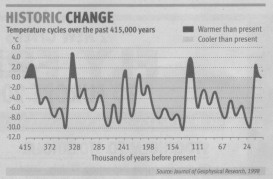
This poor-quality image comes from a newspaper. Originally it came from the Journal of Geophysical Research, 1998.

The horizontal axis is in thousands of years before the present. The vertical axis has units of 2oC. The black denotes temperature differences above current global temperature, and the rest meazures temperatures below the current.
The horizontal axis is in thousands of years before the present. The vertical axis is in degrees, with the black denoting temprature differences above current global temperature, and the rest, for below current temperature.

Contrary view

The newspaper article presented the view of marine geophysicist Bob Carter, a professor at Queensland's James Cook University, arguing that the global temperature changes of recent years are part of a 'normal' pattern.
While not disputing this, I would ask:
The article states that CO2 is not responsible for current global warming, but this ignores the effects of methane and other gases that have more than 30 times greater effect than CO2.

Carbon trading

It has become politically popular to promote carbon emissions to reduce global warming. I believe that all the carbon emissions you care to buy will not affect global warming because the 3 causes of excessive methane and carbon dioxide emissions will not be affected, namely: Since our energy supplies are being depleted, we are living too extravagantly. Oil, so limited and precious, should not be wasted as a fuel but should be reserved for manufacturing other products. Adding value to the oil, not just burning it.

It is possible to live comfortably on $200 per week, some $10,000 per year, yet people are earning over $50,000 and spending all of it. The $40000+ difference is spent on generating excessive methane, carbon dioxide and countless other pollutants – whether you are buying unncessary goods and services or travelling by car or jet.

My contribution ?
Lest you think I am an armchair greenie, I will tell you. I began planting trees in 1971, and have spent considerable time planting and nurturing trees on 5 properties that I have bought and sold. In addition I have landscaped 4 other properties free-of-charge so that I could plant more trees and, by example, persuade Australians to plant trees and, in particular, Australian native species. Further I planted over 2000 rainforest trees on a block of pasture on the Tweed River, and since this involved digging holes with a mattock in 80% rock, it required considerable effort and determination. Those trees are now a rainforest over 5-8m high and growing rapidly, and dense enough to regenerate itself. Birds now come in scores each day, voiding seed brought from elsewhere, so new saplings are springing up everywhere. Wallabies, possums, potoroos, echidnas, skinks, goannas and snakes thrive there.

Unfortunately most of my efforts have come to nought because Australians buy these properties and immediately cut down the trees to plant lawn. It is the same country in which parents were bribed by the government to have more babies, in this over-populated world. Australians are not noted for their intelligence.