Science

Introduction

Return to Index

At the end of the first week of every science course, I discuss what science is and tries to do. I try to impress that science is not Truth, but merely a useful tool used for predicting behaviour. When we realize that the predictions are no longer sufficiently accurate, we change our theories to fit the observations. We will keep on changing our theories and 'laws'. There is no such thing as a Law of Science – they are merely temporary rules.

When students are caught between the Theory of Evolution and fundamental Judaic/Christian/Islamic interpretations, I carefully explain that science is as much a faith as is religion, and one takes from it only that which is useful for our daily living. I insist on teaching the Theory of Evolution, not because it is True, but because a knowledge of it is essential if one is to understand our society. That Theory influences the structure of our education system, our law, our economics, our civil liberties and, above all, our religion. If you oppose the Theory of Evolution, you must understand what you are opposing. To understand the theory of evolution is not to believe it. Whenever I sojourn in another country, I study its beliefs, not because I want to believe them, but because I wish to understand that society.

There are many concepts in science which are incorrect or unfounded or contradictory or require a giant leap in faith, such as:

Definitions

Scientific terms usually have slightly different meanings to those in colloquial speech or layman's terms. Relevant examples here, are:
A study of the history of science shows that science is influenced by philosophy and religion, technology and fashions of the time. Like anyone else, our approach to solving problems is influenced by the beliefs we hold. So scientific 'discovery' is influenced by our biases.
Science is NOT 'Truth', but a systematized collection of ideas useful in predicting the outcomes of future events.

Philosophy of science

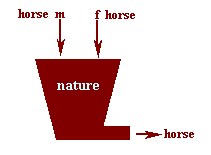
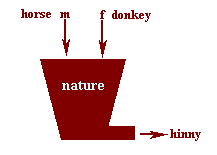
Science seeks to understand the universe in terms of rules which can predict the result of a process, when the inputs change.
Now if we change the input, what will happen ?
By knowing how a change in inputs affects the change in output, so we hope to control our environment.

But science does not ask "HOW ?". The existence and power of God cannot be tested scientifically, and so the hypothesis that God exists, lies beyond the scope of science.
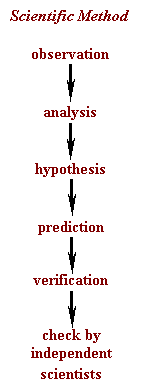
Scientific method

not found The two extremities of scientific thinking are: Of course, most scientists are a mixture of both - observing, theorizing, experimenting, more theorizing.

The 'practical' scientists follow the scientific method:

Mathematics

Some people believe that maths is a science, but I disagree. In the maths book I stress that maths is a purely mental process divorced from reality. Scientists then use mathematical tools, not mathematics itself, in their work. Statistical methods, so commonly used, are not mathematics. (You can see why in the maths book.)

You might like to visit Wikipedia's chapter on the Philosophy of Science for a slightly different slant on the philosphy of science.
Return to Index