Introduction
Because this introduction is fundamental to physics, it should be read carefully and frequently.
The job of any science is to find what happens, then explain how it happens.
Physics does not explain why it happens.
The What: the moon goes around the Earth.
The How: according to several math equations such as FEarth = – FMoon = G*mE*mM / r2
The Why: because God told it to. 'Why' is left to the clergy, evangelicals, etc.
Scientists are not to wonder why, but to see what happens and discover how.
What is physics ?
Physics is the branch of science that deals with the nature of and properties of matter and energy,
in so far as they are not dealt with by chemistry or biology;
the science whose subject-matter includes mechanics, heat, light and other radiation,
sound, electricity, magnetism, and the structure of atoms. [SOED]
Does this definition suggest that we do not know what physics is ?
In other words, physics is a graball of leftovers from chemistry and biology.
There is no simplifying or unifying frame to help us master all these different facets of physics.
That makes physics more difficult to learn than, say, chemistry or biology.
To me, physics is the study of matter and energy in all their inorganic forms.
What is matter ?
Simplified, matter is electrons, protons and neutrons, singly and combined into atoms.
Atoms are combined into molecules; molecules into crystals, crystals combine to form anything from sand to rocks.
(We think of crystals as having a regular outside shape, but this occurs only when they are left to grow in a liquid, unhindered by other solids. This occurs rarely. The essential feature of crystals is their regular internal molecular structure or lattice.)
What is energy ?
In physics, energy is defined as the ability to do work, for example, to move a body.
Work is then defined as the operation of a force in producing movement or
other physical change, especially as a definitely meazurable quantity.
Even as a teenager, I thought both definitions inadequate,
especially since neither energy nor work can be directly meazured. Calculated yes, meazured no.
I think of energy as a figment of our imagination, calculated with interchangeable formulas,
comprised of meazurable quantities. Such interchangeable formulas are:
1/2m.v2, m.g.h, F.d
We can meazure each component: m, v, g, h, F.
Put these into the formulas, and, hey presto, we have amounts we call energy.
Nonetheless, this imaginary concept, 'energy', is so useful we cannot do without it yet.
[I believe in science like I believe in Father Christmas and the Tooth Fairies.
The Tooth Fairies always brought me six pence, Father Christmas still brings me presents,
and science brings me pleasure. Science is here, not to be 'believed', but to be used.]
Basic Units
Basic units are the small number of units from which all other units are derived.
For example, force is derived from mass, distance and time:
F = mass x distance / time / time = kg.m.s–2
These basic units are defined here.
Later chapters will define other units as required.
Table 1. SI System
– Standard International Units: the basic units
| Quantity | Symbol | Unit |
|---|
| mass | m | kilogram, kg |
| length | l | meter/metre, m |
| time | t | second, s |
| current | I, i | ampere, A |
| temperature interval | T | kelvin, K |
| amount of substance | n | mole, mol |
| luminous intensity | cd | candela |
These are the basic or fundamental units from which all others are derived.
Angles are measured in radians as ratios of two lengths, so does not require a fundamental unit.
The kilogram, the unit of mass, was initially used because of universal availability,
being the mass of 1 litre of water, meazuring 100mm x 100mm x 100mm or 0.1m x 0.1m x 0.1m.
Nowadays a kilogram is defined as the mass of a particular platinum bar in Paris.
A metre is the length of a particular platinum bar held at a particular temperature in Paris.
A second is a time interval determined by an atomic clock (in Greenwich?).
The ampere is the current required in 2 straight parallel conductors of infinite length,
of negligible circular cross–section, placed 1 metre apart in a vacuum,
to produce a force between those conductors of 2 x 10⁻⁷ Newton per metre length.
A mole is the molecular weight of a substance expressed in grams.
A normal solution of a substance is the molecular weight of that substance,
in grams, dissolved in water, and made up to one litre.
Radians
Radians is the usual scientific meazure for angles, because it has no unit.
This does away with degrees, allowing for its use in calculus.
The meazure of an angle is the ratio of the arc length and the radius length.
Thus, if the arc equals 2 meters and the radius equals 0.5 m, then the angle equals
2m / 0.5m, equals 4. The units, each in meters, cancel. Rather than say just 4,
we say 4radians, to indicate an angle meazurement, and to remind us that the
angle is not in degrees.
Nonetheless, radians is NOT a unit. In any calculation, the termradian is
simply dropped.
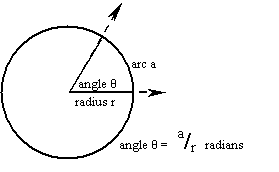 One radian is the angle subtended by an arc equal to one radius.
It does not matter how big the circle is. The bigger the circle,
the bigger the radius but the bigger the arc, and the increased size cancels out. Try it.
The angle 1800 is subtended by the arc equal to half the circle.
This arc is a little over 3 x radius, equal to πr, where π equals 3.1459... .
We can use this formula to convert any angle in degrees to radians.
What is 600 in radians?
The degrees in the numerator and denominator, cancel, leaving 600 = π/3. Learn this.
The answer is given as π/3 radians, but we know "radians" is redundant,
because it is NOT a unit.
Area of a rectangle is the length multiplied by breadth:
A = lb
The multiplication sign between letters is usually left out or replaced by a dot.
The units are metres x metres or square metres or m2.
Volume of a rectangular block is length multiplied by
breadth, multiplied again by height:
V = lbh
The units are metres x metres x metres = metres cubed = m3.
Table 2. Using prefixes to scale units
| Multiple | Prefix | Symbol |
|---|
103
106
109
1012 |
kilo
mega
giga
tera |
K
M
G
T |
|
|
| Multiple | Prefix | Symbol |
|---|
10–3
10–6
10–9
10–12 |
milli
micro
nano
pico |
m
μ (mu)
n
p |
|
Thus a milliamp is both 10–3A and 1 mA.
A nanometre is both 10–9m and 1 nm.
A microfarad is 10–6 F and 1 μF.
Knowing the definitions for the basic units, you can use the formulas to define derived units.
For example, density = mass/volume or ρ = m/v
Thus the density of an object is the mass of that object per unit volume
(kg per m3 or kg.m–3).
Mass, weight
Warning
Mass is NOT weight. Mass is a quantity of matter; weight is a force.
The mass of a substance is the sum of the masses of protons, neutrons and electrons that are in its atoms.
The weight of a substance is the gravitational force exerted on that substance.
The mass of an object is calculated by comparing it to the mass of a platinum block in Paris.
The weight of an object is calculated by multiplying the mass by the gravitational acceleration: w =mg.
Gravitational acceleration: if you fall off a high cliff, you might notice that your speed increases from zero. At 1 second your speed is 9.8 ms–1, and at 2 seconds 19.6ms–1, at 3 it is 29.4ms–1, thus increasing by 9.8 ms–1 every second. After enjoying the view for 10 seconds you will be travelling at 98ms–1, which is 35kph. All this speed without effort is due to gravity, that is, the pull of the Earth on your body, and the pull of your body on the Earth. This gives you an acceleration of 9.8 ms–2. This particular acceleration, due to gravitational force, is called gravitational acceleration.
If someone asks you your weight, they mean 'mass' not weight.
In reply you would give the mass, say 75 kg. Your weight is NOT 75 kg. That is your mass.
Your weight is 75 kg x 9.8ms–2 = 735 kg ms–2 = 735 Newtons.
Instead of multiplying by 9.8ms–2, you can say 75 kilograms weight,
where the word weight means you have still to multiply by 9.8ms–2.
Simply, 9.8 Newtons equals 1 kg wgt.
[In most work, I use 10ms–2 for gravitational acceleration, for quick estimating. This acceleration and the gravitational force which causes it, decrease slightly as you climb mountains. Why?]
Temperature, heat
Heat, radiation, temperature, hot/cold
What is the difference between heat, radiation, temperature and hot/cold?
Heat is not radiation, nor is radiation heat. Heat is atomic and molecular vibration. The more heat an object, a gas, or a person has, the faster its atoms and molecules vibrate. In a vacuum, there are no molecules to vibrate and therefore no heat. However, radiation will pass through it unhampered. When you touch something hot, the warming of your hand is nothing more than increased molecular vibration. Put your hand in front of a fire or radiator and the radiation penetrates your skin, and is absorbed by the molecules, causing those molecules to vibrate faster. Your 'heat' nerves sense this increased vibration, sending signals to your brain.
Temperature does not exist. It is a figment of our imagination, but a very useful one. In one sense it is merely man's meazure of the relative vibration of atoms and molecules. We can illustrate this by seeing how a thermometer is made. Take an empty thermometer glass with a hollow bulb at one end of a hollow glass tube. Put (liquid) mercury or colored alcohol in it. Suck the air out of the top of the tube and seal the glass end. This will be our themometer.
[Series of Diagrams]
Place the bulb in pure water. Firstly put ice in it, wait till the mercury column stops shrinking and mark the level of mercury as 0. Then bring the water to the boil and allow the mercury to expand fully. Mark this new level as 100. Divide the length between 0 and 100 into 100 units. Call this thermometer a Celsius thermometer.
Now repeat this process with another thermometer tube but instead of using pure water, we can use iced salt water for zero and an oven set to roast beef for 400. Divide this scale into 400 units. Call this thermometer a Fahrenheit thermometer. These two thermometers, Celsius and Fahrenheit, give us different numbers for the same temperature, but each will be consistent in comparing temperatures of objects. For example, iced pure water will always give 00C on the Celsius scale while the Fahrenheit will always give 320F. If water is boiled (at sea level the air pressure is 1 atmosphere) the Celsius scale will always read 1000C and the Fahrenheit 2120F. Each will provide a consistent comparative meazure of the speed of vibration of molecules, without actually telling us what that speed is.
For a further example, if we take an aluminium cup and a stainless steel cup, filling them both with tea an immersing them in the same hot water bath, they would eventually have the same temperature. The Celsius thermometer would show that the two cups had the same temperature. We would find that the Fahrenheit thermometer shows a different number of degrees because it uses a different scale, but that the reading would also be the same for each cup. This shows that temperature is an artificial meazure of some quality which causes the expansion of mercury in each thermometer. That quality, we now know, is the vibration of molecules. The faster the molecules of mercury vibrate, the longer the column of mercury in each thermometer.
If we took the two cups out of the water bath, still at the same equal temperature, and held them in our hands, we would say that the aluminium cup was hotter than the stainless steel cup. The former might burn our lips, while the other would allow us to drink the tea comfortably. The aluminium cup is hotter because it transfers the heat from the tea to our lips more quickly than does the stainless steel. Because more 'heat' goes into our lips, the molecules in our lips vibrate more quickly, thus the signal sent by our 'heat' nerves is read by the brain as 'burning lips'.
You might like to ponder on these differences until you understand them fully.
The two temperature scales, Celsius and Kelvin, have the same divisions but different zeros.
Each Celsius degree 10C = 10K
But while the zero for Celsius was given to the freezing point of water, the zero for Kelvin is absolute zero, the temperature at which no gas exists because everything is solid, and the temperature at which all atomic and molecular vibration ceases. Objects at absolute zero do not radiate. All other objects do.
Freezing point of water 00C = 2730K
Absolute zero 00K = –2730C
Boiling point of water 1000C = 3730K
[Graph of Kelvin, Celsius and Fahrenheit scales in comparison.]
Do not bother further with the Fahrenheit scale. Being clumsy to use, it has been abandoned by all but the US, along with the imperial and US meazuring systems.
Radiation
Abbreviations
nanometres (nano = 10 – 9
or one billionth of a metre)
What is radiation?
We do not know what radiation is – we cannot capture it in a bottle and observe it under a microscope. We can, however, see how our meazuring equipment interacts with it. Such equipment tells us that radiation sometimes appears like continuous electromagnetic waves and sometimes like tiny pulses of energy, called photons. Which of these qualities it takes, depends on the type of equipment used to meazure it.
When our equipment meazures radiation as electromagnetic waves, that radiation includes X–rays with very very short wavelengths, ultraviolet light, light, infrared rays, and radiowaves to radiation having wavelengths kilometers long. They all travel at the same speed, called the speed of light, nearly 300 million metres per second (300 x 106 m/s).
[Table of frequencies: wavelength, frequency, name of range eg X–rays]
The light we see by, is not in the middle of these frequencies, but is across the peak intensity of the Sun's radiation frequencies. Our eyes evolved in response to the maximum intensity of the Sun's radiation. So did photosynthesis; which is why grass is green, for green has the frequency for the most intense band of light.
[Graph of sun's frequencies]
The surface temperature of the Sun is 58000C, which gives its peak radiation intensity between frequencies of 750 to 400 x 1012 Hertz.
Because the velocity of light equals frequency times wavelength, given as c = f.λ, divide this frequency range into the speed of light to find the wavelengths of visible light.
| If f | = |
400 x 10–12 s–1 |
| λ | = |
c
f |
| = |
300 x 106 m.s–1
400 x 10–12 s–1 |
| = |
750 x 103 m
10–12 |
| = | 750 x 10–9 m |
If f |
= |
750 x 10–12 s–1 |
| λ | = |
400 x 10–9 m |
Thus the range of λ is: |
| λ | = |
750 – 400 x 10–9 m |
Professionalism
One time when the US sent a satellite to orbit Mars, the space ship forgot to stop,
and passed by, heading for outer space. The excuse given by NASA was that an engineer
used US units instead of Standard International Units. While I do not believe that
anyone could be so patriotic as to insist on using US units,
had he put the units into his calculations,
any high-school student would have picked up his mistake.
NASA employs only the best engineers. They are the sort that went thru school always achieving more than 90% in maths and physics. Whenever they did problems they were right 90% of the time. They designed the fuel system for one of the rockets. Billions of dollars were spent on this project over several years. Six astronauts were chosen. One was a schoolteacher who always praised her students if they achieved 90% in exams. The fuel system failed, the rocket exploded, and no-one ever found traces of the astronauts. Those engineers still get everything right 90% of the time. My grade 12 maths students could find the simple and obvious mistake those engineers made. They made 2 mistakes, the first in simple probability calculations, and the second mistake, unforgiveable, in not discovering their first mistake. It was that second mistake which killed those 6 astronauts. Whether sending up rockets or doing your company's accounts, you must have fail-safe systems in place. The professional, the person who prides himself on his workmanship, always puts fail-safe systems in place.
Professionalism starts now !!
Would you have the confidence to put a year's wages on your own calculations ? If not, why should your employer ?
These points emphasise the basic premise:
We must not only be right, we must know we are right.
How do we know we are right?
We build into our calculations as many checks as possible.
A check is NOT a repetition of a calculation.
Checks include:
- independent calculations
- using units throughout
- independent experiments
- where the calculations are purely theoretical:
- state the premises upon which the work is based
- use only proven rules (proven by others or yourself)
- use these premises and rules to work theoretically towards some conclusion
- from this conclusion, hypothesize or predict observable phenomena
- verify these observable phenomena
- have independent experts confirm these observations.
All this is very basic technique; too basic to ever forget.
Developing ways to check, requires vigilence, effort and practice. Above all, plan in advance.
Check 1:
Maths is symbolic English; every line must have a subject, verb and object.
Every calculation must be neatly laid out so anyone can read it like a novel.
Time 'saved' by scribbling is lost when searching for mistakes.
It is unprofessional to be wrong.
Check 2:
Quickly draw an accurate diagram, in proportion where possible.
Mark on known information; mark on unknowns as letters. From this guess the answer.
Check 3:
When calculating, insert units on every line,
cancelling them where appropriate, and carrying them to the end.
Find the pressure on the ground of a cylindrical column 5 metres tall and 0.5 metres diameter, made of a rammed earth having a density of 2.7 tonnes per cubic metre.
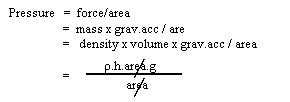 Notice:
2 and 3 lines of paper are taken to clearly write one line of calculation.
Quantities were broken down into their components; some were cancelled –
this saves time.
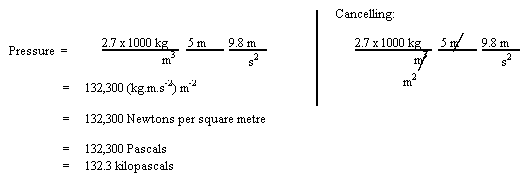
Notice:
- Units are written using a horizontal dividing line instead of using,
say, ms–2
- The dividing lines are all in line with the equals sign.
- Calculations are done only after canceling.
- Then check the final unit against the quantity being
calculated. The unit must be the one which defines the quantity.
For example, the quantity Pressure must have the unit Pascals.
1 Pascal = 1 Newtons per unit area = Nm–2 = kg m–1s–2.
This serves as a major check to ensure no mistakes are made.
Don't do a NASA; do not miss Mars.
Check 4:
Roughly estimate the quantity. Relate it to real situations. Does the answer seem realistic?
Example:
Suppose you were asked to calculate your volume and density.
What would you expect them to be ?
If I gave my density as 0.98 would it be correct? Why?
If I gave my density as 0.98 kgm–3 would it be correct? Why?
[Solution: This demonstrates how a knowledge of science is useful in everyday life.
- Find your mass in kilograms.
- Go to your local river; scare away the crocodiles;
and leap in. Breathe out and relax. Hopefully the top of your head will
be out of water – just a little, but not enough to breathe.
[Not a good design, is it?]
Where does the water level come on your body?
Guess the volume out of water – 1, 2 litres?
- Your body floats because the water pushes you up
with a force equal to your weight. You can feel this upward force by
the floating sensation – you feel weightless.
Force up equals force down.
Why is there an upward force?
Before you hopped in, your space was occupied by water.
That water had weight but was held in place by the upward force of
the water underneath. The weight of the water in your space equalled your weight.
So if your weight is 75 kg wgt, you displaced 75 kg wgt of water.
And 1 litre of water has a weight of 1 kg wgt.
This makes your volume, under water, 75 litres.
- To this volume, add the volume of you which was out of water,
the top of your head, say 1.5 litres. This gives your total volume as 76.5 litres.
- Your density = mass/volume = 75 kg/76.5 litres = 0.98 kg per litre.
- Check: This is a little less than the density of water,
which, as we know, is 1 kg per litre. Our bodies are mostly water,
with muscle denser than water while fat is lighter. This answer seems correct.
- Converting to Standard International Units,
your density = 980 kg m–3.
This is almost 1 tonne per cubic metre – frightening, isn't it ?
End of solution
On your fishing trips, how much air should you keep in your jerrycan
to stop it sinking, should it fall overboard ?