Mechanics intro
Motion, vectors
Motion has two parts:
If you are driving, your speed may be 60 kph.
If you say you are driving at 60 kph due west, your velocity is 60 kph, due west.
Distance is how far you travel. Displacement is distance and direction.
Speed is the rate of change of distance.
Velocity is the rate of change of displacement. Velocity has a scalar magnitude and a direction. When something has both scalar magnitude and direction, we call it a vector.
A Vector has two parts:

Acceleration is the rate of change in velocity. To accelerate, that is, to change a velocity you can change:
Since velocity is a vector because it has direction, so acceleration, which is the rate of changing the vector, velocity, is also a vector.
Force
F = mass x acceleration
Mass is scalar. Acceleration, being the rate of change of the vector velocity, is a vector.
Therefore force = scalar x vector.
Thus force is a vector.
Similarly, force, the product of scalar mass and vector acceleration, is a vector.

To add and subtract vectors
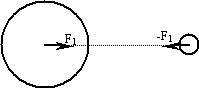
Vectors should be shown as F, and their scalar magnitude as |F|.
However, reading the equations below with every F written as |F|, is eye-wearing.
If you think that is awkward, try joining me in writing it in XHTML:
|F1|.|F2| is coded as |F<sub>1</sub>|.|F<sub>2</sub>|.
And F1F2 is coded as <u>F</u><sub>1</sub>.<u>F</u><sub>2</sub>.
Want to be a webmaster ?
Gravity
All bodies and radiation exert gravitational forces on each other.
This causes them to accelerate towards each other.
Gravitational acceleration is a vector acting along the line joining centers of gravity.

Gravity or gravitational force is the mutual force which 2 objects exert on other due to the attraction of their masses.
The moon travels around the Earth because the centripetal force owing to its orbital velocity is exactly counterbalanced by their gravitational attraction.
[Gravity is another concept I did not believe as a teenager. ( why do 2 objects attract each other ?). Fortunately for me, Einstein didnt believe in gravity either - but it is useful for Earth-bound people.]
F = m.g

where F is the gravitational force of attraction which two bodies exert on each other, due to having mass.
g = F/m

and is the gravitational acceleration due to force F.
That is, F is the gravitational pull between two bodies, which is proportional to the product of their masses, divided by the square of the distance between them.
w = G.m1.m2.r—2
where G = 6.67 x 10—11 N.m2 kg—2

G is the Universal Gravitational Constant, a number found by observation of planets.
Weight
If your mass is 70kg and you leap of a building, your acceleration of 10m/s/s is due to a gravitational force upon you of 70kg x 10m/s2 or 700 kgm/s2. That is 700 Newtons. Thus if you are sitting in a chair, the chair is holding you up with a force of 700 Newtons. The downward force which you exert because of gravity is your weight.
Mass and weight
If w = weight; m = mass; g = gravitational acceleration, then:
w = mg
Notice that weight is mass multiplied by gravitational acceleration (nearly 10 m.s-2).
Thus mass is not the same as weight. Mass is the amount of 'material' in your body (all those protons, neutrons and electrons whizzing around). Your weight is determined by your mass and the mass of the planet Earth. If you were in a rocket, your weight would decrease as you travelled further from the earth until your weight became zero. However your mass would always remain at 70 kg (about 4.184 x1028 protons and neutrons combined).
[Me ? I have 47,818 million million million million protons and neutrons combined - no wonder I find it hard to chores - just getting them all to move in the same direction is exhausting enough to sit down again.]
Friction
Friction is the 'grip' between 2 bodies in contact such that any movement along their surfaces, requires a persistent force to maintain that movement.
Static friction is the 'grip' between 2 bodies in contact at rest.
Starting friction is the force required to start one of those bodies moving (and therefore equal to the maximum static friction).
Sliding friction is the force required to keep the object moving (and is usually much lower than the static friction).
Friction depends on: Friction is independent of speed at ordinary (low) speeds.
Centrifugal force
When you swing a bucket of water around your head, your arm exerts a centripetal force on the bucket, stopping it flying away. The bucket and wwater exert a centrifugal force on your arm, trying to pull your forearm out of your elbow.(Try it.) An object is kept in a circular path by a centripetal force.
Uniform acceleration
These formulas work only for uniform acceleration.
When an object is slowing, the acceleration may be called deceleration or negative acceleration.
Consider an object experiencing uniform acceleration.
At time t0 initial velocity=v0
At time t1 final velocity=v1
time taken Δt=t1 – t0
change in velocity Δv=v1 – v0
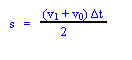
displacement s=average velocity x time taken
=average velocity x time taken
=[(v1 + v0) / 2] (t1 – t0)
or
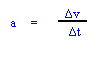
acceleration a=change in velocity / time taken
=Δv / Δt
=(v1 – v0) / (t1 – t0)
From these, show that:=
Displacement s=v0 Δt + 1/2 a Δt2
Final velocity v1=v0 + 2as
Show that, to calculate how far you have travelled since falling off your cliff:
Displacement s=1/2 g Δt2
A good fall never hurt anyone – it is the large deceleration at the bottom that is the pain.
Learn by rote:
Displacement s=v0 Δt + 1/2 a Δt2
Final velocity v1=v0 + 2as
Acceleration=
Pressure
As you drive or cycle or run, the 'wind' on your face is only the molecules of air hitting your skin.
The pressure of air in the truck tire is due to the collective force of molecules hitting the inner tube from inside. As the sun heats up the air in the tire, the molecules go faster and faster, so they hit the inner wall harder and harder, increasing the air pressure inside.
A balloon of air out in the sun, as it becomes hotter, will have the air molecules moving faster and faster, hitting harder and harder, making the balloon bigger and bigger.

The sum of all molecules hitting the balloon at any instant, is the force on the inside of the balloon. The sum of all molecules in any square metre is the pressure. Increase the area under this same pressure and you increase the total force.
As another example, stand on sand. Note the depth of the impression you made.
Then stand on one foot and notice the deeper impression.
Then place a small piece of wood or stone on the sand and stand on that.
What is your conclusion ?
Your weight does not change. The downward force does not change, but the depression increases as the area of the footprint decreases.
We say, the pressure is inversely proportional to the area.
P = F / A
In units: 1 Pascal = 1 Newton per square metre = 1N.m–2
P = kg.m.s–2 / m–2 = kg.m–1.s–2 = Pascal
P = F / A Pascal
Energy, work and power
Energy is meazured by the amount of work that could be done by expending all the energy.
Energy is also equal to the amount of work done in making all that energy.

If you eat 10 kilocalories of food, that food will give you 10 kilocalories of energy.
If you burn it up by climbing a tower, you have increased your potential energy by 10 kilocalories.
If you leap off the tower, your potential energy will decrease as you approach the ground but your kinetic energy will increase (as your velocity increases).
By the time you reach the ground your potential energy will again be zero, but your speed will have increased till your kinetic energy equals 10 kilocalories.
If you land on the raised end of a see-saw which has a bucket of water at the other end, your kinetic energy will force your end down and the other end up, giving the bucket of water 10 kilocalories of kinetic energy.
The bucket of water will rise through the air till it stops, with velocity zero, kinetic energy zero, but its potential energy increased by 10 kilocalories.
As it begins to descend, increasing its velocity, its potential energy is being converted into kinetic energy. Faster and faster.
As you look up to marvel how the bucket and its water appear bigger and bigger, you realise that not only will the bucket land on your head, but that your 10 kilocalories are about to be returned. Energy, like life, goes mostly in circles.
Power and torque
Power is the rate of energy transfer. In cars and trucks, power is the rate of converting fuel energy into wheel energy. Bigger trucks usually convert fuel energy more quickly into wheel energy and so go faster (for the same load).

When you tighten the wheelnut by using a spanner, your arm exerts a force on the end of the spanner. The longer the spanner the less force you need to use. This turning effect on the nut is called torque.
Torque equals force times the length of the spanner.
Torque equals force by distance (from the nut).
In a truck engine, the fuel energy is being converted to energy used to turn the crankshaft; that is, fuel energy becomes torque. This torque gives acceleration.

We now see that, in a truck, power gives speed but torque gives acceleration. [Learn by rote.]
Top speed depends on power; acceleration depends on torque.
If buying a vehicle, study the graphs for torque and for power.
A truck in hilly country needs high torque more than high power because good acceleration reduces gear changes.
This gives a higher average speed. High power is good in flat country where top speed is more important than the ability to accelerate.
Uniform circular motion
Velocity has a scalar magnitude and a direction.
If you hold a bucket of water and swing it in a circle, each circle of circumference 2π.r, taking time T (the period), then thespeed v = 2πr / T.

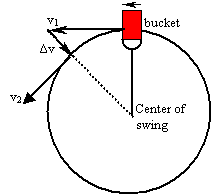
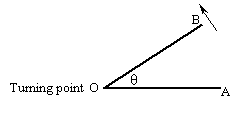
The diagram shows how the change in speed, the acceleration, is directed toward the center.
Since velocity v is a vector because it has direction, so acceleration Δv/Δt is also a vector. Keep swinging our bucket of water so at the top of the swing the bucket is upside down. If you swing fast enough the water will stay in the bucket.
Why …? …
because the bucket exerts a centripetal force, that is, a force directed towards the center of the swing. The water exerts an equal and opposite force, that is, a centrifugal force, a force directed away from the center.
Our swinging bucket has a constant speed, so v1 and v2 have the same magnitude, but different directions. This change in velocity is due the increment Δv, directed towards the center. This change in velocity Δv, over time Δt, gives the centripetal acceleration of Δv/Δt. Because Δv has direction, so does the acceleration and this makes acceleration a vector, too. The force exerted by our arm which swings the bucket, causes this acceleration a on the bucket of mass m.
F = m.a
Because acceleration a has direction, so does the force F.
F is a centripetal force.
Centripetal: p for pull; Centrifugal: f for fling.

Suppose you drive around a bend at a constant 60 kph. Although your speed is constant, your direction is changing, so your velocity is changing and you must be accelerating. (And so you are burning more fuel by slightly depressing your accelerator pedal.)
Notice how you are forced towards the outside of the bend, but the friction of the seat stops you from sliding against the door..

An angle meazured in degrees is no good to us here.
The angle must be meazured in radians, that is, θ = arc/radius.
The angular velocity is the rate at which the arm OB turns: ω = θ/t
Tangential speed vT = ω.r
The angular acceleration is the rate at which the angular velocity changes: α = ω/t
For constant angular speed v, centripetal acceleration ac = v2 / r
Centripetal force Fc = m.v2 / r

While linear momentum = m.v,
angular momentum = I.ω
where I = m.r2
and ω = v / r.
Thus angular momentum = m.v.r

Non-uniform circular motion - angular acceleration

Angular acceleration requires a tangential force, FT = m.a
But a = r.α
Thus FT = m.r.α

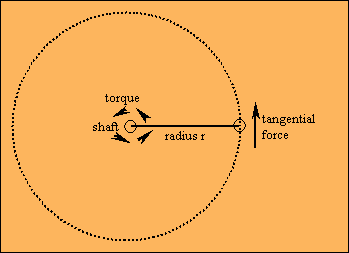
If the object enjoying circular motion, is attached to a rotating shaft by a rigid arm of length r, then this tangential force is applying a torque on the shaft.
     torque τ = tangential force x radius
= FT.r
= (m.α.r).r
= m.α.r2
Density, pressure in fluids
Density is the mass of a unit volume of the substance.
The density of water is the mass of a cubic meter of water, which is 1 tonne per cubic meter or 1 gram per cubic centimeter.
The density of rock is about 2.7 grams per cubic centimeter (but obviously rocks vary greatly in density).
If an object is less dense than water, it floats; more dense, it sinks. We float: rocks sink.

Suppose your mass is 70 kg, and you float with the top of your head level with the surface of the water. Your weight is 70 kg weight (or 700 Newtons).
Why do you float? because the water is pushing you up.
The water is pushing you up with a force of 70 kg weight. Why?
If you weren't there, the water would be pushing up the water which previously occupied your space. Imagine your skin is empty but filled with pure water.
That water does not fall to the river bed, whether your skin is there or not.
It does not fall because the water underneath is pushing it up.
It is pushing up with the same force that pushed you up, that stopped you falling to the riverbed.
That force was 70 kg wgt. How much water weighs 70 kg wgt ? 1 liter of water has a mass of 1 kg.
So you must have displaced 70 kg of water. That is therefore your volume, 70 liters.

If you float with the top of your head out of the water, say, 2.5 liters above, then your volume is 72.5 liters. Incidentally your lungs probably hold about 2 liters of air when full.
Why do people drown when everyone can float ? Because in a panic, they lift their arms out of the water, causing them to sink. When water hits the back of the throat, the throat shuts, preventing air from entering the lungs, and the person suffocates – not drowns, but suffocates.
Recently 'drowned' people do not have water in their lungs. It is only after death, when the body relaxes, that water can enter the lungs. So, teach your child to relax, face down in the water, and occasionally push open palms downward to gently lift the face to breathe.
That way, in calm water, provided we do not get hypothermia, it is impossible to drown.

Pressure is the force per unit area. If you are 70 kg, the force you exert on the ground is 70 kg wight (700 Newtons). If your two feet have a combined area of 300 square centimeters, then the pressure you exert on the ground is 70 kg wgt/300cm2, or 0.23 kg wgt per square centimeter. If your feet have an area of 600cm2, then your pressure is 70kg wgt/600 cm2, or only 0.12 kg wgt per square centimeter, or half the first value. Double the area, halve the pressure. People who live in swamps, need big feet, so they exert less pressure and do not sink into the mud.

Suppose you are diving in the sea, gathering shells or spearing fish.
For convenience, we say the pressure on the surface of the water is 1 atmosphere.
We then talk of the water pressure increasing in ternms of atmospheres.
Every 10 meters, the pressure increase by 1 atmosphere.
At 30 meters, the total pressure is 1 for the air plus 3 for the depth of water, that is, 4 atmospheres altogether.

At this pressure, the nitrogen in our lungs passes into our blood stream, increasing with time. If scuba diving (with air tanks), after a long time, there can be so much nitrogen in our lungs that if we come to the surface quickly, this nitrogen will form bubbles in our blood, causing blockages.
This is called the 'bends' because the diver is in such pain as to be doubled up. Some snorkelling divers who descend to great depths, now do what whales have always done – breathe out before they dive.

In a liquid, the pressure equals the product of the density of the liquid by the depth by the gravitational acceleration constant (10m/s2).
Pressure = density x gravitational acceleration x depth = ρ.g.h