Mechanics 2
Adding, subtracting vectors
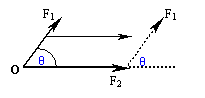
Addition: F1 + F2
(See diagrams below.)
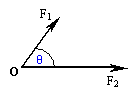
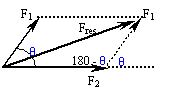
2 forces, F1 and F1, acting on a single object O, are equivalent to Fres, a diagonal to the parallelogram formed by F1 and F2.
From trigonometry's cos rule:
Fres2 = F12 + F22 – 2F1.F2.cos (180 – θ)
Because cos (180 – θ) = – cos θ
Fres2 = F12 + F22 + 2F1.F2.cos θ
Note: If θ changes, so does the resultant force. Knowing the direction of vectors is important.

Subtraction: F1 – F2
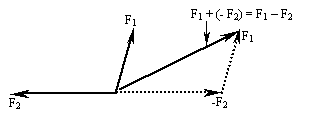
Since F1 – F2 = F1 + (-F2)
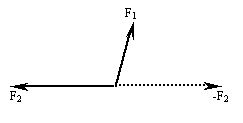
we can reverse F2 to get (-F2),
then add F1 and (-F2) as in the addition method.
Fres2 = F12 + (-F2) 2 – 2F1.(- F2).cos (180 – θ)
Because cos (180 – θ) = – cos θ
Fres2 = F12 + F22 – 2F1.F2.cos θ

These work for all vectors, including displacement, velocity, acceleration and force.

To add and subtract vectors.
Vectors can be slid across your page as long as the direction and length do not change.
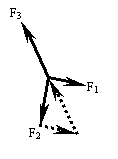
In the first diagram, see how the solid line for F1 is also represented by the dotted line F1, which is parallel to it, but now begins where F2 ends.
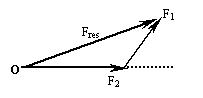
The resultant force Fres, then begins where F2 begins, and ends where F1 ends.

Adding vectors:
 not found Here we have 2 vectors pulling on one object O. What is the resulting effect, or resultant force ?
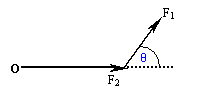
 not found Here we slide F1 across to the tip of F2, keeping it parallel to the original F1.
 not found Notice that both vectors keep the magnitude and direction as before.
 not found The resultant force goes from the start of F2 to the tip of F1.
 not found This diagram sums the whole process as it would appear in your notebook.


Subtracting vectors:
 not found Here we want to subtract F2 from F1. This is the same as adding (-F2) to F1, so we draw ( -F2).
 not found Now we do exactly as in the Adding-vectors demonstration above.

On the same diagram, draw: F2 – F1

These work for all vectors, including displacement, velocity, acceleration and force.

The product of vectors will not be covered in this physics course.

Energy, work and power
The symbol Δ represents a small change.
ΔV = a small change in V.
Δt = a small change in time.
ΔeV = a small change in electron volts.

Label S Formula Explanation
Kinetic energy, KE Ekin 1/2 m.v2  
Rotational KE Erot 1/2 I.ω2  
Energy of a spring Espr 1/2 k.Δl2  
Energy from an electron flow Eel I2.R = V.I ΔEel = I.Δt.ΔV where Δt = time interval.
I.Δt gives the total charge passing in time Δt.
Work W F.Δs.cos θ where the force F makes an angle θ with the direction of displacement Δs (distance moved). *
Mass-energy E mc2 when a mass m is converted into electromagnetic radiation at velocity c.
Power P ΔE / Δt the rate of change of energy. **
Power in AC circuit Paver I.ΔV.cos φ tan φ = X / R
Quantum of energy ΔE hf hf = hc / λ    where h = Planck's constant;
c = velocity of radiation; f = frequency;
λ (lambda) = wavelength of radiation; c = f.λ.
Energy of a photon Ephoton hf hf = 13.6 eV (1/n12 -1/n22)
where n is an integer (whole number) representing the energy level of the electron.
This equation shows that the energy of a photon is the difference in energies of 2 adjacent electron orbits.
Energy of an electron in an atom:
E = (-13.6 eV)(Zeff2 / n22)
where Z = atomic number
but Zeff = atomic number – number of electrons between nucleus and the electron considered.
Photon energy of hydrogen spectrum E hf Hydrogen's ionization energy = 13.6 electron volts eV. Relate this 13.6 eV to the energy of a photon.
* The only way we can meazure energy is by meazuring the work it does. Work and energy thus have the same units.
** In cars and trucks, top speed depends on power; acceleration depends on torque. If buying a vehicle, study both graphs. A truck in hilly country needs high torque more than high power. High power is good in flat country.

In a gas, the product of pressure and volume is dependent on the total kinetic energy of all the molecules.
pV = n.k.T
= 2/3 n.EKE
where:
Gravity
All bodies and radiation exert gravitational forces on each other.
Each body also exerts gravitational force on radiation where the mass of each photon conforms to: m = E/c2;
E is its energy and c is the speed of light (300 million metres per second).

Gravitational acceleration
All bodies and radiation exert gravitational forces on each other.
This causes them to accelerate towards each other.
 not found
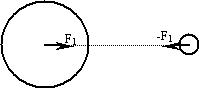
Gravitational acceleration is a vector acting along the line joining centers of gravity. F = m.g where F is the gravitational force of attraction which each of body exerts on the other, due to their both having mass. That is, the gravitational pull between two bodies is proportional to the product of their masses, divided by the square of the distance between them.

Gravity at the Earth's surface
Since Newton's law states:
F = G m1 m2 r – 2
and gravitational field strength:
g = F / m2
where m = mass of other body.
Then, for the Earth, gravitational field strength:
g = GmE / r2
where:
For an object on Earth, at sea level where rEarth = 6379 km, the gravitational acceleration g0 = 9.8 m.s – 2.

For a satellite moving in a circular orbit radius 7000 km, about the center of the Earth,
g1/g0 = 63792 / 70002
giving g1 = 0.83 x 9.8 m.s – 2 = 8.14 m.s – 2.
That is, this satellite has a centripetal acceleration of 8.14 m.s – 2.

In general, g/g0 = (r0/r)2 = (r0/[r0 + h])2
where gh = gravitational acceleration at height h above Earth.
At sea level, Earth has radius r0,
and gravitational acceleration g0.

When you fall of a cliff; your increase in kinetic energy is due to your loss in gravitational potential energy:
ΔEKE = – ΔEGPE
ΔEGPE = mgh
where:
Gravitational energy in space
Egrav = Fgrav x distance
= - G.m1.m2 / r
where m1 and m2 are masses at a distance r apart
and G = universal gravitational constant
= 6.67 x 10 – 11 N.m2.kg – 2

Gravitational potential for the Earth:
Vgrav = – G mE / rE
where mE = mass of the Earth
where rE = radius of the Earth.


Fluids
A fluid, being anything which flows, can be a gas or a liquid.

Density
Density is the mass of a unit volume of the substance.
The density of water is the mass of a cubic meter of water, which is 1 tonne per cubic meter or 1 gram per cubic centimeter.
The density of rock is about 2.7 grams per cubic centimeter (but obviously rocks vary greatly in density).
If an object is less dense than water, it floats; more dense, it sinks.

Suppose your mass is 70 kg, and you float with the top of your head level with the surface of the water. Your weight is 70 kg weight (or 700 Newtons).
Why do you float? because the water is pushing you up.
The water is pushing you up with a force of 70 kg weight. Why?
If you weren't there, the water would be pushing up the water which previously occupied your space. Imagine your skin is empty but filled with pure water.
That water does not fall to the river bed, whether your skin is there or not.
It does not fall because the water underneath is pushing it up.
It is pushing up with the same force that pushed you up, that stopped you falling to the riverbed.
That force was 70 kg wgt. How much water weighs 70 kg wgt ? 1 liter of water has a mass of 1 kg.
So you must have displaced 70 kg of water. That is therefore your volume, 70 liters.

If you float with the top of your head out of the water, say, 2.5 liters above, then your volume is 72.5 liters. Incidentally your lungs probably hold about 2 liters of air when full.
Why do people drown? Because in a panic, they lift their arms out of the water, causing them to sink.
When water hits the back of the throat, the throat shuts, preventing air from entering the lungs, and the person suffocates – not drowns, but suffocates.
Recently 'drowned' people do not have water in their lungs.
It is only after death, when the body relaxes, that water can enter the lungs.
So, teach your child to relax, face down in the water, and just lift the face occasionally to breathe.
That way, in calm water, it is impossible to drown.

Pressure is the force per unit area. If you are 70 kg, the force you exert on the ground is 70 kg wight (700 Newtons). If your two feet have a combined area of 300 square centimeters, then the pressure you exert on the ground is 70 kg wgt/300cm2, or 0.23 kg wgt per square centimeter.
If your feet have an area of 600cm2, then your pressure is 70kg wgt/600 cm2, or only 0.12 kg wgt per square centimeter, or half the first value. Double the area, halve the pressure. People who live in swamps, need big feet, so they exert less pressure and do not sink into the mud.

Pressure at depth Suppose you are diving in the sea, gathering shells or spearing fish.
For convenience, we say the pressure on the surface of the water is 1 atmosphere.
We then talk of the water pressure increasing in ternms of atmospheres.
Every 10 meters, the pressure increase by 1 atmosphere.
At 30 meters, the total pressure is 1 for the air plus 3 for the depth of water, that is, 4 atmospheres altogether.

At this pressure, the nitrogen in our lungs passes into our blood stream, increasing with time. If scuba diving (with air tanks), after a long time, there can be so much nitrogen in our lungs that if we come to the surface quickly, this nitrogen will form bubbles in our blood, causing blockages.
This is called the 'bends' because the diver is in such pain as to be doubled up. Some snorkelling divers who descend to great depths, now do what whales have always done – breathe out before they dive.

In a liquid, the pressure equals the product of the density of the liquid by the depth by the gravitational acceleration constant (10m/s2).
Pressure = density x gravitational acceleration x depth = ρ.g.h

Static & dynamic forces
Δ = a change in value.

Newton's Laws of Motion:
First Law: a force is needed to change the velocity of a body.
If forces are acting on a body and its velocity remains constant, then those forces must be in equilibrium, that is, they are effectively zero.
Second law: the rate of change of momentum of a body is due to and equal to the resultant force acting on that body.
Fres = Δ(m.v) / Δt
where Δ(m.v) = change in momentum (either mass m or velocity v can change).
Where mass m is constant, Fres = m.Δv / Δt = m.a
Third Law: if object A acts with force F on object B, then object B is acting on A with the force (- F), that is, an equal and opposite force.

Forces in equilibrium
An object is in equilibrium when it moves with constant linear and angular velocities (which may be zero); that is, has no acceleration.
Acceleration is always due to a net or resultant force.
For an object in equilibrium, there must be zero net force.
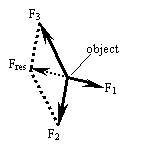
For the forces F1, F2 and F3, to be in equilibrium,
F1 must equal ( – Fres), that is, minus the resultant force of F2 and F3.
Only then will all the forces cancel.
 not found
This can also be examined using the polygon of forces.
Here F1 is slid down to meet the head of F2, and F3 is slid down to meet the head of the new F1.
Note: the forces do not change because both the magnitudes and the directions remain the same. If the forces are in equilibrium, the forces form a closed polygon, head to tail, to arrive back at the object. (Draw it.)
 not found

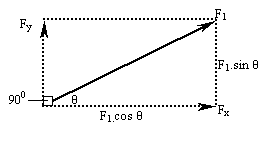
It follows from the concept of resultant force, that any force can be represented by 2 other forces.
This helps if we resolve a force into 2 perpendicular forces.
This is useful when projecting a force onto the x- and y-axes.
We call these projections, the x- and y-components of force F.
F1 = Fx +Fy
Where |F1| denotes the magnitude ofF1,
|Fy| = |F1|.sin θ
|Fy| = |F1|.cos θ
and by Pythagoras theorem,
|F1|2 = |Fx|2 + |Fy|2

Moments
Σ = the sum of.
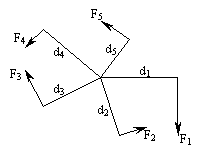
Moment = F.d
Where F is a turning force and d is the perpendicular distance from the force to the point about which it turns.
The principle ofmoments in equilibrium about a point:
Σ (anticlockwise moments) = Σ (clockwise moments)
F2.d2 + F4.d4 + F5.d5 = F1.d1 + F3.d3
The distances are the perpendicular distances from the point to the forces.
 not found

Linear momentum
Σ = the sum of.
Law of conservation of momentum:
In a perfectly elastic collision or an explosion
Σ momentums (before) = Σ momentums (after)
Σ m.v (before) = Σ m.v (after)
The impulse-momentum equation:
An impulse is a force F acting for a very very short time Δt (like a footballer kicking a ball).
impulse = change in momentum
Δ(m.v) = F.Δt where Δt is very short.

Energy
When an object is pushed by an average force F over a distance s, the work W done, is:
W = F.s
When an object of mass m moves with a velocity of v, its kinetic energy is: EKE = 1/2 m.v2
This tells us that the work W which must be done to stop it, is: W = 1/2 m.v2
To calculate what braking force will stop it in 4 car lengths, put: F.s = 1/2 m.v2
F = 1/2 m.v2 / s
If the force is not to stop but to slow down, then: F.s = Δ(1/2 m v2)
This is not1/2 m (Δv)2, but1/2 m Δ(v2) as in: = 1/2 m.[ (v1)2 – (v0)2 ]
To calculate this mentally use the short-cut: = 1/2 m.(v1 – v0).(v1 + v0)

Gravitational potential energy (at sea level): EGPE = m.g.h
Mechanical energy can be:
In a system, the total energy is conserved, that is, the sum of all energies remains constant.

Power and efficiency
Power P is the rate of energy transfer: P = W / t
But power is meazured as the rate of doing work: P = ΔW / Δt
But W = F.s, so:
P = F.s / Δt
= F.v

The efficiency of a mechanical system, like a machine: η = power out / power in.