| Quantity | S | Unit | Explanation |
|---|---|---|---|
| area | A | m2 | square meters; 1 m2 = 109 mm2 |
| Force, pressure, stress | |||
| pressure | p | Pa | pascal. 1 Pa = 1 N.m–2 |
| tension/tensile force | T | N | newton., Stress = tensile force / cross-sectional area. Stress limit of copper = 200 MPa |
| stress | σ | Pa | pascal |
| linear strain | ε | (no unit) | Strain = increase in length / original length.
For metals, stress/strain = constant, up to elastic limit. |
| Young modulus | Y | Pa | pascal. Y = stress/strain (Force/Area) 1 kN.mm–2 = 199 Pa or 1 GPa ΔL/L = 1/Y.(F/A) thus Y = L.F / ΔL.A |
| Temperature | |||
| temperature | θ, t | 0C | degree Celsius, |
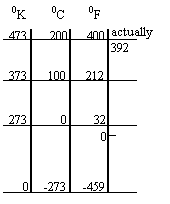
| thermodynamic (absolute) temperature | T | 0K | degree Kelvin; 00C = 273.150K |
| absolute zero | 00K | 0K | 00K = –273.150C
Theoretical lower limit of temperature, at which atomic and molecular vibration ceases. Lowest temperature achieved is within a minute fraction of one degree above zero. |
| temperature interval | ΔT, Δθ | 0C (= 0K) | |
| Energy | |||
| energy transferred by heating | Q | J | Joule. This increase in atomic and molecular vibration is usually called heat. |
| internal energy | U | J | Joule |
| mean squared speed of molecules | c2 | m2.s–2 | = Σ c2 / n meter squared per second squared |
| rms speed of molecules | crms | m.s–1 | meter per second. Air molecules have rms speed = 500 m.s–1 at stp (standard temperature and pressure) |
| Amount of matter | |||
| number of molecules | N | (no unit) | |
| amount of substance | N | mol | mole |
| Avogadro number | NA | mol–1 | per mole. The constant NA = 6.03 x10²³mol–1 |
| molar gas constant | R | J.mol–1.K2–1 | joule per mole kelvin. The constant R = 8.31 J.mol–1.K–1 |
| Boltzmann constant | k | J.K–1 | Joule per kelvin. The constant k = 1.38x10⁻²³ J.K–1 |
| Heat | |||
| latent heats of fusion & evaporation | l | J.kg–2, or J.g–1 | Joule per kilogram.
For water, with no temperature change: latent heat of fusion is: 3.35 x10⁵ J.kg–1 latent heat of evaporation: 2.260 x10⁶ J kg–1 |
| specific heat capacity | c | J kg–1 K–1 | Joule per kilogram kelvin.
For water c = 4.190 x10³ J.kg–1 .K–1 (per absolute degree rise, but 10K = 10C rise) |
| specific latent heat | l | J.kg–1 | Joule per kilogram.
For water, with no temperature change: latent heat of fusion is: 3.35 x10⁵ J kg–1 latent heat of evaporation: 2.3x10⁶ J kg–1 |
| thermal conductivity | k, λ | W.m–1.K–1 | Watt per meter kelvin. For metals, conductivity is about 200 times that for glass or bricks. |
| Density, pressure, fluid flow | |||
| Density | ρ | kg m–3 | ρ = m / V
where ρ = density; m = mass; V = volume. |
| Pressure | P | Nm–2 | P = F / A
where P = pressure;
F = force on surface having area A. |
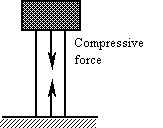 These are demonstrated by the heavy dark block:
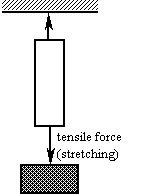 Tensile force
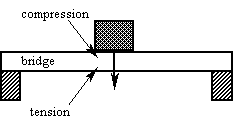 We use 2 steel mesh layers, about 50 mm from top and from bottom,
to distribute the tensile forces when the concrete shrinks as it dries and sets.
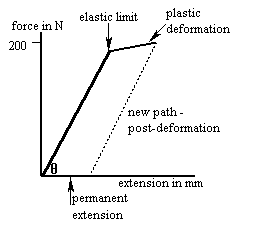 Tension is proportional to displacement.
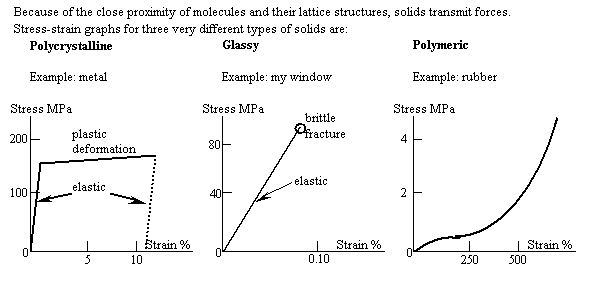
| Young's modulus Y | = | strain per unit cross-sectional area / stress relative to length |
| = | (ΔF/A) / (Δl/l) | |
| = | (ΔF.Δl) / (A.l) |
| Work | = | average force x distance |
| = | Faver Δl | |
| When Hooke's law applies: | ||
| Work | = | area under the force-extension curve. |
| = | 1/2 F Δl | |
| but F | = | k Δl |
| where k | = | slope of curve/line |
| = | tan θ | |
| so work | = | 1/2 k Δl2 |
 Heat and temperature
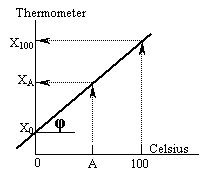 The vertical axis, "Thermometer", can represent any scale, such as Kelvin or that quaint Fahrenheit.
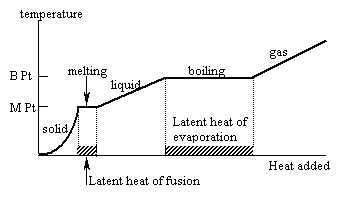 As heat is applied to the solid, its temperature rises.
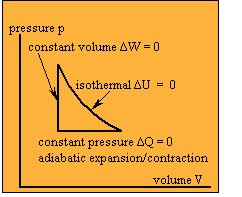 Gases:
| ΔU | = | ΔQ + ΔW |
| ΔU | = | gain in internal energy |
| ΔQ | = | energy transferred to the gas by heating |
| ΔW | = | work done on the gas (changing the volume) |