Matter 2
Conduction, convection, radiation
Heat is the vibration of molecules.
Suppose we touch something whose molecules are vibrating with a greater kinetic energy than the molecules of our skin.
EKE = 1/2 mv2
where:
Those rapidly vibrating molecules will cause the molecules of our skin to vibrate faster.
This effect is registered by our 'heat' nerves and transmitted to our brain where it is registered as 'heat'. Heat is merely a sensation registered in our brain. Something is 'hot' because its molecules are vibrating with greater kinetic energy than our molecules have.

Similarly, a mercury thermometer does not meazure that kinetic energy, but it does expand or contract to the same height every time its molecules have the same kinetic energy. We might call that height 00 or 1000, and divide the interval between into 100 divisions. But the kinetic energy does not equal 0 or 100. Nonetheless this artificial concept, temperature, gives a comparison of kinetic energy without our having to meazure that energy. For most purposes that is good enough. That mythical temperature is proportional to EKE.
Conduction
Conduction is the transfer of kinetic energy by collision of molecules within a substance or between substances. Heating one end of a steel rod will raise the temperature at the other end by conduction.

Conduction is the transfer of kinetic energy by collision of molecules within a substance or between substances. Heating one end of a steel rod will raise the temperature at the other end by conduction.

Conduction of heat
ΔQ/Δt = (k A / l) Δθ
Where:
A = cross–sectional area
L = length of bar
Δ? = difference in temperature between ends
Compare ΔQ/Δt = (σ A / l) ΔV for an electric charge
Convection
Convection is the transfer of kinetic energy by the fluid moving due to density differences within the medium. A hot air inlet at the bottom of a wall injects hot air, which, because it is less dense than cool air, floats to the ceiling, thus transferring the heat to the upper levels of the room.

Convection is the transfer of kinetic energy by the fluid moving due to density differences within the medium. A hot air inlet at the bottom of a wall injects hot air, which, because it is less dense than cool air, floats to the ceiling, thus transferring the heat to the upper levels of the room.
Radiation
Radiation is the transfer of energy by electromagnetic waves.
A hot radiator sends infra–red em waves in all directions to the front.
Anything receiving that energy will absorb it, causing its own molecules to vibrate more quickly.
Radiation is the transfer of energy by electromagnetic waves.
A hot radiator sends infra–red em waves in all directions to the front.
Anything receiving that energy will absorb it, causing its own molecules to vibrate more quickly.
Heating through 3 states
As heat is applied to the solid, its temperature rises.
If the temperature is engineered to rise uniformly, surface included, there will be no melting until all the material reaches the melting point. At the melting point, much heat must be applied to give the molecules sufficient kinetic energy to break the lattice bonds to become a liquid. With much stirring to keep the liquid and solid at a uniform temperature, there will be no temperature rise at this melting point till all the solid has become liquid.
This heat needed to break the molecular bonds in the solid, is called latent heat of fusion.
Latent means hidden, and refers to the absorption of heat, hidden because the temperature does not rise.

When all the solid has melted, further heat causes the temperature to rise till the boiling point is reached.
Again much heat must be applied, without raising the temperature, to provide the kinetic energy to the molecules, sufficient to break the molecular bonding. When all the bonds have been broken, and all the liquid has becomes a gas or vapor, then the gas temperature begins to rise owing to the further application of heat.

This vapor is mostly empty space, with molecules occupying very little of its volume.
One millilitre of water will occupy 1700 millilitres as a vapor, without rise in temperature.
The molecules are so far apart that they move vast distances between collisions.
The heat needed to break the molecular bonds in the liquid without raise in temperature, is called latent heat of evaporation.
Calorimetry
Calorimetry is a study of the effect of heating a substance. Ideally, that is, in school problems, none of the heat escapes through conduction, convection or radiation.
Heat in = heat to raise temperature and heat to change state (melt or evaporate)
= ΔQtemp + ΔQstate
= m.c.ΔT + m.lheat
then ΔQ = m.c.ΔT
applies when heating/cooling without change of state (solid – liquid – gas)
but ΔQ = m.lheat
applies when changing state without change in temperature.
Laws of Thermodynamics
The 3 Laws of Thermodynamics state:
Formulas
Temperature conversion
TK = T1 + 273.150K
where TK = absolute temperature
TK = celsius temperature
TK = (TF – 32)5/9
where TF
 
=
 
Fahrenheit temperature
(avoid F – work always in International Standard Units, ISU)

Specific heat
The specific heat of a substance is the amount of heat required to raise the temperature of one gram by 10K.
This is found for each material, by experiment. Unit is J / g.K.

ΔH = c.m.ΔT
where ΔH = heat required
c = specific heat per unit mass for that material;
m = mass being heated
ΔT = rise in temperature (degrees absolute).

Latent heat
Latent heat of fusion, LF, is the heat required to convert 1 gram of ice at melting point to water, without raising the temperature. Unit is J / g.K. Latent heat of evaporation, LE, is the heat required to convert 1 gram of water at boiling point to steam, without raising the temperature. Unit is J / g.K.
?H = L.m
where ΔH = heat required
L = latent heat: LF or LE
m = mass.

Method of mixtures
(c.m.ΔT)water = (c.m.ΔT)other

Ideal gas law
p.V = n.k.TK
= 2/3 n.EKE
where n = number of molecules
EKE = average kinetic energy of molecules

Molecular kinetic energy
EKE = 3/2 k.TK
where EKE = average kinetic energy of molecules
k = Boltzmann's constant;
TK = absolute temperature of gas.

[Careful: there is no such thing as temperature. Temperature is a figment of our imagination. Temperature is nothing more than an artificial scale used as a gauge of the kinetic energy of molecules. When temperature was first dreamed up, we knew nothing about molecules and kinetic energy.]

For ideal heat engines
W = Hin
= Hout
epsilon ε = W / Hin
= (Hin – Hout) / Hin
= 1 – Hout/ Hin
= 1 – Tin / Tout
where W = work done by engine;
Hin = heat in;
Hout = heat out
epsilon ε = thermodynamic efficiency;
Tin = temperature of input reservoir;
Tout = temperature of output reservoir.
Pressure at depth
Fluids
Fluids are gases and liquids.
Where F = a force exerted over an area A,
pressure p   =   F / A
in pascals Pa or Nm – 2
In a liquid, such as a lake or the sea, where the air is pressing down on its surface, pressure p at depth in a fluid
p   = pressure on fluid + pressure in fluid
  = pon + pin
  = pon + ρ.g.h
ρ   = density of fluid
g   = gravitational acceleration
h   = depth of fluid

Using the standard format for a proof, namely:
prove that, ignoring the atmospheric pressure on the surface of a dammed lake, the pressure at the foot of the dam wall = ρ.g.h.
Then find the total pressure (including the atmospheric pressure at the water surface) on the foot of the dam, in Pascals.

Fluid flow in a pipe
Rate of flow R = volume passing any point per unit of time.
If flow is smooth and steady, without gain or loss of fluid, the rate of flow is the same throughout. Yet the velocity may change with restrictions, bends in pipe or moves to different levels.
R = v.A
where:
v = speed in pipe
A = cross–sectional area

The relationship of pressure, velocity and height is the same throughout the pipe.
p +1/2 ρ.v2 + ρ.g.h = constant
Gas Laws
See section: Pressure (above).
This section forms a major part of our understanding our environment, and should be studied carefully till fully understood, and you can write it without referring to notes.

The gas laws are stated as for ideal gases.
Ideal gases are those which obey the gas laws.
No gas does, although they fit best at high temperatures and low pressures.
Long before zero absolute temperature, gases liquefy instead of shrinking to nothing.
At high pressures, gases at moderate temperatures may liquefy.
We ignore the pressure variation due to gravity, discussed in the previous chapter.

This box highlights the clear concise form of argument required in science and mathematics. (Important !)

This has 3 steps:
Kinetic molecular theory of gases

Premises:
Laws
Argument
Imagine a cube filled with gas. Because the gas is 3 dimensional, we can think of the molecules divided into 3 groups, each group travelling backwards and forwards parallel to one of the 3 axes.
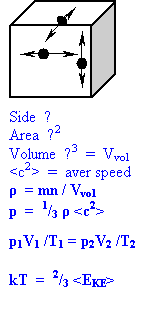
  1. From (B) & (C), p1V1 / T1 = p2V2 / T2
  2. From (A) & (1), pV = nkT
  3. p = pressure (absolute pressure = gauge pressure + 1 atmosphere)
  4. V = volume
  5. T = absolute temperature (0K)
  6. Boltzmann constant k
    k = 1.38 x 10 – 23 J per molecule per 10K
  7. n = number of molecules
  8. n/3 = number of molecules hitting one wall
  9. m = mass of one molecule
  10. v = speed of any molecule
  11. <c2> = average speed squared of molecules
  12. l = length of cube
    Each molecule travels 2l before hitting same wall twice
  13. From (12), area of wall is l 2
  14. From (10) & (12), time between 2 collisions on same wall
    time = 2 l / v
  15. From (14), frequency of collisions = v / 2 l per second
  16. From (9) & (10), change of momentum on collision at wall is from + mv to –mv
    ΔM = 2mv
  17. From (15) & (16),
    rate of change of momentum = 2mv.v / 2l
    = mv2 / l
  18. From (8) & (17), force due to all molecules = n/3 .m.<c2> / l
  19. From (13) & (18),
    pressure = Force / area of wall
    = F/l2
    = n.m<c2> / 3l. l2
    = n.m.<c2> / 3Vvol
  20. From (7) & (9), density of gas ρ = mass / Vvol = m.n / Vvol
  21. From (19) & (20), pressure p = 1/3 ?< c2>
  22. From (19),
    pVvol = n.m.<c2> / 3
    = 2/3 n.[m<c2> /2]
    = 2/3 n.<EKE> where <EKE> = average kinetic energy
    but from (A), p.Vvol = n.k.T
    and therefore n.k.T = 2/3 n<EKE>
    and T = 2/3k<EKE>
  23. Thus temperature is dependent upon the average kinetic energy of the molecules, and upon nothing else.
    – Wow !! What a proof !