| speed of radiation | = | frequency x wavelength |
| Speed c | = | f.λ |
| In a vacuum: c | = | (ε0.μ0) –1/2 |
| where ε0 | = | permittivity of a vacuum |
| = | 8.85 x10¹² F.m–1 | |
| and μ0 | = | permeability of a vacuum |
| and μ0 | = | 4π x 10–7 H.m–1. |
| Since: | ||
| Efield.q | = | B.q.v |
| and since v | = | c |
| Efield / B | = | c |
| P / A | = | (max EField . max B) / 8πk' |
| where P / A | = | power per unit area |
| k' | = | 1 *10–7 N/A2 |
| P / A | = | Pant / 4πr2 |
| where P | = | power per unit area received at distance r |
| A | = | surface area of a sphere of radius r |
| Pant | = | power of the transmitting antenna |
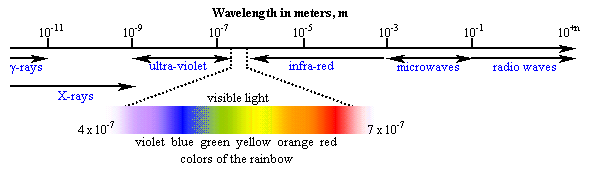 The wavelengths of visible light range from 3.8 *10–7 to
7.6 *10–7 metres.
| Quantity | Unit | Explanation |
|---|---|---|
| luminous flux from source | lumen | Total amount of light emitted by light source. |
| illumination on surface | lux | lux = lumen per square meter. Amount of light landing on surface per square meter |
| I | = | illumination on surface in lux (lumens per square meter) |
| = | F / 4πr2 | |
| F | = | luminous flux |
| r | = | radius of sphere or distance from source. |
| ΔE | = | h.f |
| = | h.c / λ | |
| ΔE | = | size of quantum of energy at frequency F |
| h | = | Planck's constant |
| = | 6.63 *10–34 J.s | |
| f | = | frequency |
| c | = | speed of em waves |
| = | 3.00 *108 m.s–1 | |
| λ | = | wavelength |
| E | = | h.f |
| = | 13.6eV.(n1– 2 – n2– 2)
where n1, n2 are consecutive energy levels for electron orbits. |
| q.ΔV | = | maximum kinetic energy of free electron |
| = | h.f – W | |
| where: | ||
| q | = | charge on electron |
| ΔV | = | cutoff potential – the emf of the battery required to stop the fastest electrons |
| h | = | Planck's constant |
| f | = | frequency of incident light |
| h.f | = | energy of incident photon |
| W | = | work function of particular metal minus energy absorbed by electron just to escape |
| Because: | ||
| E | = | m.c2 |
| = | h.f | |
| and f | = | c / λ |
| then m.c2 | = | h.c / λ |
| p | = | momentum of photon |
| = | m.c | |
| = | h / λ | |
| where h | = | Planck's constant |
| and λ | = | the wavelength it would have if it was a wave instead of a particle.
(Sorry, I couldn’t resist this jibe.) |