Light 2
Refraction


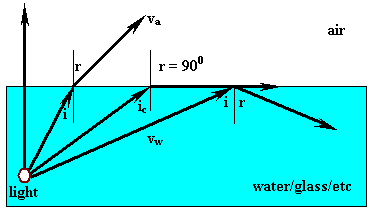
where va = velocity of light in air
vw = velocity of light in water.
i = angle of incidence
r = angle of refraction
ic = critical angle of incidence
Then sin i / sin r = vw / va
= na / nw
where na = refractive index of vacuum to air
and nw = refractive index of vacuum to water.
Snell's Law of Refraction
Snell's law of refraction for any 2 media:
sin i / sin r = a specific constant
If r = π/2,
then i is called the critical angle ic for that media interface.
sin ic = n–1
When i > ic, the critical angle,
the wave is reflected completely.
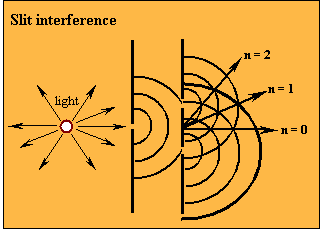
Diffraction grating interference
Diffraction is the bending of a wave around the end of an obstacle.
Put a long object in water so that it forms a solid barrier to a wave.
With a paddle or a box, generate a wave such that it moves a long distance perpendicularly to the solid obstacle. Watch the wave reach its end.
Some of the wave, at a distance from the obstacle, will continue in a straight line.
That part of the wave which is very close to the obstacle, will bend around it.
This can be seen in the sea, where a headlong juts outwards with the swell coming in at an angle.

Diffraction of a slit:
sin ?m = λ/d for first minimum (normal incidence)
Diffraction grating:
A diffraction grating has many slits, close together.
As light comes through the slits, diffracting around the slit edges, and crossing the light from the next slit, the wavs interfere, cancelling and reinforcing, so that spectra occur at:
n.λ = s.sin ?n (normal incidence)
Interference patterns
2-slit interference patterns:
fringe spacing = (λ/s) x distance (slits-to-screen)

All waves superimpose. The displacements of the superimposed wave are the sums of the displacements of the waves superimposing.

An antinode is any point equidistant from the 2 slits, which thus receives crests in phase from both slits. Where the difference between the distances to the 2 slits, is an integral number of wavelengths, there too is an antinode.
Antinodes line up to form antinodal lines having constructive interference, producing a bright bar.
There is a nodal line, halfway between the anti-nodal lines, having destructive interference and making a dark bar.
s1 – s2 = n.λ
where s1, s2 are distances from the 2 slits
where n = an integer
and λ = wavelength.
sin ?n = n.λ / d
where ?n = angle that any antinodal makes with the perpendicular to the screen
and d = distance between slits
If λ = d.x / L
where x = distance from n = 0 to n = 1 lines (using spectrometer)
and L = distance of screen from grating
and putting n.x = 1, if L is large compared to x,
then x / L = sin ? approximately.

Refraction
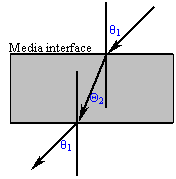
Snell's law of refraction for any 2 media:
sin i / sin r = n a specific constant
If r = = π/2,
then i is called the critical angle ic for that media interface.
Because sin π/2 = 1
sin ic = n–1
When i > ic, the critical angle, then the wave is reflected completely.
Refraction is due to the velocities of light in two media being different.
n = c/vc
= speed of light in a vacuum (2.998 x10⁸ ms–1)
v = speed of light in the medium
For media 1 and 2:
sin i / sin r = n2 / n1
= v1 / v2

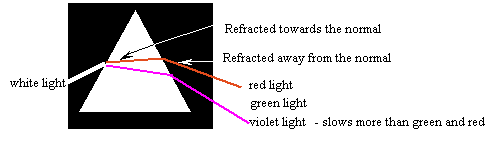
Draw a triangular prism, with angles 600, and a ray of light entering and leaving.
Allow for Snell's law.

While all wavelengths travel at the same speed in a vacuum, they differ when passing through denser media.
Higher frequencies (longer wavelengths) travel more slowly than the lower frequencies; and are therefore refracted more. Red is least refracted; violet most.

This phenomenon cause colors in diamonds, and rainbows in clouds. Colors formed when oil smears the surface of water is caused by interference between the light going in and the reflected light returning.
Lenses and mirrors
< It is easy to remember concave and convex.
A concave mirrorcaves away from you like a hollow shell.
Lens
f-1 = Do–1 + Di -1
where f = focal length of lens (positive for converging, negative for diverging lens)
Do = object distance from lens center
Di = image distance from lens center.
Di is negative for virtual images.

When the object distance is large, over 20 metres, the image distance = focal length of lens.
As the object distance decreases, the image distance increases.
A large depth of field occurs when objects through a large distance appear to be sharp, that is, in focus. They are not exactly in focus, because every point in the object becomes a little circle in the image (the circle of confusion) but this is acceptably small to the eye.
Do / Di = So / Si
So = size of object
Si = size of image.

The focal ratio = focal length / diameter for the lens.
This indicates its light-gathering quality. The smaller the f-number, the better.
A lens f:1.1 can take party shots at night without a flash.
A diaphragm is an internal pupil which contracts to reduce the light on the film.
An f:1.2 lens can be stopped down to f:22 in bright light.
Because only the center of the lens is being used, with its least curvature, the depth of field is greatly increased.
Aberration
Chromatic aberration
A curved lens is like the prism discussed above, dispersing the light and causing white light to disperse into its components. For this reason, camera lenses are doublet lenses, combining a convergent and a divergent lens, the two being made from different glass.

Spherical aberration
Spherical aberration occurs around the edges of fat lenses. To overcome this, a lens is made of many pieces of different types of glass.
Curved mirrors
A concave mirror caves away from you like a hollow shell.
A convex mirror bulges towards you like a ball does.
Convex mirrors form the same kinds of images as convex lenses; and concave mirrors form the same kinds of images as concave lenses do.
For a mirror, the focal length is half the radius of curvature.
For a convex mirror, the radius is negative because the convex mirror diverges light.
f–1 = Do–1 + Di -1
f = focal length of lens (positive for converging, negative for diverging lens)
Do = object distance from lens center
Di = image distance from lens center. Di is negative for virtual images.
Do / Di = So / Si
So = size of object
Si = size of image.

When the size of the image is negative, the image is virtual and opposite the side of the object.
Telescopes and microscopes
Your eye contains a lens which is adjusted by muscles.
When an object is 10 or more meters away, the muscles are relaxed and the lens is not distorted. As you move closer the muscles pull on the lens, making it thicker and so shortening its focal length, so that the lens continues to focus on the retina.
The near point, when the object is about 250 mm away from the lens, is the closest the eye can still focus on the retina.

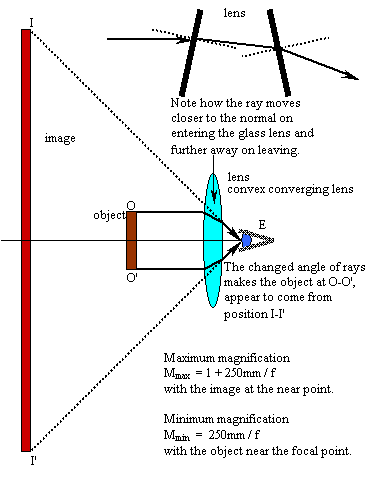
Magnifying glass
When using a magnifying glass, maximum enlargement occurs when the image appears as a virtual image at the near point, about 250 mm from your eye.

Telescope, microscope
There are two lenses:
The essential part is the eyepiece, usually a convex convergent lens, because this is the one which does the magnifying.
Unfortunately the objective lens inverts the image but the eyepiece does not; so the final image is upside down.
Magnification M = fo / fe
where fo = focal length of objective lens
fe = focal length of eyepiece.

The microscope is similar to the telescope but the objective lens has a very short focal length, so it also magnifies the object.
Total magnification = Mo.Me
= (L / fo).(250mm / fe)
where L = length of tube
fo = focal length of objective lens (mm)
250mm = near point
fe = focal length of eyepiece (mm).

Caution: do calculations with the units written in with the numbers (as urged everywhere), and then cancel the units wherever possible to leave the final unit as a check.