| Time | Temp | Event |
|---|---|---|
| 00:00 (–13.7x10⁹ years or 13.7 billion years ago) | Big Bang: the shrinking Universe suddenly begins to expand in all directions. The Universe is not simply one point but all of space, and space itself begins to expand.
In units, 10K = 10C. But the scales have different starting points: 00K = –2730C. The velocity of expansion is known – what is it? The average mass density will be determined within the decade by experiment. These 2 factors, velocity of expansion and the mass density of the Universe, determine the behaviour of the universe. Will it continue cooling or shrink back to its original furnace? This will take at least another 15 billion years, while our Sun's destination to form a red star will eliminate us before then. |
|
| 1/100 second | 1x10¹¹(0K) 100 billion 0K |
As the Universe expands, so it cools.
Nearly thermal equilibrium with an undifferentiated soup of matter (protons, electrons, neutrons, neutrinos) and radiation. Each particle collides with other particles. Initially, protons and neutrons are equal in number, but neutrons decay while protons do not. If a neutron is not locked inside a nucleus, it decays: n → p + e + neutrino. A neutral neutrino hitting a neutral neutron, splits it into a positive proton and a negative electron. The difference in mass between a proton and a neutron is 1/2000. In thermal equilibrium, radiation's energy and density are fixed by temperature. The big question now, is what happened in this first one hundredth of a second. |
| 4 minutes | 1x10⁹(0K) 1 billion 0K |
As the Universe expands, so it cools.
The Universe is now cooled enough for the He (helium) nuclei not to be blown apart by radiation. The ratio H/He (hydrogen nuclei to helium nuclei) is 10/1. A hydrogen nucleus is nothing more than a proton. A helium nucleus is 2 protons with 2 neutrons. Therefore, 2 hydrogen nuclei with 2 neutrons can make one helium nucleus. But the mass of one He nucleus is less than that of the 2H + 2n which make it, and this mass difference is released as energy. (Remember the hydrogen bomb dropped on Hiroshima, Japan?) This release of energy is why our Sun shines warmly upon our Earth. |
| 1x10⁶(0K) | As the Universe expands, so it cools.
In thermal equilibrium, radiation's energy and density are fixed by temperature. If the temperature is too high, the radiation destroys nuclei. Nuclei, because of cohesive forces, can resist the destruction by radiation at 1x1060K. Atoms are held together by much weaker electron-proton electrical attraction, and so cannot survive at temperatures above a few thousand degrees. Electrons move independently of nuclei. |
|
| 300,000 years and onwards | 30000K | As the Universe expands, so it cools.
This is the end of a near thermal-equilibrium. With the passing of thermal equilibrium, no longer will all matter have the one temperature. From now on, the universe cannot be designated by a single temperature. The temperature is now down to where atoms can survive. While thermal equilibrium of matter lasted, it generated radiation energy in the form of photons. (Radiation can be meazured as electromagnetic waves or as photons.) Photons bounce off electrical charges like protons and electrons, but do not bounce off atoms, which are neutral. Once atoms formed (at 30000K ), photons then ceased interacting with matter, but still persisted as randomly directed radiation. If you point an antenna in any direction, you will pick up their frequency. A photons energy is proportional to its frequency of radiation (and inversely proportional to its wavelength.) The photons had a wavelength determined by this temperature of 30000K. From this time, as the universe expanded 1000 times, so the photon wavelength expanded 1000 times. These photons have been detected coming from every direction of the universe, indicating they have no specific source. They must have been here since the beginning of time, but simply changing wavelength as the universe expanded. This expanded wavelength indicates a temperature of 2.7350K (from Wien's law). Multiplying by the growth factor of 1000, gives 27350K, close to the estimated temperature of 30000K. Gino Segre [A Matter of Degrees, 2002; 221] suggests that neutrinos are distributed in a thermal distribution of 2 degrees, their equivalent temperature as reflecting the universe expansion from a temperature of 10 billion degrees when they were last in thermal equilibrium with matter. This implies an expansion of the universe 5 billion times. Unfortunately there is as yet no experimental verification that neutrinos are at this equivalent 2 degrees. |
| 380,000 years | The universe has cooled sufficiently for atoms to form. The first stars were giant hydrogen stars, 70% H, 28% He, and by converting hydrogen into helium produced energy (as our sun does today). These giant stars exploded to form hypernovae which produced bigger atoms than H and He. When the hydrogen was exhausted, those suns contracted, converting the helium into carbon, nitrogen and oxygen.
By fusion, 3He → C By fusion, C + He → O Silicon burns at 3.5 billion degrees. Iron is the limit of these fusion processes inside hypernovae. Look at the Periodic Table in the Book on Chemistry to see how far the unverse had progressed. Once this limit is reached, there is no more fusion to generate energy. The star explodes, forming supernovae, which then cook the iron to form all the other elements. These hypernovae fuse the iron atoms, going up the chain to form all the bigger atoms. |
|
| 1 million years | Small fluctuations in density began to grow into larger agglomerates. Clouds of H and He formed. Stars appeared within the clouds of nuclei. Larger stars made heavier nuclei, then exploded, providing material for new stars (and eventually our Earth). | |
| 10 billion years | Our Sun was formed; it is still 91% H, 9% He (ratio 10/1) with all other elements contributing< 1%. | |
| 10.2 billion years | Earth was formed with a core of iron and iron-nickel alloys. The Earth's elements are mainly from exploding large stars. Any helium and any hydrogen not captured to form denser molecules, floated off into space. | |
| 13.7 billion years | Today | |
| 16 billion years | Sun, depleted of hydrogen, expands into a red star, enveloping our Earth.
Goodbye, folks ! |
| Years ago | Event |
|---|---|
| 5 to 4.6 billion | 10 billion years after the Big Bang
Out of the interstellar medium of the 10 billion year-old universe, was formed a huge cloud of matter and radiation, mainly hydrogen and helium. Because this huge cloud was spinning, (in an anticlockwise direction relative to our north pole) it formed a flattened disk with the central part thickest. This central part, under its own gravity, shrank in size but increased in density, which in turn increased the gravitational pull. The core of this cloud thus formed the Sun, about 90% hydrogen and 9% helium, drawn together by gravity into a ball which, under gravitational compression, heated up to the 15 million degrees necessary for the colliding protons (hydrogen nuclei) to form helium nuclei. This released intense energy. Energy is released because the mass of a helium nucleus is less than that of the hydrogen making it. This mass deficit is converted to energy calculated by the equation e = mc2, where e is energy, m is mass and c is the velocity of light. Because the value of c is so large and the c is squared, a tiny mass makes a lot of energy. This energy generates more heat, which, today, maintains our Sun's inner core temperature at 15.7 million degrees. Elsewhere, exploding stars hurtled particles through space, which were caught by the gravity of this protoplanetary disk. Those exploding stars sent elements of hydrogen through to iron, made in their cores by the heat of the H-to-He process, as well as the heavier elements from nickel to uranium and more, made by the energies of their explosions. The interstellar medium forming the protoplanetary disk, whose matter and radiation were not in thermal equilibrium, was 'rippled', with rings of higher and lower densities and temperatures. The denser formed 8 concentric rings of gas and dust around the evolving protostar whose increasing radiation raised the temperature of its immediate surroundings. In the nearest ring (Mercury), the temperature rose to about 10000K while the fourth ring (Mars) rose to 4000K. In each ring, the gas, dust, and particles collided and coalesced, till large enough to exert gravitational attraction on other matter in the same ring, drawing all together. As the mass of each agglomeration increased, so did the gravity exerted on all particles within itself, increasing compression which raised the temperature. (As pressure on objects increase, so does their temperature.) The heat reached a temperature at which fusion occurred so the mass developed an almost spherical shape but spinning cause slight flattening into an ellipsoidal shape. The four inner rings became the small dense rocky planets Mercury, Venus, Earth and Mars. The four outer rings were so cold that the gases froze. The original dust formed very cold grains which acted as nuclei, forming giant ice-balls of methane, ammonia, water etc. Then their masses attracted the H and He out of the disc. These four rings became the huge gaseous Jovian planets: Jupiter, Saturn, Uranus and Neptune. The 4 inner planets are 5 times as dense as the 4 outer planets. From the above description, it can be seen that temperature determined the size, density and composition of the inner eight planets. The ninth planet, Pluto, was probably a passing interstellar rock, hurtling through space when it was captured by the gravitational pull of our solar system. Meteors and asteroids are the same, but are used to indicate a size difference - meteors go up to, say, 100 meters, while asteroids are anything above that. Each year the Earth is visited by some giants up to a few hundred kilometers across, while over 200 of them exceed 75 kilometers. Most meteors and asteroids cruise between Mars and Jupiter. |
| 4.5 billion | The Planets were formed over hundreds of millions of years but by 4.5 billion years ago, had relative stability. The Earth was much hotter (than today), with its rocks so hot as to be viscous. (At present, the Earth has cooled to an average surface temperature is 288.50K (or 15.50C) while its core is estimated to be between 5000 and 60000K.)
Mars' volcanic activity had produced considerable atmospheric carbon dioxide with its greenhouse effect. There was water flowing over its surface 3 billion years ago. Today Mars, being further from the Sun than our Earth, is frigid. Not all the dust in the solar system became part of planets. Some coalesced to form meteors and asteroids, continuing to circle the sun, mainly in a belt between Mars and Jupiter. Some 200 are larger than 75 kilometers diameter but there are hundreds of thousands of them. Some 300 tonnes of it rain on our atmosphere each day, but most of it is the size of dust. The table for the History of Earth, gives examples of asteroids run riot. Jupiter picked up 4 moons: Calypso, Europa, Ganymede and Io. With a year equal to 12 Earth years, Jupiter passes through on constellation per year (roughly). In 2010 Jupiter will be in Aquarius, so work from there. Jupiter is mostly hydrogen and helium, with a tiny core of rock covered in liquid hydrogen (looking like liquid mercury) because of the enormous pressure under its huge atmosphere. The composition of Jupiter is like that of the Sun. Fifty times bigger, would make Jupiter compress under gravity, heat up, and become another sun. Saturn has Titan, Neptune has Triton and Pluto has Charon. See the next table for Planets. |
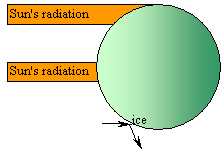
Planets and asteroids receive radiation from the our Sun. If they spin with respect to the sun, they are toasted around their whole surface. If they do not spin, they are roasted on one side and in cold shadow on the other side.
However spinning does not give a perfectly even suntan because the equators receive radiation vertically while the poles receive horizontally, distributing each unit area of radiation over a much larger area. Compare the left end of the rectangles, imitating equal areas of radiation, with the right ends, imitating radiation spread on the planet's surface. On Earth, ice forms on the poles, reflecting most of the radiation without absorption, so the wavelengths are unchanged and the radiation shoots back into space. |
| Merc | = | Mercury |
| Jup | = | Jupiter |
| Nept | = | Neptune |
| Distance from Sun | = | average distance |
| Mass | = | mass compared to that of the Earth, so multiply by the mass of the Earth, 5.976 *1024 kg. |
| Spin | = | period of spin, that is, one rotation about its own axis. |
| Circles Sun | = | one year in its own time, that is, the time for the planet to make one loop around the Sun. |
| Sun | Merc | Venus | Earth | Mars | Jup | Saturn | Uranus | Nept | Pluto | |
|---|---|---|---|---|---|---|---|---|---|---|
| Distance from Sun (million km) | 0 | 58 | 108 | 150 | 228 | 778 | 1427 | 2875 | 4497 | 5900 |
| Diameter at equator ('000 km) | 1,392 (1.4m) | 4.878 | 12.104 | 12.756 | 6.792 | 143 | 120.5 | 51.1 | 49.5 | 2.284 |
| Mass (*Earth = 1) | 333,000 | 0.06 | 0.8 | 1 | 0.11 | 318 | 95 | 15 | 17 | 0.002 |
| Spin (days,hours) | 25d | 58.7d | 243d | 23.94h | 24.63h | 9.93h | 10.66h | 17.24h | 16.11h | 6.4d |
| Circles Sun (days,years) | 88d | 225d | 365.25d | 687d | 11.9y | 29.5y | 84y | 165y | 248y | |
| Moons | 0 | 0 | 0 | 1 | 2 | 16 | 18+ | 18+ | 8 | 1 |
| Diameter | = | 3.476 *103 km |
| = | 1/3 diameter of Earth | |
| Volume | = | (1/3)3 *Earth |
| = | 1/81 *Earth | |
| Mass | = | 1/81 *Earth |
| = | 384,000 km | |
| Spin | = | 27.3 days |
| Circles Earth | = | 27.3 days |
| = | period of spin, so the same side of the moon always faces Earth. | |
| Phases | = | 29.5 days, giving 12.38 lunar months per year. |
| Gravity | = | 1/6 *Earth's gravity. |
| Temperature | = | from -1500C to 1200C (night & day temperatures). |