General Relativity 2
Source: Gary Felder 2003
http://www4.ncsu.edu/unity/lockers/users/f/felder/public/kenny/papers/gr1.html
For interesting articles on science and maths, also try
http://www.ncsu.edu/felder-public/kenny
This paper is a brief introduction to the ideas of Einstein's general theory of relativity, one of the cornerstones of modern physics, taking Newtonian physics into the 20th century for:
- high speeds
- astronomical masses
- ultra-accurate measurement of time.
Acronyms
GR General Relativity
SR Special Relativity (excludes gravity and its effects)
BB "Big Bang", the origin of the Universe as hot plasma, followed, not by an explosion but an expansion of this plasma as space stretched, with resultant cooling, formation of atoms, and eventual forming of galaxies.
Predictions of GR
In the following four subsections are four predictions of GR that are qualitatively different from anything in Newtonian physics. These predictions (explained below) are:
- light cones
- black holes
- gravity waves
- the big bang (BB) model of the universe.
The section on black holes requires the section on light cones but otherwise you can omit this section.
1. Light Cones
The existence of light cones was predicted by special relativity SR (which excludes gravity). Light cones were predicted by GR.
The basic idea behind light cones is the fact that nothing can travel faster than the speed of light. That means that if a light signal is sent from the point x=0 at t=0 it cannot reach the point x=7 until a time equal to or greater than 7/c, where c is the speed of light. For instance if someone is seven light years away, they cannot receive the signal before at least seven years have passed. And nothing can travel faster than the maximum universal speed, at which light travels.
From this point on, units will be omitted for distances (light-years) and times (Earth-years). In these units the speed of light, c, is equal to one.
Spacetime diagram showing the paths of signals sent out from the origin, ie x=0, t=0
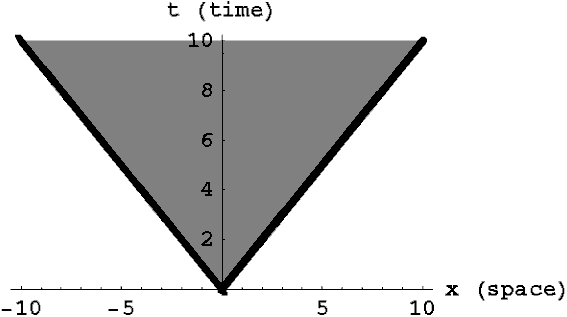
Check this graph. How far does the graph say that light travels in 10 years ?
To see this another way, consider the spacetime diagram above for a spacetime with no gravity. Mathematically this is the condition for which general relativity reduces to special relativity. The bold lines represent the paths which light beams would follow if I emitted them at the origin (x=0, t=0) either to the right or left. The shaded region in between these two lines represents all the points in spacetime to which a signal could be sent. These points are said to be inside the (future) light cone.
Why are there no points below the heavy black lines ?
For example the point (x=7 light years, t=4 years) is outside the light cone. Nothing that can be done at (x=0, t=0) can possibly have an effect on what happens at (x=7, t=4) or vice-versa. Note that this light cone is particular to a specific point in space and time, namely (x=0, t=0). If the light beams were drawn emanating from this same point in space (x=0) at a different time, for example, they would demarcate a different region of spacetime.
Spacetime diagram showing the paths of signals sent to the origin:
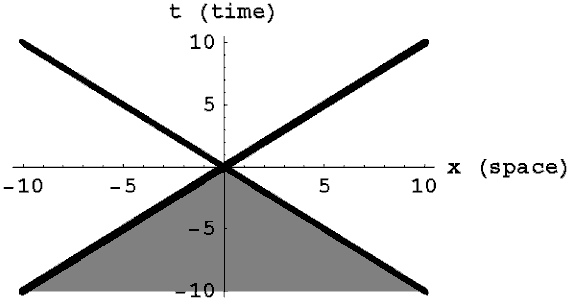
In addition to the future light cone, there is also a past light cone associated with each point in spacetime. In the diagram above the bold lines at negative times represent light beams that would reach me at (x=0, t=0) coming from either direction. Study the diagram to see that the region in between those two lines represents all the points in spacetime that can be affected. For example a signal at x=7 can reach someone at t=-9 telling them what to do at time t=0, but if they send the signal at t=-3 it will be too late for that signal to reach the receiver by t=0.
Light cone in a 3D spacetime, (two spatial dimensions):
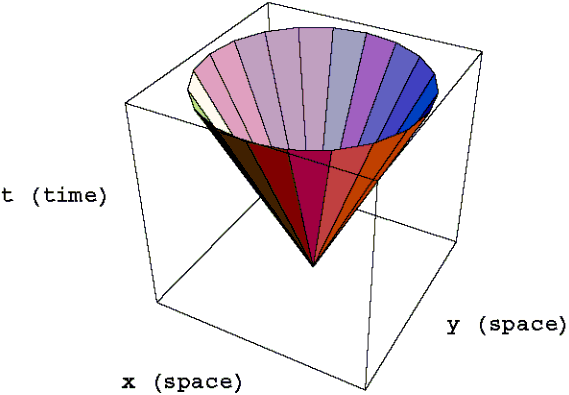
Finally, the diagram above shows a spacetime diagram with two spatial dimensions instead of one. The figure in this diagram represents the paths of light beams moving in all possible directions. This figure is the aptly named "light cone" for the point (x=0, y=0, t=0).
2. Black Holes
Consider the gravitational field around a massive object such as the sun. In GR, "gravitational field" refers to the spacetime curvature induced by massive objects, to the space and time near stars. Previously the spacetime diagram for the vicinity of a massive object showed geodesics bent inwards towards the object. Here the diagram shows light cones instead of world lines. (The light cones continue past these lines, but only small sections are shown for the sake of clarity. Future light cones are shown emanating from various points.)
Light cones in the vicinity of a massive object such as the sun:
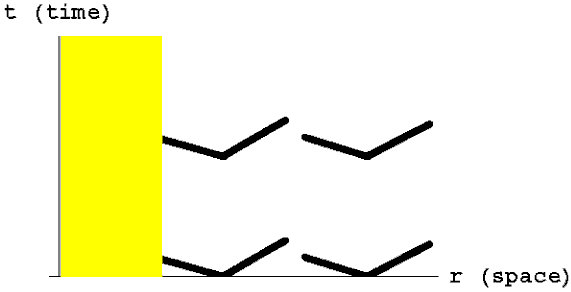 Showing radial distance only.
Light, like everything else, is bent towards the object. This means that the light cones are now somewhat bent, but the bending is very slight. Recall that the future light cone shows the limits of the possible world lines of particles. Particles moving away from the sun can not outrace the outgoing light beams. Since these are bent slightly towards the sun in the spacetime diagram, a signal sent outward to someone three light-minutes away will take longer than three minutes to reach them. Conversely a signal sent to someone three light-minutes closer to the sun could take less than three minutes to reach them. This doesn't violate the rule that nothing can move faster than light because the signal must still lag behind (or exactly match) a light beam moving towards the sun.
What happens at something denser than the sun ? For example a neutron star is an object a few times more massive than the sun but only about 16kms across. Very close to the surface of such an object the gravitational field is very strong, and geodesics are all very strongly bent, as shown in the diagram below.
Light cones in the vicinity of a neutron star:
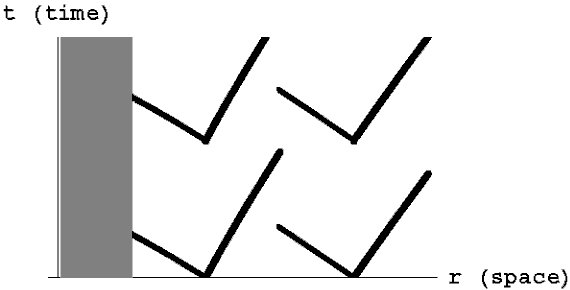 Showing radial distance only.
What happens when an object becomes even denser than a neutron star? Consider a hypothetical object with the mass of the sun but a radius of only 1km, as shown below in the spacetime diagram.
Light cones in the vicinity of a black hole. The dashed line shows the event horizon (defined below):
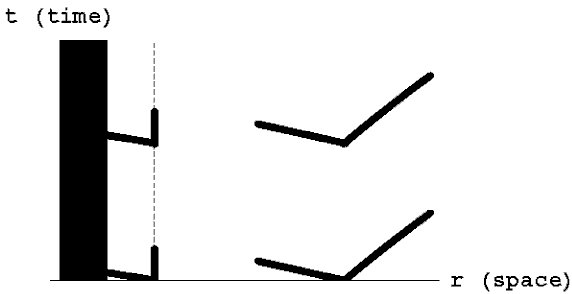 Showing radial distance only.
The light cones very near the object are so strongly bent that a light beam shone directly outwards cannot escape from the gravitational field of the object. Recall from above that the light cone emanating from a particular point in spacetime defines the region to which one can send a signal. If you are sitting close enough to the object shown above, then any light beam, and anything else, can move only closer to the center of the object.
An object so dense that it acts like this is called a black hole because even light can not escape from it. The place where the light cones start to turn inwards is called the event horizon, shown with a dashed line in the diagram above. That is the point of no return; once inside the event horizon there is no escape, not even for light which has no mass. Remember that I'm only in these diagrams, so the event horizon looks like a point in space, and thus a line in spacetime. In the full three-dimensional space the event horizon is not just a point but rather a sphere surrounding the black hole.
On the event horizon, the outer edge of the light cone is vertical. Recall that the two branches of the light cone represent the paths taken by light emitted in either direction. That means that if you were exactly at the event horizon and shone a beam of light directly outward the light would eternally hover at this same radius. If you were inside the event horizon, the outer edge of the light cone would actually be tipped inwards. In other words whether you shone a light inward or outward it would still approach the center of the black hole. The motion of any object, such as yourself, is bound by the light cone. Thus if you are inside the event horizon you must approach the center.
The next diagam shows inside the event horizon of a black hole. The bold lines show the light cone and the blue line shows a sample trajectory of an object falling into a black hole.
Inside the event horizon of a black hole:
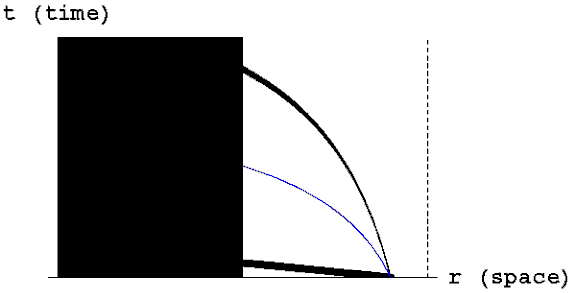
What would that look like ? If a light beam was shone away from the black hole would you see it turn around and start rushing towards the centeryou shone ? No. The light would be approaching the center, but you would be approaching it even faster. From your point of view the outgoing light beam would be moving away from you at exactly the speed of light.
This is a general property of GR. No matter how strange a given spacetime might be, a local observer will always see light beams moving in all directions at exactly the same speed. This is the sense in which GR preserves the special relativity rule that says nothing can move faster than light. Your coordinate speed might be faster than c, but you will never see yourself catch up to a light beam.
Properties of black holes:
Consider the massive object in the center. That object is the source of the gravitational field, but each particle in the object is itself living in the spacetime we've been describing. That means that it can not stay at rest but must move towards the center.
In other words once an object has become dense enough to form a black hole it must keep collapsing and getting denser. If gravity were a force you might imagine some repulsive force strong enough to overcome it even in these extreme circumstances. As it is, however, no conceivable force in the universe could possibly resist this pull because spacetime itself is so strongly bent that there are no paths leading out.
The maximum time that a particle could possibly take to fall in to the center of the black hole, assuming it was being pushed outwards with an arbitrarily strong force, can be calculated, and the result is finite. Thus the object that formed the black hole originally will keep collapsing down and within a finite time it will have all collapsed into a single point in the center. Such a point of infinite density is called a singularity.
To sum up, massive dense objects exert strong gravitational fields, warping the spacetime around them. For an object of any given mass, there is a characteristic radius called the Schwarzschild radius with the property that if the object gets squeezed into a sphere of that radius or smaller it will become a black hole. If that happens it will continue to shrink until a short time later it forms a singularity.
The Schwarzschild radius for an object of mass m is:
R = 2Gm/c2, where G is Newton's gravitational constant.
Exercize:
Given that Newton's gravitational constant G = 6.67 x 10⁻¹¹ N m2 kg-2
the mass of the Earth = 5.976 x1024 kg
the speed of light you know as c = 2.998 x10⁸ m.s-1
to what diameter must the Earth be shrunk, to become a black hole ?
To what diameter must the Sun be shrunk, to become a black hole ?
The event horizon of a black hole is a sphere at the Schwarzschild radius. Note that as the object inside the black hole collapses its mass remains constant, so the size of the event horizon remains fixed at the Schwarzschild radius 2Gm/c2. That means that if we were to observe the formation of a black hole we would see an object (typically a dying star) collapse down to within its Schwarzschild radius and disappear. The theory tells us that the object would continue to collapse after that, but without going in ourselves to take a look we can never directly observe that fact. From the outside, once a black hole has formed you can't tell what's going on inside it. This property is usually referred to by the whimsical phrase: Black holes have no hair.
Exercize: Draw the diagram of light being bent around a black hole. If a star is behind it, how could that star appear to you ? Could it hide the black hole ?
3. Gravitational Lensing
When light moves from one medium to another, say from air to glass, it is bent at the interface. This fact forms the basis for a lens, which can be used to focus light.
A simple lens:
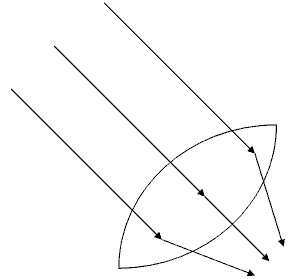
GR shows that light rays (and everything else) are bent in the vicinity of a massive object. This means that a sufficiently massive object can act just like a lens, focusing the light from sources behind it. In fact this observation provided one of the earliest tests of GR. When the light from other stars passes near the sun it gets bent, which changes the apparent positions of the stars. (In effect the area of the sky behind the sun has been magnified to look bigger than it is.)
The next diagram shows bending of starlight by the sun. The arrows show the paths of light rays and the dashed stars show the apparent position of the stars as seen from Earth.
The effect has been greatly exaggerated in this diagram for clarity.
Bending of starlight by the sun:
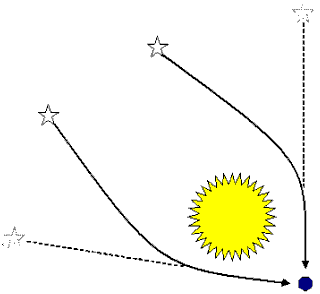
This effect is very hard to observe, first because the bending of the light rays is very small, but even more so because we can't normally see starlight close to the sun. We only see stars at night when we're looking away from the sun. The only exception to this is during a solar eclipse when the moon momentarily blocks the sun's light. Einstein first published the theory of GR in 1916. In 1919 there was a total solar eclipse and a team of scientists led by Arthur Eddington traveled to West Africa to observe the eclipse and check whether the starlight was deflected. The stars did appear to be slightly moved relative to their nighttime positions in exactly the way predicted by GR. This observation was the first crucial test of Einstein's theory.
This kind of magnification of a region of space is called weak gravitational lensing. If the object causing the lensing is massive enough the light of an object behind it, will bend around it to appear as a ring of light.
Bending of light from a distant galaxy by a (less distant) large cluster of galaxies. The single galaxy (upper left) appears as two images (upper right and lower left).
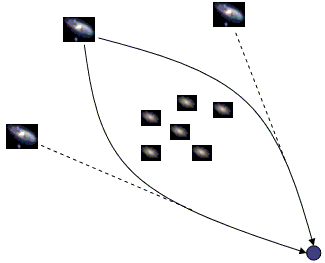
The production of multiple images in this way is called strong gravitational lensing, and has been observed dramatically in many instances by the Hubble Space Telescope among others.
4. Gravity Waves
In the theory of electricity and magnetism a changing electromagnetic field can cause additional changes in the electromagnetic field in the surrounding space.
(Place two copper wires parallel. Pass an alternating current through one, The movement of electrons back and forth generates an e-m field which rises and falls. This oscillating field cuts the other copper wire, inducing an alternating current.)
That e-m field can propagate through space reproducing itself continually. That is how radio waves go from your radio station transmitter to your aerial and into your radio.
In GR the same effect occurs for gravitational fields. Ripples in spacetime can induce other ripples in spacetime in such a way that a wave is propagated through space. Thus the vigorous vibration of heavy mass will cause a spacetime ripple to radiate (outwards).
What would such a ripple look like? As a gravity wave passed, the space would alternately stretch in two orthogonal axes, causing any sphere present to be elongated first along one direction and then the other.
The effect of a gravity wave passing through a circular object:

Such an effect might be detected by measuring the time it takes a light beam to travel from one side of the sphere to another in different directions. In the presence of a gravity wave, the relative times in the two directions would oscillate.
Such an experiment has been built recently. Instead of a sphere it uses two long perpendicular lines. These lines are actually evacuated chambers four kilometers long. Lasers are continually fired back and forth along both chambers. At the intersection of the two lines is a detector that can detect minute changes in the relative light travel times along the two paths. (For those familiar with optics the detector is actually a laser interferometer.) A regularly oscillating change would be the hallmark of a gravity wave. This experiment is called LIGO, or Laser Interferometer Gravitational Wave Observatory.
To date neither LIGO nor any other experiment has ever detected a gravity wave. The reason for that is simply that gravity is weak. Even in the vicinity of the sun the bending of spacetime by gravity is a small effect. Moreover to get a gravity wave it's not enough to have a massive object; something has to shake that object back and forth very vigorously. What could produce such violent behavior?
There are several possible sources for gravity waves. The most dramatic, and potentially easiest to detect, are closely orbiting massive objects. Imagine for example two very dense objects like neutron stars or black holes orbiting around each other at a very small distance. From the point of view of a distant observer each of these massive objects would be swinging back and forth in the sky as they moved through their orbits. The result would be the emission of a strong gravity wave.
Gravity waves, like electromagnetic waves, carry energy. That means that the orbiting objects mentioned above would steadily lose energy as they emitted these waves. When an object in orbit loses energy it tends to fall inwards towards the center of its orbit. Thus the two objects would spiral in towards each other. This effect would be very gradual at first, but the closer they got the faster the oscillations would be. That means the rate of energy loss from gravity waves would increase, causing them to spiral in faster and faster until they collided. It is hoped that the last stages of an inspiraling pair of massive objects would produce gravity waves strong enough for us to detect on Earth.
Another possible source for gravity waves is the early universe. In the first few seconds after the Big Bang, the universe was an extremely hot, dense soup of elementary particles. At the very beginning, a tiny fraction of a second after the Big Bang, that soup would have been so dense that any ripples propagating through it could have moved enough matter around to emit strong gravity waves. If such waves could ever be detected they might give us direct observational data about processes occurring in the universe within its first fraction of a second of existence.
The Expanding Universe
From the time of Newton until the development of GR most physicists assumed that the universe was essentially unchanging, or static. Of course things change on small scales - moons and planets move around, etc - but it was generally believed that everything had its place in the universe and stayed there, so the universe as a whole had always looked more or less like it does today.
Shortly after Einstein developed the theory of GR, he and others thought of applying it to the question of cosmology, the study of the large scale structure of the universe. The equations of GR describe the nature of space and time, so in a sense it was natural to ask what those equations said about the nature of things on the largest scales. The answer is that GR equations have no solutions that are static on large scales. More specifically, the equations of GR predict that the universe must either be expanding or contracting.
This behavior essentially comes from the attractive nature of gravity. In a Universe where all the stars were at rest relative to each other, their mutual gravity would cause them to start moving towards each other. In Newtonian physics, it was assumed that the universe went on forever and thus the attraction felt by any given star would be equally balanced on all sides. In GR you can show, however, that even in such a case the space as a whole will contract and the distances between the stars will shrink. The universe could start out expanding, and depending on how fast it was expanding it might continue to do so or it might eventually stop and start contracting. It could never stay still, however.
A more complete description of what it means to say the universe is expanding or contracting would be beyond the scope of this paper. For a longer discussion of that issue see my paper on the Big Bang Model: The Expanding Universe. That paper also discusses the big bang itself and some of the evidence for the Big Bang Model in more detail than I do below. Here I simply note a few of the key ideas behind the model.
The conclusion that the universe could not be static seemed so implausible to Einstein that he attempted to modify the theory in order to allow static solutions. His modifications didn't work, however, and it remained an inescapable conclusion of the theory that the universe could not be static. In 1929, thirteen years after the publication of GR, Edwin Hubble observed that all distant galaxies appeared to be moving directly away from us in exactly the way predicted by GR for an expanding universe.
Conclusion - Open Questions
The theory of GR has brought about one of the most dramatic upheavals ever to occur in our understanding of the universe. Space and time, long considered to be a simple fixed background for all events, are now seen as dynamic, curving and changing in response to the matter and energy within them. Gravity is no longer viewed as a force but rather as a description of the geometry of the universe.
Nonetheless, while GR may be a beautiful theory, the ultimate judge of its value is not its aesthetic appeal but its ability to predict the results of experiments. Since the theory was first developed there have been a number of high precision tests of its predictions:
- the precession of Mercury
- the bending of starlight near the sun
- galaxy images near large clusters
- evidence for the expansion of the universe
- a change in the speed of clocks near gravitational sources
- the observation of objects believed to be black holes in the centers of galaxies (including our own)
- more
Thus wherever an experiment or observation has been done to test a prediction of GR, the theory has been shown to be correct.
Meanwhile the early twentieth century saw another revolution in physics, the development of quantum mechanics. This theory completely changed our understanding of matter and energy. In quantum mechanics a particle is not seen as a simple dot existing at a particular place, but as a fuzzy wave existing as a collection of probabilities for where it could be and how it could be moving.
Taken together these two theories, GR and quantum mechanics, form our best current understanding of the physical laws of the universe. The problem is that you cannot use them together. Every attempt that has been made so far to reconcile the geometric view of spacetime in GR with the fuzziness of quantum mechanics has led to contradictions. The search for a single theory that could bring these two pieces together, a theory of quantum gravity, occupied Einstein for much of his life and is still one of the greatest outstanding challenges in science today.
There is currently one favored candidate called string theory, which essentially reworks quantum mechanics by treating particles as small strings rather than points. This simple idea has dramatic consequences for the theory, and it seems that it may be able to resolve the contradictions of quantum gravity. Unfortunately it's very difficult to do calculations in string theory, so the theory is still untested.
Regardless of whether or not string theory is correct, many questions certainly still remain. The nature of geometry on small scales where quantum mechanics is important is not understood. It is likely that some of our basic concepts of space, time, and causality may need to be radically changed on those scales. The history of the universe for the past fourteen billion years or so is pretty well understood, but what happened before that is not. Was there a big bang? What, if anything, happened before it? What will be the ultimate fate of the universe in the future?
Footnotes
Note 1. Technically the definition of a geodesic is more complicated than this, and it does not always correspond to a path of minimal distance. In this paper, however, this definition is good enough.
Note 2. Light travels at the universal maximum speed c, (nearly 300,000 km/s) only in a vacuum, and when inside glass, water and other matter, light is slower. This has nothing to do with the properties of spacetime.
Note 3. As we know from special relativity, the time it takes for a sequence of events to occur can be different from the point of view of different observers. When I say it takes a finite time for an object to reach the center of the black hole, I am talking about time as experienced by that object. In other words, if you fell into a black hole wearing an indestructible stopwatch, that stopwatch would still have some finite reading (depending on the size of the black hole) when you reached the center.
Note 4. It turns out that even in Newtonian physics a static universe would be unstable and the stars would eventually start collapsing in towards each other in different regions. This fact wasn't appreciated when the theory was developed.
Answer to exercize: The Earth, in order to become a black hole, would have to be squeezed into a sphere less than 5 mm across.
Exercize: Draw the diagram of light being bent around a black hole. If a star is behind it, how could that star appear to you ? Could it hide the black hole ?
Answer: It produces multiple images as in strong gravitational lensing, which has been observed in many instances by the Hubble Space Telescope and others.