General Relativity 3
Source: Gary Felder 2003
http://www4.ncsu.edu/unity/lockers/users/f/felder/public/kenny/papers/gr1.html
For interesting articles on science and maths, also try
http://www.ncsu.edu/felder-public/kenny
This paper is a brief introduction to the ideas of Einstein's general theory of relativity, one of the cornerstones of modern physics, taking Newtonian physics into the 20th century for:
- high speeds
- astronomical masses
- ultra-accurate measurement of time.
Brief glossary
BB: Big Bang, origin of the Universe as hot plasma, not an explosion but a stretching of space.
Event horizon: is the (imaginary) hollow sphere surrounding a black hole, inside which light cannot escape. The event horizon of a black hole is a sphere at the Schwarzschild radius.
Free fall: an object experiencing no non-gravitational forces is said to be in "free fall," like an object falling towards the Earth with no other forces on it. Or a satellite whizzing past the planet Venus.
GR: General Relativity
Inertial: Any coordinate system for which Newton's laws hold valid is called inertial.
Metric: A metric is a mathematical description of spacetime in terms of a particular set of coordinates. Roughly speaking, the metric states how to find the distance between any two points. For example, in a two-dimensional Euclidean space the distance ds between two points is given by
ds2=dx2+dy2.
The metric itself represents this information in the form of a tensor. Roughly speaking you can just think of that as a matrix, although mathematically it must satisfy certain conditions. The rows and columns of that matrix represent the different coordinates, x and y in this example, and the elements of the matrix tell you the coefficients of these coordinates in the distance formula. For example, if the metric is called g (which is the usual convention) then g11 and g12 in this example would be the coefficients of dx2 and dxdy respectively. In this case:
g11 = 1
g12 = 0.
Singularity is a point of infinite density.
Schwarzschild radius for an object of mass m is:
R = 2Gm/c2
where:
R = radius of the object
G = Newton's gravitational constant
m = mass of the object
c = maximum universal speed (nearly 300 million m/s).
If such an object gets squeezed into a sphere of that radius or smaller it will become a black hole, continuing to shrink until a short time later it forms a singularity. For the Earth to become a black hole, it would have to be squeezed into a sphere less than 5 mm across.
SR: Special Relativity (excludes gravity and its effects)
Weak gravitational lensing Light travelling near a star, is bent inwards, giving the impression of magnification to a distant receiver.
This kind of magnification of a region of space is called weak gravitational lensing. If the object causing the lensing is massive enough, the light can bend so much that multiple images of another object can be seen behind it.
Worldline: the path of an object in spacetime. (A trajectory is the path in space.)
Introduction: What General Relativity is About
General Relativity (GR) can be viewed in a number of different ways, including the following two, with how they relate to each other.
1. General relativity explains space and time
Prior to the 20th century all physics theories were based on the validity of Newton's physics, which assumed space and time to be absolute, unchangeable. Newton stated that every 2 objects, of mass m1 and m2, separated by a distance r, experience a gravitational force of attraction, F, such that:
F = Gm1m2/r2
Einstein's physics states that there is no such force. What appears to be a gravitational force of attraction is the effect of the curvature of the 4-dimensional spacetime of the Universe.
A rocket, sent close to the Sun, will follow a bent path when it nears the Sun. Newtonian physics explains that the gravitational attraction between Sun and rocket, pulls the rocket temporarily towards the Sun.
A light beam, such as a laser beam, sent close to the Sun, will also bend in its path. Why ? Why, when light has no mass and so cannot experience gravitational attraction ?
Einstein explains that the Sun warps the 4-dimensional spacetime of the Universe, which causes the light to follow the bend (without any force being applied).
In GR (general relativity), spacetime, a 4-dimensional world combining the 3-D of space with the 1-D of time, becomes curved in response to the effects of matter. In a curved spacetime the laws of Euclidean geometry no longer hold: the angles of a triangle do not in general add up to 180°, the ratio of the circumference of a circle to its diameter is in general not π, and so on.
This curvature in turn affects the behavior of matter. In Newtonian physics a particle with nothing pushing or pulling it (no forces acting on it) will move in a straight line. In a curved spacetime what used to be straight lines are now twisted and bent, and particles with no forces acting on them are seen to move along seemingly 'curved' paths (but these paths are the shortest distance between points in spacetime, and so are straight).
2. GR explains gravity
Newtonian theory, which held sway prior to the 20th century, described gravity as a force. In other words two massive bodies like the Earth and an apple were understood to exert a pull on each other as a result of the law of gravity. If an apple started out at rest, say just as it broke off from a tree, then gravity would cause it to move towards the Earth until it collided with it. Newton's law of gravity was able to explain in detail not only the fall of apples, but also the orbit of the moon about the Earth, the motions of the planets about the sun, and much more.
GR can also explain all of those things, but in a very different way. In GR, a massive body like the sun causes the spacetime around it to curve, and this curvature in turn affects the motion of the planets, causing them to orbit around the sun.
For the most part the predictions of GR and Newtonian gravity are very similar. However there are small differences that have been measured in the solar system, which conradict Newton and verify GR. Moreover, there are certain situations, like the vicinity of a black hole, where GR makes predictions beyond the ability of Newtonian physics.
In short, GR is a theory in which gravity is described by saying that the 4 dimensions of space-time collectively is a dynamic quantity that can curve in response to the effects of matter and can in turn alter the behaviour of matter.
The next sections discuss:
1) how space is curved
2) how spacetime is curved
3) how gravity is viewed in GR
4) applications.
Curved Space
Suppose you and a friend stand on the equator; with you at 00E and your friend 10E, placing you 111 km apart.
You look around and see that your world is flat.
You both walk due north across your flat world.
As you look ahead you know you are both walking along straight lines, parallel to each other. Yet after 100 km you notice that you are closer than when you began; after 5000 km you are so close you can speak to each other. You have both walked along straight lines (the shortest distance between two points), and parallel lines (both due north), and yet you have met. This is because your flat world, your 2-Dimensional map is curved without your being able to see that it is.
For mathematicians, on any surface the shortest path between two points is called a geodesic [geo = Earth; daio = to divide].
The shortest pencil line between two points drawn on a global (spherical) surface has positive curvature. The shortest pencil line between two pointsdrawn on a horse's saddle has negative curvature. From above those surfaces, those lines look curved, but to an ant on those surfaces they like straight lines. Such lines, giving the shortest distance between two points on a surface, are straight lines or geodesics.
In the same way, 'straight lines' in spacetime appear straight, and are straight (being the shortest distance between two points) but are curved when viewed from 'outside' the system. You might say that the shortest path between the equator and the pole goes through the interior of the sphere, but we insist that the line is not allowed to move off the surface, neither above nor below.
Why not verify this yourself ?
Draw a line on a basketball using string to find the shortest line between two points. Put your eye on one end of the line and look along it to see if it straight for that surface or space. Now draw a line on the ball between the same two points but by using a straight edge or ruler, Meazure it with string to see if it is shorter or longer. If you have a globe with a map of the world, draw a geodesic from London to New York or Tokyo. Notice that it does not coincide with a line of latitude. What path do airplanes use when going from northern Europe to the northern US ? On the globe, draw a geodesic from Copenhagen to Los Angeles. Draw a geodesic between these cities, but on a Mercator map. Compare the cities touched by these lines.
Do the same on a horse's saddle or on the inside a large bowl.
Diversion:
On the equator at sea level:
one longitudinal second measures 30.92 metres, a longitudinal minute is 1855 metres and a longitudinal degree is 111.3 kilometres. .
one latitudinal second measures 30.715 metres, one latitudinal minute is 1843 metres and one latitudinal degree is 110.6 kilometres.
At 30° a longitudinal second is 26.76 metres, at Greenwich (51° 28' 38" N) 19.22 metres, and at 60° it is 15.42 metres.
Radius of Earth (Equatorial) = 6378 km approx
Radius (Polar) = 6356 km approx
End of Diversion
On the surface of a sphere, two geodesics which begin parallel, do not stay parallel. Such a space, where parallel lines tend to curve inwards towards each other, is said to have positive curvature. To picture a negative curvature space, where parallel lines curve outwards, you could put the two ants on the surface of a saddle. The sign of the curvature is determined by whether parallel lines bend towards or away from each other, and the magnitude of it (how big a number it is) is determined by how quickly they do so. A space with large, positive curvature, for example, is like the surface of a very small sphere.
We've just used a trick called embedding, which means describing the properties of a curved space by considering it to be a curved surface viewed from some higher dimensional 'flat' space. This trick is very useful because it allows us to use our natural ability to picture flat spaces when trying to understand curved spaces. Use embedding as a tool for picturing the properties of curved spaces, but always remember that it is just a tool. In general, curvature is an intrinsic property of a space.
To wrap up this section, I want to note one more property of geodesics, which is that to an observer in the curved space, geodesics will appear straight on short enough scales. Imagine dropping 2 objects from hands 1 metre apart. They are obviously falling parallel to each other over the short distance. If they could keep falling, they would meet at the center of the Earth. Do parallel lines meet ? Are these two objects really falling parallel ?
Spacetime
In Newtonian physics space and time were viewed completely separately. Ask most people how many dimensions our world has, for example, and if they understand the question they will most likely answer three. In relativity theory, however, it is conceptually simpler to view time as a fourth dimension. We can't picture a 4D world, so instead let's imagine that we are one dimensional beings. In other words we live and move only on a line. In that case we can picture spacetime as a 2D surface, where the horizontal direction is space and the vertical direction is time. The motion of a particle in this 2D spacetime traces out a curve, called a world line.
The world line of an object in a one-dimensional space:
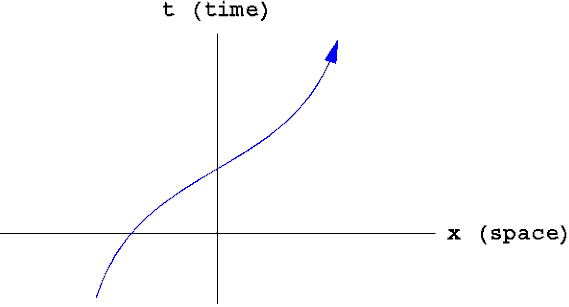
Spacetime diagrams such as the one above are critical to relativity, so you would be helped by playing with them in your mind now to get comfortable with them. For instance, try to answer the following questions before you read on. (The answers are in the next paragraph.)
What's the world line of a particle at rest?
What's the world line of a particle moving with constant speed in one direction?
How would you describe the motion of a particle with the world line shown below?
What does the motion of this particle look like in space rather than spacetime?
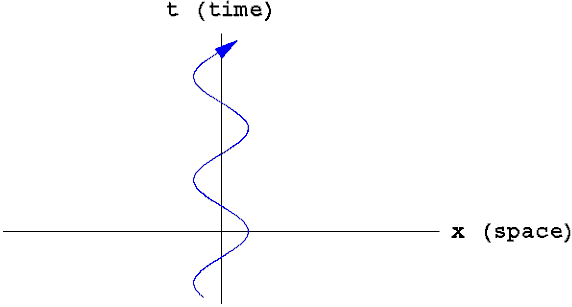
The answers:
The world line of a particle at rest is a vertical line. As time (t) moves forward it always stays at the same position (x).
The world line of a particle moving at constant velocity is a tilted line. In each interval of time, say each second, the position of the particle changes by some constant amount.
Finally, the world line shown above describes a particle that's oscillating, like a mass on a spring. As time progresses the particle moves back and forth periodically.
Understand before reading on.
Viewing space and time this way allows us to formulate physics in a new way. Consider, for example, Newton's first law, which states that an object with no forces acting on it will move in a straight line at a constant speed. Another way to say this is that the world line of a free object (one with no forces on it) is a straight line.
Be careful not to confuse an object's motion in space (its trajectory) with its motion in spacetime (its world line). The latter contains more information than the former. For example, saying that the world line of an object is a straight line tells you not only that its trajectory is a straight line, but also that it is moving with constant speed.
As another exercise, try to picture the world line of a particle accelerating in a straight line. Try to picture the world line of a particle moving in a circle at constant speed. (This last exercise requires two spatial dimensions, and hence a 3D spacetime.)
In Newtonian mechanics the notion of spacetime is unnecessary. You are free to think of space and time as separate things and formulate Newton's laws in terms of the motion of particles or think of them as unified and formulate those laws in terms of world lines. In fact the former description is simpler and easier to work with.
In relativity, however, (both special and general) it is necessary to view spacetime in a unified way. In GR this unified spacetime is curved by the effects of gravity. Newton's first law continues to hold in GR, but in a generalized form: A free particle will move along a geodesic. In the presence of gravity, however, that geodesic will in general be more complicated than a simple straight line.
Gravity
Consider two objects initially at rest. They could be planets, stars, or elementary particles.
Assume that they are far enough away from anything else that they feel no influence from anything but each other.
Assume that they are exerting no non-gravitational forces on each other.
In a Newtonian picture these objects will exert a mutual gravitational attraction, causing them to accelerate towards each other until they eventually collide.
In GR the same effect will occur, but the description will be very different. Because gravity is not a force in GR, the objects neither exert nor feel any non-gravitational forces, the objects should act like free particles, moving along geodesics. (Such an object experiencing no non-gravitational forces is said to be in "free fall," like an object falling towards the Earth with no other forces on it.) In a flat spacetime (= no gravity) the geodesics would be straight lines. In particular, since we specified that the objects started out at rest, their world lines would be vertical lines. In other words they would always stay the same distance from each other.
The objects warp the spacetime around them. Recall that in a curved space, parallel lines do not always stay parallel. In this particular curved spacetime, the geodesics followed by the objects start out parallel but converge over time. Thus the objects eventually collide. The result is the same as predicted by Newton's theory, but the GR explanation is different.
To show how this works more explicitly, I'm going to assume for simplicity that one body is much heavier than the other. For example this could be a description of the sun and the Earth. That way we can ignore the gravitational effects of the smaller body and just consider what spacetime looks like around a single, massive object. The spacetime diagram for this situation is shown below with a couple of geodesics drawn in.
Spacetime around a massive object such as the sun:
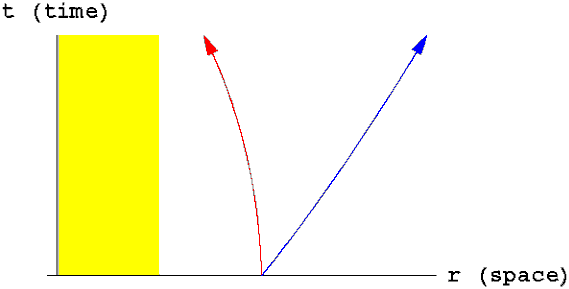
The yellow rectangle in this diagram is the sun itself. The space around the sun is three-dimensional, but the spatial dimension in this diagram is represented by just a line going directly outward from the sun. The spatial axis is labelled "r" (for radius) rather than "x" to remind you that there is only one of the three spatial directions. This means that the geodesics shown are for particles moving directly towards or away from the sun. The full spacetime diagram would also have geodesics corresponding to stable orbits around the sun like those of the planets. (Try to picture what those would look like.) Bearing in mind that only one spatial direction is shown, think about why the sun should appear as a rectangle in the diagram.
The red geodesic shows that an object initially at rest will curve in towards the sun. Even an object initially moving away from the sun could fall back in if it were moving slowly enough. The blue geodesic, however, is for a particle starting out at the same place but with an initial outward velocity large enough that it will never fall back. Such an object is said to have escape velocity.
Excercize: calculate the escape velocity.
In weak gravitational fields with objects moving much slower than light, the predictions of GR are very close to those of Newtonian theory. That had to be true for GR to be a viable theory because we know that to high accuracy Newtonian theory had worked to predict the effects of gravity in many situations. Changing those conditions causes the predicted results of Newton's and Eistein's systems to diverge.
For a deep explanation, including the maths, see next chapter. Without the math behind GR, explanation of why or how these predictions diverge, is too difficult, but the first chapter contains some examples of the new predictions arising from the theory.
More interesting than such numerical predictions, however, are some of the qualitatively new effects that can occur in GR. The next section describes a few of them.