General Relativity 4: Advanced
Source: Gary Felder 2003
http://www4.ncsu.edu/unity/lockers/users/f/felder/public/kenny/papers/gr1.html
For interesting articles on science and maths, also try
http://www.ncsu.edu/felder-public/kenny
A 3rd Way of Viewing GR
There are 3 ways of viewing GR:
- theory of space and time as dynamic quantities that can curve and bend
- a theory of gravity, in which massive bodies cause spacetime to curve and then move in ways that are determined by that curvature
- a theory of physics in arbitrary coordinate systems.
This paper discusses:
General relativity is a theory of physics in arbitrary coordinate systems.
To describe an object's motion we use coordinates (x,y) or (x,y,z), connecting them together with a function such as:
y = x - x2
which might describe the flight of a cannon ball where x is the longitudinal distance and y is the height above ground.
With this function we can plot every point of the trajectory. This cannon ball was fired at our feet and landed 1km away, reaching a maximum height of 0.25km.
If we wanted to include the directions of the compass, we would introduce a 3rd variable, z, where z points, say, north, and x points east. Then the function y = f(x,z) would give us the height, distance and direction.
The variables x,y,z give us the coordinates or distances along a fixed reference frame, meazured along the orthogonal axes:
x-axis, y-axis and z-axis.
Any fixed reference frame is called an inertial reference frame as distinct from an accelerating reference frame or a rotating reference frame. Newton's laws are only valid in inertial reference frames (that is, fixed coordinate systems).
How to choose between Newton and Einstein:
- Use Newton's Laws for:
- low mass
- low gravity
- low speeds
- inertial coordinate systems.
- Use Special relativity (SR) for:
- no gravity
- high speeds
- inertial coordinate systems
- Use GR for:
- gravity
- high-speeds
- non-inertial coordinate systems, such as one that is accelerating or rotating relative to an inertial one.
On Earth gravity is so low that we can walk freely. In this low gravity, Newton's Laws give very good approximations. But very close to the Sun, or near black holes, the gravity is huge, so huge that Newton's Laws are too crude.
On Earth we move about slowly; to us 3,000 m/s seems amazingly fast; and so Newton's Laws give good approximations. Particles in the Large Hadron Collider can be accelerated to speeds near the speed of light, near 300,000,000 m/s, and Newton's Laws are too crude. For such speeds we need more accurate Laws, such as SR and GR.
Special relativity (SR) is a modification of Newton's Laws, but, like Newton's Laws, is only valid in inertial coordinate systems. If gravity can be ignored, then SR is accurate enough.
GR, which describes the curved spacetimes that result from gravity, also applies to flat spacetime (no gravity) if that spacetime is being described in a non-standard coordinate system, such as one that is accelerated or rotating relative to an inertial one.
Special relativity is more accurate than Newton's system when:
- describing how objects move when not affected by gravity
- describing spacetime using an inertial coordinate system.
GR is a generalization of those laws that applies to any coordinate system. But, without gravity, there is always some coordinate transformation to convert a non-inertial coordinate system to an inertial one. Thus the key factor is gravity.
When gravity is present the same laws of GR can be used. In this case, however, there is no coordinate transformation that can make the coordinate system inertial.
A spacetime that cannot be described by an inertial coordinate system is called a curved spacetime.
GR provides a mathematical way of describing the coordinate-free properties of a spacetime. Finally, GR tells how those properties will be determined as a function of the matter inside the spacetime. In the words of John Wheeler: "Matter tells space how to curve, and space tells matter how to move."
When to choose Newton, SR or GR:
- Newton for inertial coordinate systems, for low speeds, low masses, low gravity
such as in our everyday working lives
- SR for inertial coordinate systems, for no gravity, high speed, high mass
- GR for high accuracy on systems having gravity, particularly with high speed and/or high mass, (and it will accommodate any coordinate system).
For low gravity think satellites; for high gravity think stars and galaxies; for high speeds think Large Hadron Collider.
A theory in arbitrary coordinates
The rest of this paper will explain:
- how the laws of physics are formulated in Newtonian mechanics and in SR, with particular attention paid to the role of coordinate systems in these theories
- what it means for GR to be a theory of physics in arbitrary coordinates
- how one goes about formulating laws in such a theory.
- how GR generalizes this description by formulating laws valid in any coordinate system
- the Big Bang Model as an example of how to apply these ideas to a particular situation.
As in most heavy learning:
- at first peruse lightly for an overview
- then read carefully without faltering over difficult concepts
- finally read carefully, pausing to do the exercises.
- if necessary, repeat the 3rd step
- finally, memorize top-down.
To memorize top-down means:
- Step 1: learn a small frame of major points
- Step 2: relearn step 1; learn a larger frame by adding next level of points to first frame.
- Step 3: relearn step 2; expand on Step 2, so each step relearns the previous steps.
- Step 4: relearn step 3; continue till all knowledge is memorized perfectly.
- Step 5: relearn step 4; test, test and test for 6 weeks.
The following text gives firstly a general introduction to the basic ideas, and then repeats this with the detail.
Coordinate Systems in Newtonian Mechanics
The use of a coordinate system was introduced above, but now a 4th coordinate, time, is added, as in (x,y,z,t) to map the trajectory of any object in space-time. The origin of this coordinate system,
x = y = z = t = 0
... might be used to locate the starting point, but not necessarily.
If the cannon is positioned at the origin and fired, the position of the cannon ball from the origin is given by reading x metres along the x-axis, y metres along the y-axis, z metres along the z-axis, and t seconds long the t-axis. If you have difficulty thinking in terms of a 4th axis for time, then imagine there is a stop-watch at each point, each stopped at the instant that the ball passes.
Newton's three laws of motion will work only in a inertial coordinate system, which is a subset of possible coordinate systems: inertial, accelerating, rotating, ... . Any coordinate system in which Newton's Laws hold true, must be an inertial coordinate system.
A coordinate system, once defined, can be used to predict the motions of any particle, provided the forces acting on it are known. These predicted motions for that coordinate system, can be transformed into any other inertial coordinate system by substitution of x' for x, y' for y and z' for z, where:
x = fx(x')
y = fy(y')
z = fz(z').
By generalizing these results, general laws of physics for these coordinates can be formulated.
For instance suppose a new coordinate system is defined in terms of the old coordinate system, such that x, y,and t are the same for each point as they are for your inertial system, while the third spatial coordinate is assigned a new value z' = z + 9t. (The coefficient of t, such as 9, is the velocity measured in the units the coordinate system uses, such as 9 m/s.)
This new set, x',y',z',t', defines a coordinate system in constant motion relative to the original inertial one x,y,z,t.
What do Newton's Laws look like in this new coordinate system ?
Consider F = m.a (Force = mass x acceleration)
Force, as determined by the various force laws (gravity, electricity, etc.), will not change in the new coordinate system. To relate the acceleration in the two systems we note that
d2x'/dt2 = d2x/dt2
d2y'/dt2 = d2y/dt2
d2z'/dt2 = d2z/dt2.
For any object, both F and a will be the same in the new coordinate system as they were in the old one. You can likewise confirm that Newton's first and third laws are unchanged in the new system, so we can conclude that our new coordinate system is inertial. Any coordinate system related to an inertial one by a transformation of the type z' = z + vt will also be inertial.
Suppose, however, that you choose instead to define a coordinate system that is accelerating relative to your old one: with x' = x and y' = y, but z' = z + 5t2 giving the z distance increasing with the square of the time. Once again the forces given by Newton's law of gravity or Coulomb's law will remain the same, as will acceleration in the x and y directions. In the z direction, however,
d2z'/dt2 = d2z/dt2+10
where the superscript 2 indicates the 2nd derivative with respect to time, and 10 = 5x2x1.
We know that:
m.(d2z/dt2) = F
so in terms of the new coordinates we can write:
m.(d2z'/dt2) = F - 10m.
Thus in this coordinate system all particles experience an acceleration due to normal forces such as gravity and electricity plus an additional constant force of -10m in the z' direction. General most coordinate transformations will give extra terms like this in Newton's second law. Such extra terms are called "fictitious forces."
Exercise: Consider starting in an inertial coordinate system and defining a new system where z' = z + t3. What are the fictitious forces in this new system ?
Fictitious forces ?
Are fictitious forces fictitous ?
The implication of this name "fictitious forces" is that the correct description of physics is the inertial one and all other descriptions are simply mathematical fictions. In Newtonian physics this conclusion seems quite natural. From our calculationsin our world around us since the time of Newton, we have seen:
F = m.a
is better than a system in which:
F + F' = m.a
where F is the sum of forces from all other particles
and F' is an arbitrary force acting on everything all the time.
However, are the fundamental laws of physics those laws which describe mechanics on the surface of our Earth, which rotates relative to an inertial system ?
Or are the fundamental laws those which describe what is seen floating freely in space ? The former are simpler and more elegant, but when we need GR there are no inertial systems and no coordinate-dependent set of laws, that is, the former cannot be used and therefore cannot be the more fundamental.
Coordinate systems in SR
Understanding how special relativity (SR) alters the Newtonian notion of inertial coordinate systems will help to understand the role of coordinate systems in GR.
SR is very much like Newtonian mechanics in certain ways. Like Newtonian mechanics, SR gives you a set of laws for predicting the motions of particles subject to arbitrary forces. As with Newtonian mechanics, these laws are only valid in a special class of coordinate systems, the set of inertial coordinate systems.
There are essentially two differences between Newtonian mechanics and SR:
- the laws of SR are more complicated.
Examples:
- when an object accelerates from rest it will contract
- an arbitrarily large force can never accelerate a particle above the speed of light
Once you have defined an inertial coordinate system you can use these laws to predict the motions of particles. (See Physics chapters on Mechanics.
- the transformation between inertial coordinate systems is more complicated in SR than it is in Newtonian mechanics.
Remember that the laws of physics in any coordinate system apply in all others, because any inertial coordinate system can be transformed into any other inertial coordinate system. Suppose, then, that we try to repeat the calculation we discussed in the previous section. We start with an inertial system, where we know the laws of physics, and we define a new system such that at each point:
x' = x, y' = y, t' = t, and z' = t2+4t.
This time we will find that the new system is not inertial. The laws of physics in this new coordinate system are different, and more complicated, than the laws were in our inertial coordinates. For example we will find that in these new coordinates particles do sometimes have a coordinate speed dz/dt that is greater than the speed of light. If we play around enough, however, we will find that there is a particular set of transformations you can apply to an inertial coordinate system, known as a Lorentz transformation, that will generate a new coordinate system where the laws of physics have their usual, special relativistic form.
How do we formulate physics in some other coordinate system, such as one that is rotating or linearly accelerating relative to the first one ? In Newtonian mechanics, the result is simple. Newton's second law remained unchanged except for the addition of some new terms to the left-hand-side. In SR the result iscomplicated, but such a description must be possible since coordinates from an inertial system can always be transformed to make predictions in any other coordinates.
The maths of GR is needed to describe a relativistic world in any coordinate system.
GR and coordinate-independent physics
We need GR because GR is a theory of gravity.
Gravity is described in GR as a warping of spacetime.
Thus in the presence of gravity there are no inertial coordinate systems.
The rest of this section will be a discussion of that statement and its consequences.
The need for coordinate-independent laws
Suppose you set up a coordinate system for a certain region in space, and then test the laws of physics but find that they are not the laws of SR. So you apply some coordinate transformations. If gravity is negligible in this region, then you will find a set of transformations that will give you a coordinate system where SR holds. If there is a gravitational field present, however, you will not be able to find any such transformation.
(There is always a gravitational field present, but if it is sufficiently weak you might not be able to detect any deviation from the laws of SR or SR might be sufficiently accurate for the task in hand.)
Thus the laws of GR must be formulated in very differently to the laws of Newtonian mechanics or SR. In both of those theories we wrote down laws for how the coordinates of a particle would behave. For example, Newton's first law states that for a free particle, acceleration along any axis is zero:
d2x/dt2 = d2y/dt2 = d2z/dt2 = 0.
These laws are then taken to be true for a certain class of coordinate systems, i.e. inertial ones, and physics in any other coordinate system is then derived from that. That there are no inertial coordinate systems in the presence of gravity means the behavior of the coordinates cannot be devised in any particular special set of coordinate systems.
Instead the laws of GR must be written in a coordinate-independent way.
They still tell you how to calculate coordinate-dependent quantities like x(t), but they do so in a way that is equally valid for any coordinate system.
Any calculation requires some defined set of coordinates. If there is no gravity then this coordinate system may or may not be inertial; if it is inertial the laws reduce to those of SR. If there is gravity the coordinate system definitely will not be inertial. Spacetime must be defined in this coordinate system. Given that characterization, GR can then tell you how to write down the laws of physics in a way appropriate for that particular coordinate system.
The next section thus describes the main tool used in GR for characterizing a spacetime. It is called a metric.
The Metric
The Metric characterizes Spacetime in a particular coordinate system.
Definition: A metric is a mathematical description of spacetime in terms of a particular set of coordinates.
Roughly speaking, the metric tells you how to find the distance between any two points. For example, in a two-dimensional Euclidean space the distance ds between two points is given by
ds2 = dx2 + dy2
where 'd' indicates a change in distance; dx is the change in distance parallel to the x-axis or the x-component. This formula is a version of Pythagoras Theorem.
The metric represents this information in the form of a tensor (a generalized form of vector involving 2 or more directions for each of its components).
Think matrix with the rows and columns representing the different coordinates, say x and y, with the elements giving the coefficients of these coordinates in the distance formula.
For example, for the metric g (which is the usual convention) then g11 and g12 in this example would be the coefficients of dx2 and dxdy respectively. In this case they are one and zero.
The entire metric for this case is:
 (Normally when metrics are written out in matrix form you won't see the labels for the rows and columns, x and y in this case, but these are included here for clarity.) Polar coordinates give the distance as:
ds2 = dr2 + r2df2.
The metric for this coordinate system is:
 This is the same metric as the one described above for x and y. By that I mean that if you pick any two points in this space either distance formula will give you the same answer. If you write down two metrics such that you can find a coordinate transformation that goes from one to the other, then they are simply different ways of describing the same space (or spacetime). You can get a feeling for how this works by working out the metric for a more complicated coordinate system.
For example, if x' = x2 + y2, y' = y, the metric in these new coordinates looks like:
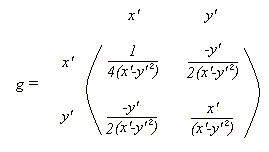 A quick note about notation:
Technically speaking, the matrix g is the metric. Nonetheless, it clearly contains the same information as the distance formula, just written in a different form. For that reason physicists often say they are writing the metric when they write the formula for ds2. This practice will be followed below.
SR and the Spacetime Interval
After all this effort, you may be disappointed to see us going back to SR again. Nonetheless, in order to understand how GR describes physics in terms of the metric it is easiest to start with the simplest case, namely an inertial coordinate system. Since SR is simply a special case of GR, namely the case where there is no gravity and you use inertial coordinates, there must be a metric to describe this case. In fact the metric for SR is:
ds2 = dx2 + dy2 + dz2 - c2dt2.
(Some authors make the spatial components negative and the time component positive. This is purely a matter of convention and makes no physical difference.)
This metric looks strange because although spatial distances normally use Cartesian coordinates, this metric shows that the squared distance between two events occurring at the same place but different times is actually negative. Mathematically this means that ds is not a real distance but a convenient quantity that shares some of the properties of a distance function. In practice ds2 is more useful to work with than ds itself. ds is often called the spacetime interval (for consistency with the usual definition of distance).
For any two events this interval gives 3 alternative states:
- positive
then the separation is spacelike
- negative
then the separation is timelike
- zero
then the separation is lightlike.
It can only be zero between two events if their spatial distance = time between them x speed of light.
In other words a light beam emitted at one event will exactly reach the other one.
Such events are said to have a lightlike separation.
From the discussion of light cones in the previous paper the causal structure of spacetime can be summarized by saying that one event can cause another only if the separation between the two is timelike or lightlike. That is equivalent to saying one event lies on or inside the future light cone of the other.
What makes such a description useful is that it is valid in different coordinate systems. To claim that the metric above is for SR is true only if the metric were the same for any inertial coordinate system.
Exercise: (Find Lorentz transformations are on the Internet.) Show that a Lorentz transformation on the coordinates x and t, leave this metric unchanged:
ds2 = dx'2 + dy2 + dz2 - c2dt'2.
GR uses the term 'spacetime interval'. For any two points, the interval is the same in any coordinate system. In other words a transformation from one coordinate system to another recalculates the metric components such that the interval between any two points remains the same. This happened above when switching from Cartesian to polar coordinates. The components of the metric looked different in the new coordinates, but the result was the same.
The relationship between SR and GR can be stated in yet another way. In GR any spacetime in any coordinate system is described by specifying the components of the metric. The laws of physics applicable in that coordinate system are then given in terms of those metric components. Changing coordinates gives new metric components and equations that look different, but all physically measurable results must come out the same. If and only if there is no gravity acting, will a coordinate transformation put the metric in the form:
ds2 = dx2 + dy2 + dz2 - c2dt2.
The laws of GR for this particular metric, will be the laws of SR. In cases where there is gravity no coordinate transformation will get the metric into this form (see below).
The Law of Inertia
The Law of Inertia is Newton's first law.
All objects with mass, have inertia, that is, to change their velocity (speed and direction) requires the application of a force. An object sitting still requires a force to give it speed. To make a moving object change direction or speed or both requires a force.
A geodesic was previously defined as the path of shortest distance between two points (x,y,z) and (x',y',z'). The term geodesic also applies to the time dimension.
A geodesic in GR gives the shortest spacetime interval between points (x,y,z,t) and (x',y',z',t').
In an inertial coordinate system the geodesics are simply straight lines. For most coordinate systems the geodesics will be more complicated, but the metric gives you all the information you need to find the geodesics in your space. The metric tells you the interval ds2 between any two nearby points, and by integrating that quantity along any path you can find the total interval along that path. You can then find a formula for the path with minimal interval. To do this in arbitrary coordinates is somewhat tricky in practice, but the problem has been solved and there are formulas worked out for how to write down the geodesics in any coordinate system provided you know the metric.
The law of inertia, Newton's first law, can now be generalized to say that in any spacetime, described in any coordinate system, free particles will move along geodesics.
In flat spacetime the geodesics are lines of constant velocity, in an inertial coordinate system. With spherical coordinates or accelerating coordinates or some strangely warped coordinate system, dx/dt does not usually remain constant along geodesics. Nonetheless if the spacetime is flat a coordinate transformation can always be made to a set of coordinates where all free particles move along paths with dx/dt, dy/dt, and dz/dt all constant.
However, if there is gravity acting in spacetime this cannot be done. If coordinates are assigned to all points in spacetime and the paths of free particles measured, those derivatives will not be constant, and no coordinate transformation will make them so.
Physical results do not depend on your choice of coordinates. The equations for geodesics, i.e. paths of free particles, look completely different in different coordinate systems, yet any given geodesic will still be comprised of the same set of points in spacetime no matter what coordinate system I use. The choice of coordinates is just a choice of how to label those points.
The law of inertia illustrates that the laws of GR are coordinate-independent. To apply this law and make calculations it is necessary to specify a particular coordinate system. Nonetheless the law itself can be stated in a general way that is equally valid for all coordinate systems.