The Einstein Equation
There are other laws in GR that describe how particles move in response to non-gravitational forces, and with the law of inertia in the previous chapter, these laws form the GR generalization of Newton's Laws of motion. Given a particular metric and a known set of force laws, these laws tell you how particles will move. In addition to these, however, GR has a new law that tells you how the metric itself will evolve in response to the matter inside it. This law is called the Einstein Equation:
Gij = 8p(G/c4)Tij
Although this equation looks elegantly concise, opening it to see what this equation means is complicated. Recall that the metric is a tensor, an object that is represented by a 4x4 matrix because there are four spacetime coordinates (x,y,z,t).
The main components are:
- Gij
Gij is called the Einstein tensor, a new 4x4 matrix formed out of different time and space derivatives of the metric components. (Tensors are often written with subscripts like this, which indicates their components. For example G00 is the upper left entry in the matrix for the Einstein tensor.)
- Tij
Tij is a tensor called the energy-momentum tensor, made out of different properties of the matter and energy in your space (density, pressure, various shears, etc.).
If you know all about the matter filling your space, the Einstein equation tells you how the metric components will evolve.
Note that this is a tensor equation, meaning it sets each of the components of the Einstein tensor, proportional to the corresponding component of the energy-momentum tensor, so in reality there are 16 Einstein equations. In practice they are never all independent, and for spacetimes with a high degree of symmetry such as cylindrical or spherical symmetry, there are often only a few independent components of the Einstein equation.
Just as GR's law of inertia reduces to the Newtonian one in the limit of a flat spacetime, so too the Einstein equation has a Newtonian parallel. In regions where gravity is very weak, meaning the spacetime is nearly flat, and all objects are moving much slower than the speed of light, the Einstein equation can be shown to reduce to Newton's law of gravitation.
What this means is the following: Say you have two light objects far away from each other and moving slowly. You can use the Einstein equation to find the metric for this spacetime. The metric components will be different for different coordinate systems, but you can define a coordinate system in which the metric looks like the SR metric (i.e. flat) plus small corrections. If we assume these objects experience no non-gravitational forces, then we can calculate their motion simply by finding the geodesics in this spacetime. Doing so we will find that they accelerate towards each other at a rate given by
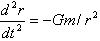 where m is, for each object, the mass of the other one. This is precisely Newton's law of gravitation. Thus GR automatically reproduces all the successful predictions of Newtonian gravity.
For situations where relativistic corrections become important, such as in strong gravitational fields and/or speeds near the speed of light, the predictions of GR differ from those of Newtonian gravity. In every case that has been tested the predictions of GR have been shown to be correct.
Example: the expanding universe
Consider the large-scale behavior of the universe, simplified by a few useful assumptions:
- the universe is homogeneous
Both the spacetime and the matter/energy inside it, is exactly the same everywhere.
- the universe is isotropic
Every direction is indistinguishable from every other one.
Of course we know that neither assumption is correct but observations indicate that these approximations work well when averaged over large areas, ignoring local variations like stars and galaxies.
If we want to write a metric for such a spacetime there are very few possibilities. We should treat x, y, and z on an even footing to ensure isotropy, and none of the metric components should depend on space to preserve homogeneity. Neglecting cross-terms such as dxdy, the most general way to write such a metric is
ds2 = a2(t) (dx2 + dy2 + dz2) - b2(t) c2 dt2.
In fact this formula can be simplified further without any loss of generality by redefining a new time coordinate
tnew = b(t) t,
which eliminates b(t) in the metric. Just to simplify the equations I'll use t from now on to mean the new time I just defined, so the metric can now be written as
ds2 = a2(t) (dx2+dy2+dz2) - c2 dt2.
This metric is known as the flat Friedmann-Robertson-Walker metric. Technically this metric is not the most general possibility for a homogeneous, isotropic spacetime, because the cross-terms have been deleted.
If the chosen spacetime is homogeneous and isotropic then it is possible to find a set of coordinates such that the metric is independent of space, and symmetric in all the spatial coordinates. Compare this with saying 'a spacetime has no gravity = there is an inertial set of coordinates'.
The properties of spacetime are the same irrespective of the coordinate system used. The physical properties of the spacetime, however, limit the possible ways you can write the metric. [Read again and again - important.]
Returning to the flat FRW metric, note that no possible coordinate transformation will change the form of this metric into the SR metric. Suppose for example that we tried to do this by defining new coordinates x'=a(t) x (and likewise for y and z). That would set the coefficients of dx2, dy2, and dz2 to one, but it would also introduce new cross-terms such as dxdt. You can try playing around with this for a while and I think you should be able to convince yourself that unless a(t) is a constant you can not reduce this metric to an inertial one.
The nature of the spacetime described by this metric depends on the behavior of the function a(t), which at any given moment could be increasing, decreasing, or constant. For now let's focus on the first case, where a is increasing with time. In that case this metric describes an expanding universe. We know that because the metric tells us how to compute distances between points, so if a is increasing with time then the distance between two points x1 and x2 is getting larger.
To go further we could use Einstein's equation, which relates the metric components to the matter and energy in the spacetime. If you make certain assumptions about the matter filling space (for the experts, you assume it's a perfect fluid), the equation becomes particularly simple. Since this example is so highly symmetric, there are only two independent Einstein equations:
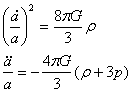 where dots indicate time derivatives and r and p are the energy density and pressure of the matter respectively. The most important thing to note about these equations comes from the first one. Assuming there is any matter in the universe, a(t) can not be constant. In other words a flat FRW universe must either be expanding or contracting. The prediction that the universe cannot be static was one of the most startling early results of GR.
We could continue discussing the properties of this spacetime. Given this metric, for example, you could find the geodesics to see how free particles would move, or you could find the light cones, which tell you about the causal structure of the spacetime. My purpose with this example, however, was simply to illustrate the basic idea of how you can use a metric to describe a given physical situation. Another example, which I won't discuss in any detail, is the spacetime around a spherical object like a star. By assuming the spacetime is spherically symmetric and static you can narrowly define the space of possible metrics, much like we did here. Similarly, you can study more complicated situations like spinning stars (which are no longer spherically symmetric) or collapsing stars (which are no longer static). For each of these cases, you can write down a form of the metric valid in some coordinate system. Once you know the metric, you know everything there is to know about the spacetime.
Conclusions
The first paper in this series said what GR describes as a theory. Specifically, it characterized GR as a theory of space, time, and gravity. The goal of this paper was to say, at least in conceptual terms, how GR describes those things. To summarize that description, I can first note that in Newtonian physics space and time were assumed to be absolutes and the goal of physics was to characterize the behavior of matter. To do this you first needed a way to characterize the state of the matter.
If you were dealing with particles this characterization could entail specifying the positions and momenta of all your particles. If you were describing a fluid you could characterize it by giving its density, pressure, and velocity at every point. In either case you then wrote down a set of laws telling you how those quantities would evolve over time. Those laws were only valid in inertial coordinate systems, but you could always find such a system and use it to do your calculations.
In GR you still have matter and you can describe it in much the same way as before. In addition, however, the spacetime itself is now dynamic and requires characterization. You achieve this by specifying the metric, which is to say the formula for the interval between any two points in spacetime. The component description of the metric will be different in different coordinate systems, but always in such a way that the interval between two spacetime points is the same regardless of the coordinate system being used. The laws of GR then tell you both how the matter will evolve in this metric and how the metric will behave in response to the matter inside it.
Assuming no non-gravitational forces are acting, these equations will be sufficient to determine the future evolution of the system from any initial starting point. (If there are other forces then you have to use the appropriate force laws as well, just as you did in Newtonian physics.) This procedure works equally well in any coordinate system. In a spacetime with negligible gravity, however, you can find a coordinate system where the metric, and thus the laws of physics, reduce to the relatively simple forms they have in SR.
One law of SR that holds even in the presence of gravity, is that the speed of light is the upper speed limit for all particles. No matter what the spacetime is like, both SR and GR state that the speed of light is an absolute limit. Particles always move along timelike or lightlike curves, so any two events outside each other's light cones cannot be causally connected. (If you're dealing with fluids instead of particles then you say that wave fronts move along timelike or lightlike paths. The basic conclusion, namely that spacelike separated events can not influence each other, remains valid.) Note that you can always choose coordinates where the coordinate speeds, e.g. dx/dt, are greater than c. However fast you may be moving in those coordinates, however, a light beam shining ahead of you will be moving even faster. Put in simple physical terms, nothing cannot go faster than light. The speed of light is the maximum speed attainable in the universe. As such it is a Universal constant.
GR is often called a geometrical theory of gravity. Rather than viewing gravity as a force, GR describes it as an interaction between matter/energy and the geometry of spacetime. Meanwhile, the other forces like electromagnetism are still viewed in essentially the same way as before. They now act in the geometry defined by gravity, but otherwise they are still treated as pushes and pulls that particles exert on each other.
Many people, including Einstein, have found the geometrical description of gravity so compelling that they have tried to come up with similar descriptions of the other forces as well. Thus far all such attempts have failed. Nonetheless, GR has brought geometry into physics as a dynamical quantity.