Marginal utility 1

The sections down to and including "Marginal utility and risk" should be clearly understood.

REWRITE

I am unsure about the wisdom of that part of this chapter which explains marginal utility:
How does this affect you ?
Perhaps you might choose to skim-read the "marginal utility by numbers" until reading a paper where someone else uses it.
Skim-read the "marginal utility by preferences" remembering that surveyed preferences and cash register sales give different results. Furthermore you can live on sales but not on surveys.

My attitude is that you need to understand how 'marginal utility' affects preferences and preferences affect aggregate demand, but the mathematics seems irrelevant to company management. Does any company manager ever use it ?

If you are new to this it would help you to learn the vocabulary by reading aloud, but mull over each sentence till you understand it before proceeding to the next.

Glossary

Utility: is the usefulness (how useful is $5's worth of oranges to you ?)
or:
Utility: is the relative usefulness (Which would you rather have, $5 oranges or $5 apples ?)
Margin: at the edge
Marginal utility: is the relative usefulness of the extra unit you buy.
Marginal utility: is the additional satisfaction a consumer derives from the consumption of one extra unit of a product. (Having eaten 3 vanilla slices what would you pay for one more slice ?)
Equimarginal Principle: To maximize utility for a given income, allocate spending to give equal MU/P for each item. (MU/P = marginal utility per unit cost)
Opportunity cost marginal utility per dollar afforded by other goods or services.
This opportunity cost is often called "the marginal utility of money" or the "marginal utility of income." To me, marginal utility of money = the maximum utility I can get by having one more dollar.
Marginal utility of income: is the maximum utility I can get by having one more dollar in income. (... is the opportunity cost of an additional dollar spent on any other good or service).
Maximizing preference: is the choice a rational consumer makes to maximize her preferences within the limit of her budget.
Marginal benefit curve: = the individual demand curve. When a person's income or wealth drops, their demand for most goods and services will decrease and their preferences will shift to cheaper substitutes.
Indifferent alternatives: = When two alternatives come up with the same ranking, we say the consumer is "indifferent" between them, and that the two alternatives are "indifferent choices" or "indifferent alternatives."
Indifference curve: = "indifference curve", which is a linking of all the combinations of goods and services that come up with the same ranking in a person's preference ranking.

Marginal utility, example

Marginal utility: = relative usefulness of the extra unit you purchase.
If you have just bought $100's worth of oranges, and have $5 left, how badly do you want another $5's worth of oranges ?
The $5 is your margin.
'How badly you want them' is your marginal utility for oranges.
'How badly you want them' is your marginal utility for oranges, when you already have $100's worth.
Which is different to your marginal utility for oranges, when you have $10's worth or none at all.

Let us convert from dollars to kilograms.
If you have zero kilograms of oranges, how much would you pay for 1kg ? For a balanced diet we should eat 2 fruit per day so I am prepared to pay up to $3.00/kg for oranges.
But if I already have 3kg of oranges at home, I would not buy more unless the price dropped to $1.30 per kg. At that price I can afford to eat oranges, not for merely a balanced diet but also for pleasure.
So the price drops to $1.30, so I buy another 3kg. I now have 6kg of oranges. That is a lot of oranges.
I would not normally sit down and eat four oranges at one sitting but could make a juice drink from 4 oranges. But that is such a luxury, beyond my budget, I would do that only if the price dropped to $0.50/kg.
If the price goes up to $4.00/kg then I look for alternate fruit, such as lemons, grapefruit, bananas.
If the price goes up to $5.00/kg then I skip fruit till the price comes down. At this price I am better off taking vitamin pills as a short-term substitute. Let us sum this in a table.

Price/kgBuyPurpose
$0 - free
$0.50
$1.30
$3
$4
$5
10kg
10kg
5kg
3kg
1 orange
0
There is a maximum I can eat without suffering.
Juice + salads + eat singly
salads + eat singly
eat singly
I look for cheaper alternative fruit
I substitute vitamin pills for fruit.

From this you can see that the marginal utility of oranges varies with: ** A clothing manufacturer might switch from wool to cotton to polyester, rayon or nylon.
Other factors may be involves such as cultural conditioning, allergies, ability to make substitutes (or grow them), and lots more that you will think of.

Another example

Suppose we have $105. Let us spend $100 on rice. We have $5 left. Do we spend that last $5 on more rice or on something else ?
This $5 is at the edge of our spending, that is, at the margin. The $5 is our marginal spending.
We could spend this $5 on a chicken, but if we spend this $5 on rice we have to forego our chicken. Just between you and me, I would like some chicken on my boiled rice.
We can either increase our rice (from $100 to $105) and decrease our chicken (from 1 to 0), or
decrease our rice and increase our chicken.
The marginal utility of $5 of rice = 1 teaspoon of extra rice per meal ($100's worth of meals)
The marginal utility of $5 of chicken = 2 meals of boiled rice with chicken.
For me the marginal utility of the $5 chicken is far greater than the marginal utility of $5 rice. So I buy the chicken.

But if I had $100's worth of chicken, and no rice, then the marginal utility of $5 rice would be far greater than the marginal utility $5 extra chicken.
I would buy the rice.

If I had $50 of rice and $50 of chicken, then, because rice is my food staple, I would buy $5 rice.
At 50:50 the marginal utility of chicken is far less than the marginal utility of rice.
For me, not until I have $80 rice to $20 chicken, would I have difficulty choosing. Therefore not till then, does the marginal utility of chicken equal the marginal utility of rice.

Definitions

Marginal utility: the additional satisfaction a consumer derives from the consumption of one extra unit of a product.
Thus, an individual's demand for a product is determined not by the total utility of it but by its marginal utility.
Therefore, the greater the supply of a product, the smaller its marginal utility.

The consumer's decision is not an all-or-nothing one.
Instead, it is a decision to buy or not to buy just one more unit.
That means it is a mistake to look at the total utility of the two goods as the basis for demand. The total utility is irrelevant to the decision to buy or not to buy one more unit of the good.

What is relevant to any decision to buy, is: If you spend your last $5 on oranges, you cannot spend it on bananas. So you gain oranges but lose bananas.
Or you could buy bananas but lose extra oranges.

In Tasmania apples are so plentiful, people give them away to neighbours. When I was in Malaysia, the same apples were so expensive that a family would buy one as a Sunday treat and divide it between all members of the family. For the same price they could have feasted on Malaysian fruits. Obviously the marginal value of common fruits is much lower than the marginal value of rare fruits.

When I was backpacking along a road in the hills, a Malay stepped out of the rainforest, carrying 2 large branches of rambutans, gave me one with a cheery smile, and walked on. Back in Tasmania, those rambutans are too expensive for me to buy, yet in Malaysia this generous Malay was giving them away. Again, the marginal utility of common fruits is much lower than the marginal utility of rare fruits.

So we should not look at the total utility but at the "marginal" utility.
Marginal utility: is the increase in utility that one more unit brings.

Thus, when you go into business, it might be useful to remember this rule.

Marginal utility and risk

Risk

Given that all businesses should initiate projects that lead to gaining an advantage over the competition, and given that each project carries risks of failure, risk becomes a major factor in determining marginal utility of projects. What is risk ?
 
Risk = probability of failure x cost of failure
Case 1Case 2
Probability of failure = 5%
Cost of failure = $100,000
Risk = 5% * $100,000 = $5000
Probability of failure = 0.1%
Cost of failure = $1,000,000
Risk = 0.1% * $1,000,000 = $1000

Case 2 carries 10 times the cost but its risk is one-fiftieth of the risk of Case 1.
Given equal outcomes, choose Case 2.

Cost of failure = cost of resources used + cost of not having completed alternative.
Cost of not having completed alternative = money lost by not having the alternative completed.
Example: Deposit savings of $1000 in the bank for one year at 1% interest.
Let us guess the risk of bank failure leading to loss of deposit = 0.000001 (1 in 1 000 000)
Risk = 0.000001 x $1000 = $0.001

Invest the same money, $1000, with a venture company offering 20% interest. Such a high return warns us that the risk is high. Let us guess from this company's previous list of successes and failures that the probability of failure is 10%, that is, one in 10 ventures fail.
Risk = 0.10 x $1000
Risk = $100
Which risk do you prefer:
Every investment is a risk, whether the government pretends to guarantee it or not (government banks in the past have closed their doors on depositors trying to withdraw), so you should always balance risk against return, to your satisfaction. Do not trust your broker or fund manager. (Witness the number of Shire and County Councils, and banks, around the world, who have lost millions totalling billions, on CDOs and sub-prime mortgages in 2009 because they did not research the risks.)

Marginal Utility and Demand

The marginal utility approach resolves the "paradox of diamonds and water." There is no paradox: the scarcer good, diamonds, have the higher marginal utility, even though water gives the greater total utility. This opens the way to develop a theory of demand based on utility. But we aren't there yet.

Demand is a relation between money price and quantity purchased. So far, using our example, we have seen why a person might give up a large amount of water to get a diamond. That's not quite the same as giving up a large amount of money for a diamond. So one step we need to take is to translate from the barter of goods for goods to the exchange of goods for money. Let's check that out, next.

From Utility to Benefits

Now let's take a closer look at the idea of maximization of utility, and see in a little more detail how to make the transition from utility, in undefined subjective units, to benefits, measured in dollars.

Table 3: Total Utility
BuyBurgersCoke
1
2
3
4
100
150
170
180
65
75
80
80
As a start, we will look at the cokes and burgers example in terms of utility. Let's suppose that Joe is going to lunch, thinking of eating burgers and drinking cokes. Here, for the example, are Joe's utility numbers for cokes and burgers.

Looking at the table, we see the quantity of burgers or cokes in the column at the left, and the total utility gained from consuming that quantity of burgers in the second column, and from that quantity of cokes in the third column. There is a hidden simplifying assumption here -- we are assuming that the utility of burgers doesn't depend directly on the consumption of cokes, and vice versa. That's unrealistic, of course, but making the example realistic would mean we would have to use calculus to go through it -- and we would come out with the same answer, for our trouble. So we will go ahead with the simplifying assumption.

With that in mind: suppose that Joe consumes two burgers and three cokes. (OK, Joe is really hungry!) How much utility would that give him? The burgers give 150 units of utility and 3 cokes give 80 units of utility, for a total of 230 units of utility. But Joe can do better than that.

Marginal Utility of Cokes and Burgers

The idea is that people act "as if" they were maximizing the utility they get from spending their limited income on burgers and cokes. In other words, they try to "allocate" that limited income between burgers and cokes efficiently -- in such a way as to give the greatest utility. We remember that "marginal" approaches have a lot to do with efficient allocation and maximizing anything. So, we will want to figure the marginal utilities of burgers and cokes.

In order to "maximize", our rational consumer will need to get the most out of every dollar spend. So we will also compute the quotient of marginal utility divided by price, that is, the marginal utility per dollar spent on burgers and cokes. We will assume that a coke costs $1 and a burger costs $2.

Table 4: Marginal utility / Price
BuyBurgersCoke
 Total
utility
Marginal
utility
MU/PTotal
utility
Marginal
utility
MU/P
0

1

2

3

4
0

100

150

170

180

100

50

20

10


50

25

10

5

0

65

75

80

80

65

10

5

0


65

10

5

0


For example, we see that when Joe goes from one burger to two, that increases his utility from 100 to 150 units, so his marginal utility is 50. But since the burger costs him $2, he is increasing his utility only by 25 units per dollar spent.

Optimum Spending

Let's use that information to answer the following question:

Suppose a consumer has $8 to spend for lunch, utility described by tables A1 and A2, and wants to maximize the utility of lunch. How many burgers and how many cokes would he buy?

We can think it through this way: The first dollar will bring 65 units of utility if it is spent on a coke, only fifty if it is spent on a (half of) a burger, so the consumer will buy at least one coke.

The second coke will yield only 10 units of utility, though, whereas $2 spent on burgers will yield 50 units per dollar for the first burger and 25 per dollar for the second burger. So at least 2 burgers will be bought.

That leaves $3. These will yield 10 units of utility per dollar on either good, so the consumer will purchase a third burger and a second coke for the last three dollars. The total utility of 245 units cannot be improved upon.

Equimarginal Principle

The "optimal" number of burgers and cokes is a combination such that the quotient MU/P is the same for each of the goods purchased.
 
MUburgers
  Pburgers
=MUcoke
  Pcoke

That is, a dollar gives the same MU/P regardless of which good it buys.

This is an instance of a very general principle in economics, called the equimarginal principle.

Equimarginal Principle: To maximize utility for a given income, allocate spending to give equal MU/P for each item.

Opportunity cost

opportunity_cost.gif not found Suppose we have $1, and it can buy a dollar's worth of bananas, or oranges, or papaya, or avocado, which dollar represents the best value ? Supposing we choose avocado. Which is next best ? Suppose the next best is papaya.
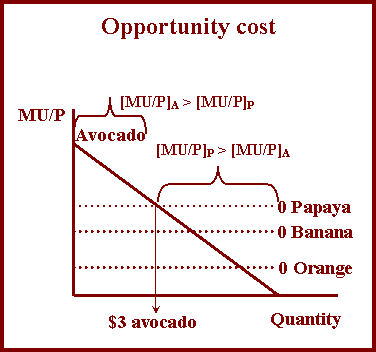
[MU/P] avocado > [MU/P] papaya.
We cannot have both, so the opportunity cost of having avocado, is a dollar's worth of papaya.

Opportunity cost = marginal utility per dollar afforded by other goods.

Suppose we have $10.
We buy $1's worth of avocados and go to spend the next dollar.
On more avocado or on papaya ?
Again we choose avocados.
Now we have $2's of avocados and go to spend the 3rd dollar – avocados or papaya ?
After $3's of avocados, we decide that now papaya is the best buy.

Up to $3's of avocado,
[MU/P] avocado   >   [MU/P] papaya.
With $3's of avocado,
[MU/P] papaya   >   [MU/P] avocado.

We kept spending on avocado until the marginal utility per dollar spent on avocado is less than the opportunity cost of papaya.

In the graph, the MU/P decreases for any given price, because the marginal utility decreases with quantity procured (diminishing marginal utility). Thus the graph of MU/P for avocado decreases with increasing quantity bought. The other lines are horizontal because none of these have been bought yet, so the MU/P remain constant. Where the diminishing avocado line strikes the zero papaya line, that is the time to switch to buying papaya. After this point the MU/P for papaya exceeds the MU/P for avocado.
This leads us back to the equimarginal principle: spending on avocado will increase until the marginal utility per dollar spent on avocado diminishes to the opportunity cost, that is, the marginal utility per dollar spent on papaya.

You should discuss the equivalent episodes for bananas and oranges.

You will have noticed that eventually MU/P for avocado diminishes to zero. There is a limit to how many we can use before they go rotten.

The line does not have to be straight. The line might curve as it drops to zero or it might suddenly dive vertically to zero. For example, an owner of a garage will desperately want a lathe or a welder, but will have no use for two of them. They would lie unused and take-up valuable space.
[MU/P]welder=0   =   [MU/P]welder=1   =   0

We could choose not to spend. We could save our money. Why ? Saving is not an exception to the concept of opportunity cost. If we save a dollar, then we put that dollar either into the bank for interest or into shares for dividend. That interest or dividend must promise a greater MU/P than anything else on offer.)