War for oil ?
Part 1 – Intro
There is, in 2009, enough evidence to show, conclusively, that the 2003 invasion of Iraq was an illegitimate war for oil instigated by President George W Bush of the US, drawing in the Prime Minister Tony Blair of the UK, and that toadie Prime Minister John Howard of Australia.
An attack on a sovereign state is a crime. This was made clear in the UK by:
- Britain's chief law officer and attorney general, Peter Goldsmith, before he broke under pressure
- by the Foreign Office's own legal advisers
- by the UN secretary general
- by the UN charter.
Contents
Part 1 Intro:
- The Presidency
- Introduction
- Iraq's Oil Reserves
- The truth
- Importance of Iraqi Oil to the U.S
- History 1912 - 1972
- Saddam tricked by Bush Snr
- Machiavelli rules, OK ?
Part 2 Well-oiled politicians:
- Was Bush elected with oil money ?
- Do donations bring influence ?
- Bush's links to oil
- Iraq oil for Iraqis ?
- Post-war contracts
- Bush saves US oil profits
- Bush saves Osama for his "War on Terror"
- 8 lies by Bush
- The real oil
- Pipelines to China
- U.S. Department of Energy
- CIA on oil
- UNOCAL
- More pipelines
Part 3 All the world's a stage:
- Bush and Cheney in bed with Halliburton
- Richard (Dick) Cheney
- Alan Greenspan
- Exclusion
- Paul Henry O'Neill, Secretary of the Treasury
- Wolfowitz
- Unconfirmed
- Hans Blix
- Corporate censorship
The Presidency
When a 'Mafia' (crime family) dynasty, greedy for wealth, kills 10 people, there is a national outcry.
When the Bush dynasty, greedy for wealth, kills 5000, there is silence.
The US Presidency, backed by the power of the CIA, FBI and military, and financed by the taxes on the poor, provides a licence to invade, to steal, to kill, to corrupt, to provide billion $ contracts in return for favors, while avoiding the retribution of law. Little wonder then that organizations, capitalist in nature but criminal in intent, provide the funds to mount presidential campaigns.
What oily Halliburton was for Bush and Cheney, so greasy Goldman Sachs was for Obama and Hillary Clinton. Both corporations were rewarded handsomely for their electoral donations; Halliburton with oil fields and billion dollar contracts in Iraq in 2003, and Goldman Sachs with a huge rescue package in 2009. The cycle is never-ending. Such is the pretense of democracy.
Introduction
Iraq has the world's largest total reserve of oil in the world (some sources say second largest after Saudi Arabia or even third largest).
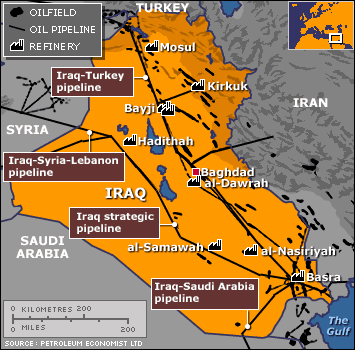
To enlarge images and text, hold [CTRL] + click [+/=] several times.
These figures have not been confirmed so please verify before using them.
(Try: http://tonto.eia.doe.gov/dnav/pet/pet_move_impcus_a2_nus_ep00_im0_mbbl_m.htm
The US:
- uses about 25% of the world's total oil production
- imports about 31% of the total net exports on the world market
- imports about 70% of its oil, at a cost of about US$700 billion per annum (T. Boone Pickens has called this the "biggest transfer of wealth in history"). Since Iraq offers the cheapest oil in the world, its inclusion into the US Empire is important in lessening the US's burgeoning debt.
- imports 18% from the Persian Gulf and about 45% from OPEC (which includes several African and Sth American countries).
- receives about 32% of Iraq's exported oil. (About 25% goes to Europe and 38% to Asia.)
- supposedly imported zero% from Iraq while Saddam was in power, (except for illegal contracts) so the US was not going to sit idly while the rest of the world drank Iraqi's oil.
- imports oil from shrinking fields (eg Mexico)
- is increasingly dependent on imports from hostile countries (Venezuela), politically unstable and/or very remote.
- imported 22% of its crude imports, from Africa, 2006, up from 15% in 2004 (22% is slightly more than its Mideast imports)
- imports slightly more crude oil from sub-Saharan Africa than from the Middle East - that is, with the bulk from Nigeria and Angola but also from Chad, Congo (Brazzaville), Equatorial Guinea and Gabon (excluding the Arab North African producers of Algeria and Libya) Sub-Saharan oil imports slightly exceed those from the Middle East – Saudi Arabia, Iraq, Kuwait, and a small amount from Yemen - (1.736 million barrels per day (b/d) from Sub-Saharan Africa in February 2007). Sudan also exports Darfur oil, which explains the trouble there.
Obviously Russia and China were threatening competitors for Iraqi oil, and were and are intending to build pipelines from Iraq.
Saddam had nationalized the oil fields (government takeover from capitalist control). With falling production Saddam seems to have been considering allowing involvement by foreign companies but in his list of prospective companies, there were no US oil companies. Did Saddam exclude all US companies or were US sanctions preventing US companies preventing their listing. Certainly Halliburton was trying to enter via its off-shore Caymen subsidiaries.
In the 1990s, when Dick Cheney was running Halliburton, he told the oil industry that, "By 2010 we will need on the order of an additional fifty million barrels a day. So where is the oil going to come from? While many regions of the world offer great oil opportunities, the Middle East, with two-thirds of the world's oil and the lowest cost, is still where the prize ultimately lies."
Prior to the invasion of 2003, US oil companies were excluded by Saddam Hussein from oil contracts with Iraq. Obviously Saddam had to be removed.
The UN was considering lifting sanctions, which would have let in non-US oil companies en masse, to snatch up the prized oil-fields. Immediate action was necessary.
Equally obvious was the need to put a pro-oil puppet into the presidency to overcome this problem. On one documentary, an oil-man praised Bush with: "George is a big help to our industry. He helps us in ways you would never know." Gaining wealth thru highly suspicious oil-share deals, and known to favor oil companies, whose executives were personal friends, Texas Governor George W Bush was the obvious choice.
When Cheney' entered the White House, secret meetings were held at the White House with the oil industry and other energy conglomerates. These secret meetings took place six months before 9/11, and two years before Bush and Cheney invaded Iraq. (Bush and Cheney blocked release of the meetings' documents, in the Supreme Court.)
Soon after the invasion, Donald Rumsfeld's deputy, Paul Wolfowitz, told the press that war was our only strategic choice. "We had virtually no economic options with Iraq," he explained, "because the country floats on a sea of oil."
According to the US Energy Information Administration (EIA), "Iraq holds more than 112 billion barrels of oil - the world's second largest proven reserves. Iraq also contains 110 trillion cubic feet of natural gas, and is a focal point for regional and international security issues."
Iraq's Oil Reserves
In the 1990s key figures in the US, including the Energy Information Administration (EIA), Pentagon, CIA, and oil-men like Dick Cheney, were expressing concern about the world's diminishing supply of oil and increasing demand. The 1990s showed:
- continued US prosperity and power depends upon future supplies of foreign oil
- Iraq has enormous supplies of oil
- Iraq provides outstandingly cheap oil
- Saddam Hussein nationalized Iraq's oil industry in 1972
- Saddam Hussein stood between the US oil companies and Iraqi oil.
While its proven oil reserves of 112 billion barrels ranks Iraq second in the world behind Saudi Arabia, EIA estimates that up to 90-percent of the county remains unexplored due to years of wars and sanctions. Unexplored regions of Iraq could yield an additional 100 billion barrels. Iraq's oil production costs are among the lowest in the world. However, only about 2,000 wells have been drilled in Iraq, compared to about 1 million wells in Texas alone.
EIA's oil industry experts generally assessed Iraq's sustainable production capacity at no higher than about 2.8-2.9 million barrels per day, with net export potential of around 2.3-2.5 million barrels per day. In comparison, Iraq produced 3.5 million barrels per day in July 1990, prior to its invasion of Kuwait.
The truth
"The purpose of U.S. engagement, as espoused in the NSS, is to protect the United States' vital interest in the region - uninterrupted, secure U.S./Allied access to Gulf oil."
Pentagon, US Government
milnet.com/milnet/pentagon/centcom/chap1/stratgic.htm#USPolicy
"We're hostage to oil, that's as simple as you can put it. We have let the economic considerations take precedence"
Larry Johnson, former CIA officer "Al-Quaeda is always there, where the oil is, even in Asia or South America"
From 1949 to 1972, the demand for oil increased:
- by five and a half times in the USA
- by 15 times in Western Europe
- by 137 times in Japan.
The hydrocarbon society was born and developed through the 50s, 60s and 70s.
The petrochemicals industry converts the oil molecule into clothes, food and fertilisers, added to the value of oil as a raw material of importance for energy and trade strategies.
In 1971, the Organization of Petroleum Exporting Countries. Opec, was established.
Two years later, came the world's first oil boycott, as a part of the so-called Yom-Kippur war between Israel and Egypt in October 1973. The signal to the world was a clear one. Oil was cast into power politics and it is still there as a global power in itself.
To understand, why the so called "war on terrorism" is in reality a war on oil, which needed an official startup (September 11), one has to examine the different positions of:
- Chevron Texaco
- BP Amoco
- SOCAR
- Exxon Mobil
- British Gas
- Agip
- Conoco Phillips /Phillips Petroleum
- the Norwegian Statoil
- TotalFinaElf
- Russia LukOil/LukArco
- GasProm of Ex-Premier Tschernomyrdin
- Kaz Munai Gaz in Kazakhstan
- Mitsui of Japan
- UK's Sibir Energy plc (Mr Chalva Tchigirinksi, director, Moscow)
- British-Dutch Shell
- and a few more.
1,200 oil Investment companies and manufacturers of oil equipment are competing on the oil of:
- Middle East (Iraq, Iran, Saudi Arabia, Kuwait)
- Norwayan-Russian North Sea
- Caspian Sea
- Chechnya
- Ukraine
- Sudan
- Nigeria
- Libya
- Turkmenistan
Importance of Iraqi Oil to the U.S
During December 2002, the United States imported 11.3 million barrels of oil from Iraq. In comparison, imports from other major OPEC oil-producing countries during December 2002 included:
Saudi Arabia - 56.2 million barrels
Venezuela 20.2 million barrels
Nigeria 19.3 million barrels
Kuwait - 5.9 million barrels
Algeria - 1.2 million barrels
Leading imports from non-OPEC countries during December 2002 included:
Canada 46.2 million barrels
Mexico 53.8 million barrels
United Kingdom 11.7 million barrels
Norway 4.5 million barrels
History 1912 - 1972
In 1972, Saddam nationalized the Western-owned Iraq Petroleum Company, which had long held a monopoly on the country's oil. Through the 1970s, Saddam cemented his authority over the apparatuses of government as Iraq's economy grew at a rapid pace.
The Iraq Petroleum Company (IPC), until 1929 called Turkish Petroleum Company (TPC), was an oil company jointly owned by some of the world's largest oil companies, which had virtual monopoly on all oil exploration in Iraq from 1925 to 1961.
In 1912, the Turkish Petroleum Company (TPC) was formed to seek a concession from the Ottoman Empire to explore for Iraqi oil. The owners were a group of large European oil companies and the purpose of the company was to avoid rivalry among the partners and to outflank other concession seekers. The brain behind the creation was the Armenian-born businessman Calouste Gulbenkian, and the largest single shareholder was the British government-controlled Anglo-Persian Oil Company, which by 1914 held 50% of the shares. Another important shareholder was Royal Dutch/Shell. TPC received a promise of a concession from the Ottoman government but the outbreak of World War I in 1914 put a stop to all exploration plans.
Following the defeat, and break-up of the Ottoman Empire after the war, shareholding in TPC became a major issue at the San Remo conference in 1920 (where the future of the non-Turkish areas of the Ottoman Empire was finally decided), as the war had demonstrated to the big powers the importance of having their own sources of oil. One of the original partners had been a German oil company, and the French had seized those shares as enemy property and demanded entrance into TPC through those. And both the Italian and United States governments demanded that their oil companies should be partners as well. After prolonged and sharp diplomatic exchanges, US oil companies were permitted to buy into the TPC, but it would take several years until the negotiations were completed.
TPC obtained a concession to explore for oil in 1925, in return for a promise that the Iraqi government would receive a royalty for every ton of oil extracted, but linked to the oil companies' profits and not payable for the first 20 years.
In July 1928 the shareholders signed a formal agreement: the Anglo-Persian Oil Company (which in 1935 became the Anglo-Iranian Oil Company (AIOC) and in 1954 BP), Royal Dutch/Shell, the Compagnie française des pétroles (CFP, which in 1991 became Total), and the Near East Development Corporation (a consortium of five large US oil companies, among them Standard Oil) each received 23.7% of the shares, and Calouste Gulbenkian the remaining 5%. TPC was to be organized as a nonprofit company, registered in Britain, that produced crude oil for a fee for its parent companies, based on their shares. The company was only allowed to refine and sell to Iraq's internal market, in order to prevent any competition with the parent companies.
The big loser was Iraq. The San Remo conference had stipulated that Iraqis should be allowed 20% of the company if they wanted to invest in it, but the oil companies successfully resisted Iraqi efforts to participate, despite pressure by the British government to accept Iraqi shareholders. In 1929 the TPC was renamed the Iraq Petroleum Company (IPC).
On 1st June, 1972 the Iraqi Petroleum Corporation was nationalized by Saddam Hussein. The nationalization of the IPC was the result of a long-running battle for control between the government and the IPC.
Relations between the two can be examined on two major factors. First, oil was a vital part of the Iraqi economy. Because of this, the IPC had a huge impact on the amount of revenue that the government generated and thus had a certain amount of influence over the government. The second major factor was the ability or lack thereof of the Iraqi government to nationalize or neutralize the IPC. Over time, the Iraqi government became more powerful and thus was able to nationalize the IPC. There was no serious issues between the IPC and the Iraqi government until the overthrow of the Hashemite Monarchy, which had been installed by the British and were dependent on the British militarily for survival. The Hashemites’ main disputes centered on:
- increasing the amount of crude oil extracted
- getting more Iraqis involved in the process of producing the oil
- getting more royalties.
Saddam tricked by Bush Snr
After World War I, in the carving up of the collapsed Ottoman Empire, Iraq and Kuwait had been created as separate kingdoms by the western powers, and not unexpectedly, the two countries disputed oil fields on their common border. During George H W Bush's one-term presidency, Saddam asked the US ambassador to Iraq what would be the reaction of the US to an Iraqi invasion of Kuwait. Bush replied thru his ambassador that the US would take no action. When Saddam invaded, Bush's reaction was immediate. On August 2, 1990, Iraqi troops moved into Kuwait. Bush used his oil ties to Saudi Arabia's royal family and other Middle Eastern states, to support a US invasion of Iraq. Some 541,000 U.S. forces were deployed to the Gulf. Saddam Hussein had been ruthlessly tricked by oil-funded Bush who was seeking an excuse to take Iraqi oil for the US.
Remember that George H W Bush had grown rich on oil contracts in the Middle East. Bush was greedy for more such contracts.
But Bush failed in his intended takeover of Iraqi oil, by allowing the famous "turkey shoot", incinerating the helpless retreating-in-disorder Iraqi army. Not one soldier survived. Bush had to prevent the press filming his horrendous war crime, so he stopped the invasion, and lost his chance of taking Iraq. The US had to wait 10 years for another excuse, 9/11, and his son's lies about terrorism.
Machiavelli rules, OK ?
If you think that nations are above such Machiavellian ruthlessness, remember that Winston Churchill, as UK's Minister for the Navy in 1920, gassed the helpless Kurds in the north and bombed defenceless Shi-ite villages in the Basra oilfields of the south, in order to take control of Iraq's oil. Churchill expressed amazement "at all this squeamishness over gassing a few natives". The UK airforce boasted that they could wipe out a whole village, every man, woman and child, within 45 minutes by bombing a circle around the village, thus driving all inhabitants into the center, then bombing the center. Of what value is a country which praises such war criminals ?