Halliburton 1
In his farewell speech President Eisenhower warned America of the embodiment of the Iron Triangle, the nexus of the government, military, and big business, in which each nourishes the other at the expense of the general citizenry.
This is the defining characteristic of fascism.
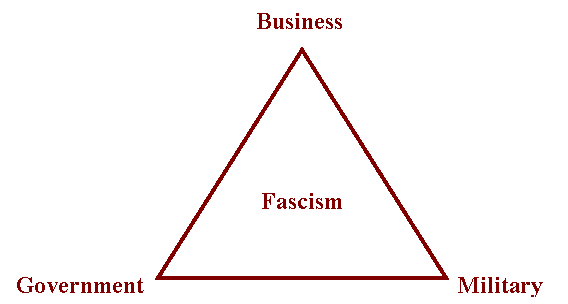
This chapter, using Halliburton as an example, perfectly illustrates US fascism.
The current use of torture, secret indefinite detention without charge of innocent citizens who object to the abuse of power, illegal phone-tapping and punishment of whistleblowers, are the weapons of fascism. As Mussolini, Franco, Hitler and Pinochet demonstrated, worse is to come.
Bush and Cheney in bed with Halliburton
Prescott Bush, George W. Bush's grandfather, was senior director of Dresser Industries which is now part of Halliburton.
The practice of delegating a vast array of logistics operations to a single contractor dates to the aftermath of the 1991 Persian Gulf War and a study commissioned by Cheney, then defense secretary, on military outsourcing. The Pentagon chose Brown and Root to carry out the study, and subsequently selected the company to implement its own plan. Cheney, after leaving office, was apparently rewarded by serving as CEO of Brown and Root's parent company, Halliburton, from 1995 to 2000, when he resigned to run for the vice presidency. Then Halliburton magically won contracts worth more than $1.7 billion out of Operation Iraqi Freedom and will make billions under a no-bid contract awarded by the US Army Corps of Engineers.
Halliburton was run by Dick Cheney from 1995 to 2000, who was selected by Bush to become Vice President in 2000.
Halliburton provides equipment and other services to oil and natural gas companies for exploration and production.
Halliburton oils its politicians
The company gave the Republican Party almost $200,000 in the 1999-2000 campaign cycle.
Halliburton has donated approximately $129,000 in soft money, or unlimited contributions to parties, to Republican organizations including $80,000 to the Republican National Committee, Federal Election Commission (FEC) records showed.
Most of Halliburton's other contributions were to the National Republican Senatorial and Congressional committees, which can then pass it on.
While the funds cannot go directly to candidates, the money is often used for party building events and advertisements on specific political issues.
The company's political action committee also contributed $62,252 to candidates running for the US House and Senate with all but $2,000 going to Republicans, according to data compiled by the Center for Responsive Politics.
For their part, Cheney and his wife, Lynne, have contributed $2,000 each to Bush's campaign and the oil executive has donated $2,500 to Halliburton's political action committee, according to FEC data.
Halliburton employees contributed independently. And then there are 'soft' contributions. So it is impossible to accurately assess Halliburton's total contributions.
Cheney, who has been CEO of Halliburton since 1995 and recently took on the title of chairman, holds a $45.5 million stake as the company's biggest individual stockholder.
The executive also holds $12.5 million worth of exercisable stock options and another $1 million in options that are not exercisable yet, according to company documents filed with the Securities and Exchange Commission. On resigning from Halliburton, Cheney was sweetened with a $36m (£19m) severance package. Although Cheney sold his Halliburton stock when he left the company to run for vice president, he continues to hold unexercised options for 233,000 shares and still receives annual deferred compensation payments until 2005.
"(Cheney's) ability to open doors and have access to very senior people domestically and internationally has been exceptional," said Jim Wicklund, managing director of energy research at Dain Rauscher Wessels.
(In addition, Cheney serves on the board of directors for Union Pacific Corp., Procter & Gamble Co. and Electronic Data Systems Corp. )
The excerpts below can be found in the article "Contract Much Larger Than Previously Known" published on Wednesday, May 7, 2003 by Agence France Presse. Find on CommonDreams.org (Wed 06Jan10).
Halliburton has been successfully prosecuted for many crimes, including:
- bribery of government officials
Halliburton is facing investigation in Nigeria and the United States after disclosing that some employees in Nigeria paid $2.4 million in bribes to a Nigerian who claimed to be a tax consultant and turned out to be a tax official.
- failure to meet standards of its government reconstruction contracts in Iraq
- failure to adequately account for monies given by government contracts
- dealing with Iraq and Iran, 2 of Bush's "Axis of Evil"
- Pentagon auditors found more than $100 million in questionable costs in one section of a massive, no-bid Halliburton Co. contract for delivering fuel to Iraq
- * Halliburton is currently being investigated by the US Federal Bureau of Investigations and the Securities and Exchange Commission. Additionally, the US Department of Justice is investigating Halliburton's work in Nigeria, Iran, Iraq, and the Balkans.
- Former Halliburton accountants filed a class action lawsuit in August 2004 alleging "systemic" accounting fraud from 1998 to 2001. They are among dozens of "whistleblowers".
- Allegations of overcharging in Iraq persist: Early in 2004, Halliburton returned $6.3 million to the US military, admitting that two of the company's employees took kickbacks from a Kuwaiti company. The company still hasn't repaid the $212.3 million the Defense Contract Audit Agency says Halliburton overcharged for fuel transportation in Iraq
- VP Cheney "Coordinates" Halliburton Contracts: The e-mail says Feith approved arrangements for the contract "contingent on informing WH [White House] tomorrow. We anticipate no issues since action has been coordinated w VP's [Vice President's] office." Three days later, the Army Corps of Engineers gave Halliburton the contract, without seeking other bids.
- Halliburton in Nigeria #1: French Judge Renaud van Ruymbeke recently threatened to subpoena US Vice President Dick Cheney over a massive corruption scandal involving Halliburton's operations in Nigeria in the 1990s.
- Halliburton Co. will pull out of Iran after its current contracts there are wound down, its chief executive said Friday. "The business environment currently in Iran is not conducive to our overall strategy and objectives," Chief Executive Dave Lesar said in a conference call. . .Halliburton said in July that it had received a subpoena seeking information about operations in Iran of its Cayman Islands subsidiary, Halliburton Products & Services Ltd. The company has argued that using a Cayman Islands subsidiary exempts it from a US-imposed trade embargo against Iran, which is accused of seeking nuclear arms and funding terrorist networks. Halliburton provided no details on when its current contracts in Iran would be completed or on the value of the work. The company generated about $80 million in revenue in Iran in 2003.
- In an effort to crack down on one of the world's most notorious international criminals, President George W. Bush last summer signed an order barring US citizens from doing business with Russian arms trafficker Victor Bout. But not long afterward, US officials discovered Bout's tentacles were wider than anticipated: for much of this year, NEWSWEEK has learned, a Texas charter firm allegedly controlled by Bout was making repeated flights to Iraq—courtesy of a Pentagon contract allowing it to refuel at US military bases. One reason for the flights, sources say, was that the firm was flying on behalf of Kellogg Brown & Root, the division of Halliburton hired to rebuild Iraq's oilfields. US officials say Bout—once dubbed a "merchant of death" by a British foreign minister—built an empire in the 1990s flying weapons to the Taliban and African dictators
- The investigations of Halliburton's work in Iraq, by 10/4/04, include:
- A criminal investigation into whether kickbacks were involved in Halliburton's use of a Kuwaiti subcontractor to provide gasoline for Iraq's civilian market. Halliburton says it notified federal authorities after an internal probe found two of its former employees may have been involved in corruption worth $6.3 million. And now Halliburton officials acknowledge that two of its managers (not subcontractors, after all) have pocketed a total $6 million in kickbacks for subcontracts.
- Overcharging US for Oil: The Halliburton Company overcharged by roughly a dollar a gallon on gasoline trucked in from neighboring Kuwait. Its total skim: $61 million.
- An investigation by the former Coalition Provisional Authority's internal watchdog which found Halliburton could not account for scores of items in Iraq worth millions of dollars.
- A report by Congress' Government Accountability Office, which found a "pattern of contractor management problems" by the Army on Halliburton's largest Iraq contract. The nonpartisan GAO said the problems including taking more than a year to finalize the documentation on work orders worth billions of dollars.
- A Pentagon audit, which found that Halliburton charged the Army for meals it never served to troops. Halliburton said the problem was caused by the widely fluctuating levels of troops in and around Iraq. Halliburton has repaid $36 million and set aside more than $140 million for a possible settlement as it negotiates with the Army on that issue.
Separately, a federal grand jury in Houston is hearing evidence to decide whether to indict Halliburton or current or former executives for violating the US trade embargo on Iran. Foreign subsidiaries of Halliburton dramatically expanded their trade with Iran while Cheney headed the company.
- Halliburton Co workers may have taken kickbacks from a Kuwaiti subcontractor supplying US troops in Iraq, causing a potential US$6 million overcharge to US taxpayers, the company said on Friday.
- Cost-Plus Scam. Referring to Halliburton's "cost-plus" contract, which allows the company to charge the US a fixed percentage fee on top of whatever price it pays for goods, the former employees told Waxman that supervisors ignored prices when making purchases.
As a result, the company paid too much for everything from rented jeeps to cellular phones to specially embroidered towels that cost three times what an ordinary towel would, they said.
- Accounting Scam. In the Fall of 2001, both Halliburton and Enron lost value on the stock market, both availed themselves of Arthur Andersen's special skills, and both seemed poised for trouble. Andersen, it turned out, helped Halliburton boost its books by postponing losses and counting uncollected money as revenue.
So called "unbilled receivables" allowed Halliburton to carry $234 million in disputed claims in 2001 (twice the amount from the previous year). Halliburton and Andersen changed the rules on "unbilled receivables" when Cheney was its CEO. Cheney’s Halliburton used accounting sleight of hand to fool investors . . . The commission says the undisclosed accounting change caused Halliburton’s public statements regarding its income in 1998 and 1999 to be materially misleading, boosting Halliburton’s profits on paper by $120 million. . .[Halliburton CEO David] Lesar says “Cheney knew that the firm was counting projected cost-overrun payments as revenues. The vice president was aware of who owed us money, and he helped us collect it,” Lesar told Newsweek. When Cheney moved to Bush's side, his second-in-command, David Lesar, took over the firm. Before Lesar joined Halliburton, he was a senior partner in Andersen.
- The Federal Bureau of Investigation is investigating whether the Army's handling of a large Iraq contract with the Halliburton Company violated procurement rules, according to lawyers for an Army official who made the charges of improprieties.
F.B.I. agents have requested an interview with the official, Bunnatine H. Greenhouse, the chief of contracting with the Army Corps of Engineers, on her allegations regarding a 2003 contract with Halliburton to repair Iraqi oil fields. Charging that the Army granted Halliburton large contracts for work in Iraq and the Balkans without following rules designed to ensure competition and fair prices to the government, Greenhouse has called for a high-level investigation of what she described as threats to the "integrity of the federal contracting program.". In an Oct. 21 letter to the acting Army secretary, Ms. Greenhouse said that after her repeated questions about the Halliburton contracts, she was excluded from major decisions to award money and that her job status was threatened.
- No corporation has gained more from the invasion of Iraq than Halliburton. Since the war began, it has moved from No. 19 on the US Army's list of top contractors to No. 1. Last year, the company pocketed $4.2 billion in US taxpayer dollars. And that's merely the take so far; the company's Kellogg Brown & Root (KBR) subsidiary has collected what the Washington Post describes as "one of the contracting plums of the war: a classified no-bid deal worth up to $7 billion to do the restoration work." Yet Halliburton and KBR have failed thru negligence and apparently criminal intent, to meet the standards required in its reconstruction. Why are the contracts not withdrawn by the Army Corps of Engineers ?
- The Department of Defense paid former Halliburton subsidiary KBR more than $80 million in bonuses for contracts to install electrical wiring in Iraq. The award payments were for the very work that resulted in the electrocution deaths of US soldiers, according to Department of Defense documents revealed today in a Senate hearing. More than $30 million in bonuses were paid months after the death of Sgt. Ryan Maseth, a highly decorated, 24-year-old Green Beret, who was electrocuted while taking a shower at a US base in January 2008. His death, the result of improper grounding for a water pump, has been classified by the US Army Criminal Investigations Division (CID) as a "negligent homicide." Maseth's death had originally been labeled an accident. Bonuses were paid to KBR in 2007 and 2008, after CID investigators had officially expressed concerns about the quality of KBR's electrical work. For its part, KBR denies any culpability for the electrocution deaths.
This information was revealed at a hearing of the Senate Democratic Policy Committee. According to the committee's chair, Sen. Byron Dorgan, the rewards KBR received under its LOGCAP contracts were supposed to be for work of the "highest quality" with "no deficiencies" or problems. Dorgan said KBR's work was "shoddy" and "unprofessional." Some eighteen US soldiers have died since 2003 as a result of KBR's "shoddy work," according to Sen. Frank Lautenberg. KBR/Halliburton, of which Dick Cheney was chairman and CEO from 1995 to 2000, has been the single largest corporate beneficiary of the US wars in Iraq and Afghanistan. It continues to operate globally on US government contracts.
Charles Smith, the former Army official who managed the contracts under which KBR performed electrical work in Iraq, testified that it was "highly inappropriate" that KBR received these bonuses for what he called "dangerously substandard" work. He said that the Army was well aware of KBR's "poor performance" since the beginning of the Iraq invasion, and yet continued to reward KBR because the military was "afraid" KBR would cease work. He said there was "a culture that decided KBR was too big to fail and too important to be held to account." The "perverse incentive is that there was no incentive" for KBR to do quality work because they received bonuses for poor work.
Senator Dorgan said there are "tens of thousands of examples" of unnecessary risks to US soldiers, including deaths that have arisen as a result of KBR's work. "Why should [KBR] be getting more contracts now that we know all this information?" asked Sen. Bob Casey. "The Defense Department has not answered these questions."
James Childs, a master electrician hired by the Army to review electrical work in Iraq during 2008, testified that KBR's work in Iraq was the "most hazardous, worst quality work" he'd ever seen. He said his investigation found improper wiring in "every" building KBR wired in Iraq (of which there are thousands) and that KBR's rewiring work in buildings that were previously safely wired resulted in the electrical system becoming unsafe. Childs said that KBR did not do any work "according to code." He also testified that the same risks exist in Afghanistan, which he recently visited. "While doing inspections in Afghanistan, I found the exact same code violations," Childs said.
Eric Peters, a master electrician who worked for KBR in Iraq as recently as 2009, said that 50 percent of the KBR-managed buildings he saw were not properly wired. "I worried every day people would be injured or killed as a result of this work," Peters testified. He estimated that at least half the electricians hired by KBR - many of them cheaper-costing Third Country Nationals (TCNs) - to service the US military in Iraq would not have been hired to work in the United States, saying they were not trained in US or UK electrical standards. TCNs - from places like India, Bangladesh and Bosnia - are estimated to have done some 60 percent of the electrical work for KBR in Iraq. Peters charged that KBR allowed trainees to take notes in to certification tests, making it very easy to be cleared for work.
Peters also charged that KBR "frowned upon" any refusal to sign off on work that Peters deemed incomplete or unsafe. Peters and others who testified said that "all over theater," meaning everywhere in Iraq, KBR would effectively double-bill US taxpayers by leaving electrical work half-done or incorrectly done and then billing taxpayers again to repair its own shoddy work.
Peters characterized KBR managers as "completely unqualified" and said he is not a "disgruntled former employee" but rather a "disgusted former employee."
[Source: Jeremy Scahill 20May09 thru http://www.thenation.com/
Jeremy Scahill, a Puffin Foundation Writing Fellow at The Nation Institute, is the author of the bestselling Blackwater: The Rise of the World's Most Powerful Mercenary Army, published by Nation Books. He is an award-winning investigative journalist and correspondent for the national radio and TV program Democracy Now!]
- In testimony submitted to members of Congress, one [Halliburton] truck driver explained in detail how taxpayers were billed for empty trucks driven up and down Iraq and how $85,000 vehicles were abandoned for lack of spare tires. A labor foreman said dozens of workers were told to "look busy" while doing virtually no work for salaries of $80,000 a year. An auditor related how the company was spending an average of $100 for every single bag of laundry and $10,000 a month for company employees to stay in five-star hotels. "We saw very little concern for cost considerations," David Walker, head of the General Accounting Office, the investigative arm of the Congress, told members of the Congress who attended a hearing at the Government Reform Committee in the House of Representatives. "There are serious problems, they still exist, and they are exacerbated in a wartime climate."
- In Alabama, where the technique [hydraulic fracturing] is widely used, the owners of a water well believed their water had been poisoned by the practice (a "black jelled substance" started coming out of the tap, according to one of lawyers involved). They filed a lawsuit and won, forcing the Environmental Protection Agency (EPA) to regulate the practice more strictly in that state, and opening up the possibility of regulation elsewhere. EPA launched a study over several years, concluding that the industry should stop pumping diesel fuel into the ground.
The agency might have saved itself the effort. The House-Senate compromise on the energy bill exempts the technique, known as "hydraulic fracturing," from some of the controls of the 1974 Safe Drinking Water Act.
Halliburton, which pioneered hydraulic fracturing more than 50 years ago and is a leading provider of the service, acknowledged in a statement that representatives "spent time educating many members of Congress and many staffers on the process and the issue."
- Halliburton overcharged the Army for support operations for troops deployed in Bosnia, a deal worth $3 billion so far. So why was the company rewarded with more contracts by the same organization ? In 1996, the Bosnia operation contributed roughly $400 million to Brown & Root's revenues, which totaled $3.1 billion in 1995. However, US forces are slated to withdraw from Bosnia in the summer of 1998, putting an end to the firm's lucrative operation there. The fastest-growing portion of Brown & Root Inc. is Brown & Root Services Corp., which revenue passed $1 billion in 1995, up from $200 million in 1986, largely because of federal contracts.
- "Another intensely sensitive aspect of the Halliburton connection, which could lead to conflict of interest allegations, is the company's stake in two American oil industry companies, Dresser-Rand and Ingersoll-Dresser Pump Co, which are involved in trying to reconstruct the Iraqi oil industry after the (1991) Gulf war."
[Source: The Guardian, London 26Jul00]
Halliburton has, while Bush and Cheney are in office, not been prosecuted for its dealings since the 1980s, with Iraq and Iran, two of the states maintained by Bush to sponsor terrorism, named in Bush's "Axis of evil" (namely Iraq and Iran of the Iraq-Iran-NorthKorea "axis").
Halliburton appears to have sought to circumvent US restrictions against dealing with Iraq and Iran by setting up subsidiaries in foreign countries and territories such as the Cayman Islands. [stated by senior Democratic lawmaker, Congressman Henry Waxman, 02May03]
Politicians oil Halliburton
The US Army Corps of Engineers granted the Iraqi oil contract on 08March01 to the Halliburton subsidiary Kellogg, Brown and Root (KBR) without putting it out to tender. The Army Corps made the excuse that this was a temporary meazure of only a few months until contracts could be let. In contradiction, this "temporary meazure" lasted 6 years, until after Bush and Cheney left office. Halliburton's profits went from the red to billions, causing share prices to rocket. Major shareholder Cheney gained from dividends, capital gains, and future emplyment in fat salaries and bonuses. Remember that Cheney left office to take on several directorships simultaneously. That is wealth beyond our imagination. Then add the multi-million dollar bonuses from each company.
Bush and Cheney repeatedly maintained that "Iraqi oil belongs to the Iraqi people" yet, after months of obfuscation, the Army Corps accidentally revealed that Halliburton, instead of merely putting out oil-well fires, was taking and selling oil.
"It's extremely troubling that our (Bush and Cheney) government is using taxpayer money to deliver lucrative contracts to companies like Halliburton that have used offshore subsidiaries to maneuver around restrictions on doing business with state sponsors of terrorism."
[Charlie Cray, Citizen Works, Citizen Works, a consumer advocacy group founded by one-time presidential candidate Ralph Nader]
Halliburton, by 12/10/04, passed the $10 billion mark in work orders from the Army for services supporting US troops in Iraq. The Army Materiel Command ordered $8.3 billion in work from Halliburton under a contract to support troops with meals, laundry, housing and other services. The Army Corps of Engineers awarded an additional $2.5 billion to Halliburton under a no-bid contract to fight oil fires and help restore Iraq's crumbling oil industry infrastructure. Allegations of financial misdeeds, including corruption and overcharging, have led to criminal, congressional and Pentagon investigations of Halliburton's work in Iraq. Congressional critics say the Bush administration is going easy on the oil services company, which Vice President Dick Cheney ran from 1995 to 2000. Cheney and Halliburton deny any preferential treatment.