Introduction to Fard
Fard (Obligatory) Prayer
Obligatory Factors of Fard Prayer:
- Say: 'Allahu-Akbar'.
- Qiyam: standing with right hand upon left wrist, against the body, above the navel.
- Recite Al-Fatiha (Opening chapter of the Holy Qur'an).
- Rak'at: Recite some verses from the Holy Qur'an. It is permissible to read verses of Al-Qur'an from a book or paper during prayer. Rak'at is done 2-4 times.
- Ruku: bowing with back and legs straight while hands grasp the knees.
- Sadjah: prostrating with palms, forehead, nose touching the ground. The arms do not touch the floor or the body; nor the belly touch the legs; nor instep touch the ground.
- Qa'dah: kneeling with buttocks on the left heel, left instep on ground but right foot vertical so that only its toes touch the ground.
- To signify completion of prayer by word or action.
- Do not look up or close your eyes. While standing erect or kneeling, look only at where your forehead touches the floor. During a standing bow, look at your toes.
Summary of Fard Prayer:
Details are provided in the next chapter.
- Stand erect with thumbs touching thighs, facing the Ka'aba,
Form the Niyyat in one's mind, that is, the prayer intended for offering.
- Say the takbir-i-tahrimah, namely, Allahu-Akbar, with eyes on the place of sujud (where forehead touches the ground).
- First Rak'at:
- Qiyam: standing with right hand upon left, above navel
- Recite Al-Fatiha & at least 3 other (consecutive) verses from Al-Qur'an
- Ruku: bowing with hands grasping knees but with back straight
- Sajdah: prostrating with palms, forehead, nose, knees and toes touching the ground. The arms do not touch the floor or the body; the belly does not touch the legs; the instep does not touch the ground.
- Second Rak'at: repeat step 3 for 1, 2 or 3 times, to make 2, 3 or 4 Rak'at respectively.
- Postures:
- Qa'dah: kneeling with buttocks on the left heel, the left instep on the ground but right foot vertical so that only toes touch the ground.
- Qa'da-tul-Oola: this reverential sitting posture after two of the four rak'at, used while reciting tahiyat, which is the first part of the tashahhud;
- Qa'da-tul-Akhira: the final sitting posture after the completion of all intended rak'at, used while reciting the complete tashahhud: the tahiyat, salawat & du'a.
- Signify completion of prayer by word or action:
Say the salam after turning your face to the right:
Assalamu 'alaikumwa rahmatullah. Peace be upon you, and the mercy of Allah
Turn your face to the left and repeat.
Prayer times
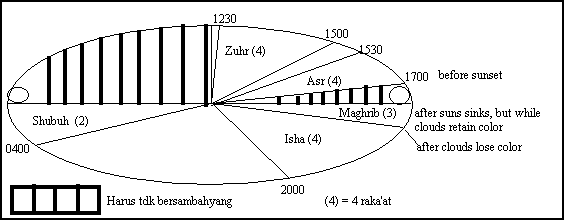
Number of Rak'at for Different Prayers
| |
Fard |
Sunnah |
| Prayer |
(Obligatory) |
Before Fard |
After Fard |
Without Fard |
| Fajr |
2 |
2 |
|
|
| Zuhr |
4 |
4 |
2 |
|
| Asr |
4 |
|
|
|
| Maghrib |
3 |
2 |
|
|
| Isha |
4 |
2 |
|
|
| Witr |
|
|
|
1, 3, 5, 7, or 9 |
Witr actually refers to the last raka'at after those voluntary 2, 4, 6, or 8 raka'at done before sleep. The witr thus makes an odd number of raka'at.