| The Beginning |
|---|
| 226 CE | Ardashir (226-240CE) overthrew the Parthian Dynasty, establishing the Sasanid Dynasty, and restoring Zoroastrianism as the state religion. The state-attached priesthood and its severe repression of independent thought, resulted in the end of orthodox Zorastrianism when the state was overthrown by Arab conquest. However, heretical Zorastrianism survived as:
- Mithraism
practised through the Roman military as far as England
- Manicheism
the creed of Mani (216-277CE), combining Zoroastrianism and Christianity, and persecuted by Moslems and Christians
- Mazdak
of the early 6th century CE in Iraq, promoting a religious communism and later encouraged dissident Shi'ite movements (Islam).
|
| 300-500 | There was a general economic decline in 'world' civilizations, including world trade, as indicated by lack of Roman coins in India after Emperor Caracalla (-217 CE). Between 4th and 6th centuries, during Jahiliyya, the Age of Ignorance, Arabia suffered a decline in its meagre cultivation, and of its centers, along with an increase in camel nomadism. This may have been due to loss of interest by the big Empires which were at peace from 384 to 502, and the trade routes through its deserts returned to the now-safe shorter and cheaper route down the Euphrates river, subsidies ended, caravans stopped, and towns were left stranded then abandoned as settlers migrated or turned to nomadism. Many southern tribes migrated northwards in search of better pastures. |
| 500 | In the 500s, all this changed as the Persian-Byzantine conflict resumed, and Arabia became important in the struggle. In times of conflict, the two trade routes were the northern steppes and the southern deserts and seas. |
| 500 | By 500 Ethiopia was a newly-converted Christian kingdom and a world trading nation, with ships trading with India, and troops stationed in Arabia. Ethiopia formed an alliance with Christian Byzantine Empire, taking Yemen and, in 507, sallying forth up to Mecca, on the caravan route north from Yemen, but lost the battle, and Persia then took Yemen to control the Red Sea shipping and the Mecca-Yemen caravans meeting ships leaving for India. |
| 552 | Two Nestorian monks smuggled silkworm eggs out of China to Byzantium, and by early 600s silk production was successful in Asia Minor, diminishing the trade with China. |
| 570 | Muhammed was born, Muhammad, son of Abdallah, of the aristocratic tribe Quraysh, in the small oasis town of Mecca in Hijaz of western Arabia, on the coastal caravan route from the Levant to the Yemen. Muhammad lost his parents, was cared for by a tribal wet nurse till six, then by an uncle and grandfather, who oversaw his education for commerce. (? One source states Muhammad was illiterate.) At 25 he married Khadija, a Quraysh business woman 15 years his senior, who bore him 2 sons who died and 4 daughters. His daughter Fatima married Muhammad's cousin, Ali, whom the Shias maintain is the true successor to Muhammad, and not Abu Bakr who was chosen by the inner circle of the Umma. |
| 600 | The two Empires were too exhausted to fight; Ethiopia was weakened; Arabia power centers had crumbled, making Arabia easy prey to foreigners, and, later, for the warriors of Islam. The trade routes remained, however, so there was a great interchange of foreign ideas, weapons, religion, writing. The Arabs began to write their own language. Mecca was on the main caravan route connecting the seaports of Yemen and the Levant. |
| c. 609 | Muhammad, on Mount Hira in the month of Ramadan, was called upon by Angel Gabriel to recite the revelations of God, in verses which became the Qur'an (Qur'an = reading + recitation). He called his belief Islam meaning surrender to God , and his followers Muslims, surrendered persons. |
| 622 | The Hijra or migration from Mecca to Medina. The Islamic calendar begins from this date.Leading families in Mecca saw Muhammad as a threat to their dominance (their power and wealth may have involved owning a religious shrine) and began to persecute his followers, so Muhammed made an agreement with the small oasis town of Yathrib, about 350 kilometers north of Mecca, whose people offered him and his followers protection and honor.
Yathrib became known as Al-Madina, 'the City'. The Islamic community was called Umma. Muhammad became ruler, with religious, political and military power. Within 8 years the Umma had conquered Mecca. |
| 632 | June 8, 632CE/10AH, Muhammad died without naming a successor. According to God's revelations, there would be no more prophets and no more revelations; Muhammad was mortal, an Apostle of God (as was the prophet Jesus), and his purpose was to return the people to the monotheistic tradition of Abraham, the same Abraham of Hebrew tradition. Unfortunately Muhammad had not named a successor, so the Companions, the inner circle of the Umma, elected Abu Bakr, Muhammad's father-in-law, father of Hafsa, one of Muhammad's wives (12 in all, not including the numbers of concubines) and one of the earliest converts. The title he chose was Khalifa meaning both successor and deputy, eventually coming to imply that he was not only the successor to Muhammad but also the Deputy of God. Khalifa became Khalifat.
The revelations of God and the associated interpretations and lore, were not written but orally transmitted for generations, making it possible that, in the early disputes, some may have altered the transmission to suit their own purposes. It is recorded that there were at least 4 versions of the Qur'an in use when Caliph Uthman unsuccessfully tried to get everyone to agree on one text. The People of Kufaused used another at least until 1000AD. There remains much debate on the meanings of the Qur'an.
When Muhammad died, Islam had not extended beyond parts of Arabia. In the early stages, people were not forced to adopt Islam. The Qur'an stated: There is no compulsion in religion (2:256). Those who professed a monotheistic religion having scriptures of earlier revelations (suggesting Judaism and Christianity) could continue their practise under certain conditions. For the first century of conquest, there was a distinct line between Arabs and new converts. In the second century, revolutionary changes ended discrimination and promoted Arabization. |
| The Succession |
|---|
| 634 |
Muhammad and Ali were of the clan Beni Hashim, of the Quraysh tribe while Muhammad's father-in-law, Abu Bakr, was of the clan Beni Umayya also of the Quraysh. The Beni Umayya clan had caused Muhammad to flee to Medina. Abu Bakr died, supposedly making 'Umar ibn al-Khattab his successor, and he maintained the unity of the Moslems for 10 years. |
| 644 |
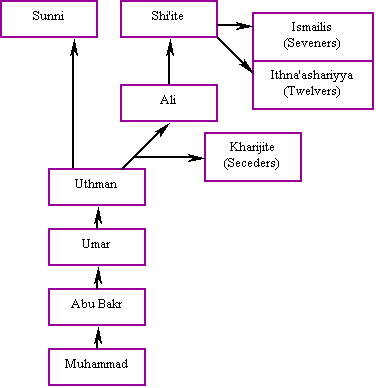
For his successor, 'Umar appointed 6 of the senior Companions as the shura to appoint one of themselves as caliph. They chose 'Uthman, of the Meccan aristocratic clan Beni Umayya, which then took advantage of his office, while Uthman misappropirated funds and appointed family to office. His attempt to produce an authoritative version of the Qur'an was unpopular.
|
|
| 651 |
The Shi'ite movement began (651-661) when the shi'at'Ali, or 'party of Ali', supported Ali as the successor to the prophet as opposed to the Umayyads (who had, in the beginning, opposed Muhammad and forced him to flee to Medina). |
| 655 |
The Battle of the Masts saw the new Muslim fleet defeat the Byzantines. The following rest from war allowed the accumulated dissensions to explode into inter-Arab civil wars. |
| 656 |
Many other Muslims grieved that Ali, the Prophet's son-in-law and rightful successor, had been deprived of the office. In 656, Muslim mutineers murdered Caliph Uthman and installed Ali - an example of God's chosen people slaughtering the Deputy of God. War broke out. His followers were called 'Ali, shi'atu 'Ali, now reduced to Shi'a. The Shi'a insist that only the descendants of Ali are capable of receiving the nur or divine light of guidance, from Ali, son-in-law of Muhammad the prophet pbuh.
When Ali refused to apprehend the assassins, and even made one governor of Egypt, he was suspected of involvement in the murder of his predecessor, Uthman. Talks and a battle followed in which Ali defeated the governor of Syrai, Mu'awiya, at Siffin in 657, but Ali agreed to submit his claim to arbitration; that arbitration decided that Ali's failure to punish the assassins negated his caliphate.
Ali then refused to abide by the decision. Either this or his weakness in submiting to arbitration, alienated some of his followers, splitting off the secessionist Kharijite. Ali then fought and defeated the Kharijites, one of whom later assassinated him, allowing the governor of Syria, Mu'awiya, to become caliph (661-80).
Fortunately, Ali's son, Hasan, had the good sense (and a fat pension) to renounce his claim in favor of Mu'awiya ibn Abi Sufyan, member of the Umayya, but also governor of Syria with its experienced army. This began the Umayyad Caliphate, in which the aristocratic Meccan family Umayya owned the Caliphate for 100 years till 750.
|
| 661 |
The governor of Syria, Mu'awiya, became caliph (661-80), establishing the Umayyad dynasty which lasted till 750 CE.
The Shi'a/Shi'ites claim the Umayya corrupted Islam, and persecuted the Prophet's rightful heirs. Even the Sunnis were later to claim that the Umayya stole the Caliphate and used it irreligiously.
The Umayyads rescued a volatile Empire by placating inter-tribal Arab jealousy by reserving the top levels of power and privilege to pure-bred Arabs. In addition, Islamic precepts were diluted to suit local populations, even though this caused violent Muslim objections. In particular the Kharijites (= to go out) insisted that any believer could become Caliph, and they always decided to whom they would give or deny their allegiance.
Most Iranian Moslems are duodecimal (= 12) Shi'ites who recognize only 12 Emams as descendants of Mohammed in the line of Ali, the Prophet's cousin and son-in-law by marriage to daughter Fatima. The 12th Emam disappeared in 940, and he is the hidden one who will come to establish the true Islamic State. According to the Prophet, these 12 Emams are the only infallible teachers, knowing the meanings hidden in the versicles of the Q'ran. For Shi'ites, truth resides not in the spoken word but in the hidden word. When the 12th Emam comes, there will be no need to search further for the hidden meanings of the prophecies ( valayat). |
| 661 |
661-675 the Umayyad Dyansty began proselytizing with military colonization of Iran. In 661, Ali was assassinated in Kufa (Najaf in Iraq) and 20 years' later, Ali's son, Hussein, was killed by the son of the Umayyad Caliph of Damascus. Ali's tomb is in Najaf, making it a holy city, which the US in its wisdom, freely bombed with radioactive missiles as part of its process for winning the hearts and minds of the people. |
| 680 |
The Umayyad by then were based in Syria. Husayn, son of 'Ali and grandson of the Prophet, when travelling was surrounded on the orders of Yazid son of Muawiya, member of the Umayyad clan, and slaughtered. Only Husayn's son, 'Ali, among the women and youngest children, survived. This massacre of Karbala' is the central festival in Shi'ite psyche, overpowering any slight doctrinal differences between Shi'a and Sunni. Today's Iran is officially Shi'ite while Iraq, under Saddam Hussein, was Sunni even though the Shi'ites form the majority of the population. Shi'ites were centered around Najaf near Baghdad, and in the south - particularly the marshlands (drained by Saddam following Shi'ite rebellion at US encouragement and then betrayal, after the 1991 war) while the Sunni stronghold is around Saddam's home town, Tikrit, north of Baghdad.
The sunna, the authentic body of Muslim custom, was, of course, composed by the Umayyads. Some 90% of today's Muslims are Sunni but mostly non-Arabs. Most Muslims in Iran, Iraq and Yemen are Shi'ite. With Asians, they total up to 100 million. |
| 685 |
In 683, a member of a non-Umayyad family declared himself Caliph, taking power from Hijaz to Iraq. In 685 Abd al-Malik acceded to the Umayyad Caliphate but did not regain control till 692. He also issued gold coins, the first ever minted by a non-Roman/Byzantine Empire; and this challenge, along with the Qur'an inscription, caused the Byzantines to declare war. The Muslims stopped borrowing and imitating, and began spreading a new culture with a new architecture. 'Abd al-Malik built a shrine, the Dome on the Rock, the rock for Abraham's sacrifice of his son, and on which had stood the Jewish Temple (demolished by the Romans). Inside the shrine an inscription rejects the concept of the Holy Trinity by declaring: "God is one, without partner, without companion". Elsewhere it is written: "He is God, one, eternal. He does not beget ...." |
| 720 |
By now, people were questioning the corruption, including favoritism, of government, for, since religion included politics and government, any corruption was a corruption of God's revelations through His Prophet. |
| 750 |
Tribal fighting, sectarianism (Kharijite and Shi'ite), and east Iranian rebellion caused a weakening which encouraged rebellion elsewhere. Marwan II (744-750) was the last Umayyad Caliph. Abu Muslim, of a militant sect led by Abu'l-'Abbas, after many years' railing against the irreligious Umayyads, rebelled in 747/129, proclaiming the Abbasids, descendants of the Prophet's uncle, al-'Abbas, to be rightful Caliph. By 750, they had replaced the Umayyads with Abu'l-'Abbas as Caliph, an Arab dynasty on the back of a Persian-Arab revolt.
Under the Abbasids, the benefits of office and privilege had to be shared with the not-so-pure Arabs and even non-Arabs. Power itself, was not shared until later, when the Arabs warrior caste was weakened by the rise of Turkish guards, and control was lost to outlying provincial autonomy. In addition, future Caliphs were often the sons of slave women.
The capital was moved from Syria, the seat of 100 years' of Umayyad rule, to the small town of Baghdad, for the next 5 centuries. |
| 750 |
750-1258 saw the next caliphate, the Abbasid Dynasty, descended from one of the Prophet's uncles. The immediate need was to reconcile the passionate needs of the followers with the cold needs of government, so al-Mansur, successor of Abdu'l-'Abbas, had Abu Muslim and friends executed. Their tolerance in religion and politics, and their need for experienced administrators, brought the Persians over, and the Persians joined the administration, promoted Islam and created a 300 year epoch in learning and philosophy, until the Mongols under Chinggis Khaan wasted the land to reduce it to the steppes from whence he came. When the Mongols finally settled, allowing civization to re-emerge, Arabic lost to Farsi. |
| 786 |
During 786-809, under Harun al-Rashid, the Abasid power peaked, but then declined with the rapid loss of provincial control: Spain and North Africa (756-800); Egypt 868 and Syria soon after; with the Bedouin taking independence between Syria and Iraq; and civil war between the Caliph's sons, eventually resulting in Iranian independence by 820. Provincial rule was nominal at best, with declining revenues worsened by court profligacy and obese administration. This problem caused the Caliph to stupidly hand over tax-collection to governors who, when in command of armies, held both money and power, enabling them to select and depose Caliphs. By early 900s, the caliph was sidelined by the Commander of Commanders. |
| 800 | By 800, Islam extended across north Africa, and south of the Sahara, northwards into Europe, and eastwards into India and central Asia, because local peoples aided the spread of Islam and joined the Arabs to conquer further fields. The Arabs offered lower taxes, tolerance and security, but their military and political control was lost quickly, while their religion, law and language remained. This was because they both colonized and assimilated. Colonization created the centers of learning and government, assimilation gave the natives equal rights to the minority Arabs, and brought them into the army and government where they needed to speak Arabic.
One of the few great benefits of war is the re-distribution of the accumulated assets of the rich, the religious body, the government, the landlords. With this release of wealth so commerce expands; agriculture can incorporate new ideas and methods, and so become more productive; tax-free privileges are abolished so taxes become distributed fairly. One of the disadvantages is the corrupting influence of the enormous booty available to the officers of the conquering armies, the resulting greed and, among the less rewarded, the anger.
In the conquered provinces to the west, the Byzantine leaders could have fled to Constantinople, but to the Persian east, the leaders had no where to go. They stayed, resenting their loss of dominance. There was immigration of Arab tribes, urbanization, the destruction of orthodox Zoroatrianism and its associated wealth and power, and Arab-to-native tensions, but none so damaging as the eternal inter-tribal Arab conflicts. The re-grouping from a tribal orientation to a national one, never materialized as in the west, and this failure still troubles Saudi Arabia and nearby countries.
The Byzantine and Arabian Empires ended the Byzantine and Persian conflict, re-establishing peaceful trade routes from the Mediterranean to Central Asia, accompanied by increasing agricultural productivity. Together, they would have created new prosperity for most, until the resulting increase in population, Malthusian-style, ate it away. |
| The Decline |
|---|
| 750 |
Tribal fighting, sectarianism (Kharijite and Shi'ite), and east Iranian rebellion caused a weakening which encouraged rebellion elsewhere. Marwan II (744-750) was the last Umayyad Caliph. Abu Muslim, of a militant sect led by Abu'l-'Abbas, after many years' railing against the irreligious Umayyads, rebelled in 747/129, proclaiming the Abbasids, descendants of the Prophet's uncle, al-'Abbas, to be rightful Caliph. By 750, they had replaced the Umayyads with Abu'l-'Abbas as Caliph, an Arab dynasty on the back of a Persian-Arab revolt.
Under the Abbasids, the benefits of office and privilege had to be shared with the not-so-pure Arabs and even non-Arabs. Power itself, was not shared until later, when the Arabs warrior caste was weakened by the rise of Turkish guards, and control was lost to outlying provincial autonomy. In addition, future Caliphs were often the sons of slave women.
The capital was moved from Syria, the seat of 100 years' of Umayyad rule, to the small town of Baghdad, for the next 5 centuries. |
| 750 |
750-1258 saw the next caliphate, the Abbasid Dynasty, descended from one of the Prophet's uncles. The immediate need was to reconcile the passionate needs of the followers with the cold needs of government, so al-Mansur, successor of Abdu'l-'Abbas, had Abu Muslim and friends executed. Their tolerance in religion and politics, and their need for experienced administrators, brought the Persians over, and the Persians joined the administration, promoted Islam and created a 300 year epoch in learning and philosophy, until the Mongols under Chinggis Khaan wasted the land to reduce it to the steppes from whence he came. When the Mongols finally settled, allowing civization to re-emerge, Arabic lost to Farsi. |
| 786 |
During 786-809, under Harun al-Rashid, the Abbasid power peaked, but then declined with the rapid loss of provincial control: Spain and North Africa (756-800); Egypt 868 and Syria soon after; with the Bedouin taking independence between Syria and Iraq; and civil war between the Caliph's sons, eventually resulting in Iranian independence by 820. Provincial rule was nominal at best, with declining revenues worsened by court profligacy and obese administration. This problem caused the Caliph to stupidly hand over tax-collection to governors who, when in command of armies, held both money and power, enabling them to select and depose Caliphs. By early 900s, the caliph was sidelined by the Commander of Commanders. |
| 800 |
During 809-833, under Harun al-Rashid's son, Mamum, Baghdad became a cultural center, making great progress in astronomy, mathematics, sciences, and anatomy; and added a free public hospital. After about 840, the army of imported slaves from Turkestan had, through excesses, antagonized the people. Later, a caliph, trying to curb these excesses, was murdered by mutineers. The army selected and rejected a sequence of caliphs, as the empire declined and disintegrated. |
| 821 |
Iranian Muslims created a succession of independent dynasties in eastern Iran, allowing the resurgence of non-Arabic but Muslim-based Iranian culture, with Arabic script but the official language becoming Persian (Farsi). Literature and sciences flourished in the cities, in spite of the increasing dogmatism which led inevitably to sectarianism. |
| 833 |
The Caliph al-Mu'tasim (833-842) began the importation of Turkish slaves for military service, mainly from the Kipchak country north of the Black Sea, and these provided both troops and commanders who eventually replaced the Arabs and Persians in the military and thus from political dominance, for 1000 years. They also formed the Mamluk, the warrior caste of Egypt, and eventually a Mamluk established the first dynasty independent of central control. Another, a slave of the Samanid Dynasty in Baghdad, established the Ghaznavid Dynasty (962-1186) |
| 946 |
Shi'ite Persians of western Iran, took Baghdad thus controlling directly the Sunni Caliph. The Sunnis later took control but kept the Caliph as a puppet. |
| 1094 |
The Byzantine Emperor Alexius I appealed to Pope Urban II to send military aid to block the Mamluk armies from Egypt. Urban I responded by calling up the Crusades. Because of the internal strife of the various Muslim rulers, the Crusades did more damage and stayed longer than would otherwise have been possible. |
| 1029 |
The Ghuzz/Oguz, a tribe of Turks from the steppes northof the Aral Sea, lived by pillaging and then disappearing. Their leaders were two grandsons of Seljuk. In time they consolidated their bands into armies. In 1055, the puppet caliph Quaim asked the Sunni Seljuks to remove the Shi'ite power in Baghdad - how many rulers have made this mistake? The Seljuks came, pillaged and left to establish a dynasty in Asia Minor, where they defeated the Byzantines. Their emperor Romanus was ransomed but on his return to constantinople, was executed by his usurper, Michael VII Ducas.
The Seljuk sultans took control over the Abbasid caliphs, re-modelled the administration, dismissed the Shi'ites, by-passing the unfamiliar Arabic, and encouraging Sunni-compatible Sufism to counter Shi'ite teaching. Thus the Seljuks ended the Arab Empire, before declining and fragmenting themselves. By 1157, they were too weak to oppose the Mongol hordes. |
| 1169 |
Salah al-Din/Saladin of Syria, became wazir in Cairo, appointed by Caliph Adid, and, in 1171 abolished the Fatimid caliphate to make himself ruler of Egypt. When Nuraddin of Syria died in 1174, Salah al-Din became ruler of Syria as well as of Egypt and Iraq.
Salah al-Din defeats the attack by the Franks, Sicilian Normans and the Assassins, on the great Egyptian port of Alexandria.
The Assassins were a Muslim Shi'a religious sect fighting on behalf of the awaited 12th Imam, formed in 1094, based partly in Syria, to fight the Seljuk rule and the Sunni sect, and surviving till the Mongol invasions of 1258. |
| 1258 |
The Mongols, the Kara-Khitay from China and led by Chinggis Khaan/Jenghiz Khan, took Baghdad. Jenghiz Khan had united the Mongol tribes by 1206, the remaining Mongol tribes and the pagan Turkish people of Northeast Asia by 1218, and then faced west. In 1219 he crossed the Jaxartes into the Islamic countries; by 1220 had taken Bukhara, Samarquand and Transoxiana, then in 1220 crossed the Oxus to conquer eastern Iran. In 1227 Jenghiz died but in 1230 a new offensive began, taking western Iran by 1240. By 1243 they defeated the Seljuk sultan of Anatolia. In 1258 the Mongols took Baghdad and slaughtered the Abbasid Dynasty (after 500 years of rule).
This was the signal of the end of an era in Islamic civilzation, an end already in process long before. The caliphate, already subject to the Sultans, disappeared. Egypt had already become the center of Arabic civilization, and, never being conquered by the Mongols, remained so. Anatolia came to be controlled by the Ottomans who had originally fled from Jenghiz Khan, but soon established an empire of their own. Central and northern Iran were devastated by the Mongols, but the south submitted, and Fars on the Persian Gulf, prospered and produced a cultural resurgence, notably in architecture, poetry and astronomy.
The Mongols converted to Islam (under Ghazan Khan), and bringing Far Eastern vigor to Iran, and a revived commerce. However, Baghdad and its hinterland Iraq, stagnated for centuries, never again achieving its previous dominance. |