[1 + 2 + 3 + 4 = 10]
and these written in dot notation formed a perfect triangle.
Pythagoras' famous geometry theorem (in a right-angled triangle, the square on the hypotenuse = the sum of the squares on the other 2 sides) was known to the Babylonians 1000 years earlier, but Pythagoras may have been the first to prove it.
The Pythagoreans are credited with several discoveries:
- The sum of the angles of a triangle is equal to two right angles. Also the Pythagoreans knew the generalisation which states that a polygon with n sides has:
- sum of interior angles = 2n - 4 right angles = (2n - 4)*π/2
- sum of exterior angles = 4 right angles = 2 π
- The theorem of Pythagoras: for a right angled triangle the square on the hypotenuse is equal to the sum of the squares on the other two sides. We should note here that to Pythagoras the square on the hypotenuse would certainly not be thought of as a number multiplied by itself, but rather as a geometrical square constructed on the side. To say that the sum of two squares is equal to a third square meant that the two squares could be cut up and reassembled to form a square identical to the third square.
- Constructing figures of a given area and geometrical algebra. For example they solved equations such as a* (a - x) = x2 by geometrical means.
- The discovery of irrationals. This is certainly attributed to the Pythagoreans but it does seem unlikely to have been due to Pythagoras himself. This went against Pythagoras's philosophy that all things are numbers, since by a number he meant the ratio of two whole numbers. However, because of his belief that all things are numbers it would be a natural task to try to prove that the hypotenuse of an isosceles right angled triangle had a length corresponding to a number.
Hypotenuse = √2
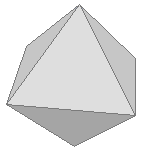
which is an irrational number, not being expressed by a ratio of two numbers. - The five regular solids. It is thought that Pythagoras himself knew how to construct the first three but it is unlikely that he would have known how to construct the other two:
Name Faces Vertices Edges Faces at vertex 1
2
3
4
5cube (hexahedron)
tetrahedron
octahedron
duodecahedron
icosahedron6
4
8
12
208
4
6
20
1212
6
12
30
303
3
4
3
5
Cube Tetrahedron Octahedron Duodecahedron Icosahedron 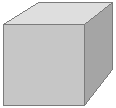



- In astronomy Pythagoras taught that the Earth was a sphere at the centre of the Universe. He also recognised that the orbit of the Moon was inclined to the equator of the Earth and he was one of the first to realise that Venus as an evening star was the same planet as Venus as a morning star.
In their ethical practices, the Pythagorean were admired for their mutual friendship, unselfishness, and honesty. The Pythagorean Society thrived and spread to many other Italian cities, and after 500bce, became political in nature, spilt into factions. In 460bce the Society was violently suppressed.
Euclid of Alexandria (325 - 265bce)
Born in Alexandria, Egypt's famed city of learning, Euclid is the most prominent mathematician of antiquity, reknown for his mathematical treatise The Elements, in use for over 2200 years. (I studied it when I was 15 and 16 years old, and it reshaped my life.) Influenced by his teacher's (Plato) insistence on premises, definitions and proof, Euclid refined the theorems of Eudoxus, Theaetetus, and of other predecessors. Euclid was taught by Plato, and was older than Archimedes, whom he knew.Euclid built a vigorous school of mathematics at Alexandria, and, like professors of today, probably used his students to write and refine The Elements.
The Elements begins with definitions and five postulates. The first three postulates are postulates of construction, for example the first postulate states that it is possible to draw a straight line between any two points. These postulates also implicitly assume the existence of points, lines and circles and then the existence of other geometric objects are deduced from the fact that these exist. There are other assumptions in the postulates which are not explicit. For example it is assumed that there is a unique line joining any two points. Similarly postulates two and three, on producing straight lines and drawing circles, respectively, assume the uniqueness of the objects the possibility of whose construction is being postulated.
The fourth and fifth postulates are of a different nature. Postulate four states that all right angles are equal. This may seem "obvious" but it actually assumes that space in homogeneous - by this we mean that a figure will be independent of the position in space in which it is placed. The famous fifth, or parallel, postulate states that one and only one line can be drawn through a point parallel to a given line. Euclid's decision to make this a postulate led to Euclidean geometry. It was not until the 19th century that this postulate was dropped and non-euclidean geometries were studied.
There are also axioms which Euclid calls 'common notions'. These are not specific geometrical properties but rather general assumptions which allow mathematics to proceed as a deductive science. For example, things which are equal to the same thing are equal to each other.
Thus we can see that Euclid's propositions sometimes make unfounded assumptions, assumptions not covered by his postulates and axioms; but no mathematics, even today, can lay claim to being 100% rigorous. If you keep questioning, there is always some starting point, some premise, some basic concept which must remain unproven. And the first attempt at a self-contained system, involving years and years of effort, must have sorely tried Euclid's patience. Try it yourself.
The Elements is divided into 13 books:
- Books 1 - 6: plane geometry:
- Books 1 & 2 set out basic properties of triangles, parallels, parallelograms, rectangles and squares.
- Book 3 studies properties of the circle
- Book 4 deals with problems about circles and is thought largely to set out work of the followers of Pythagoras.
- Book 5 lays out the work of Eudoxus on proportion applied to commensurable and incommensurable magnitudes.
- Book 6 looks at applications of the results of book five to plane geometry.
- Books 7 - 9: number theory:
- Book 7 is a self-contained introduction to number theory and contains the Euclidean algorithm for finding the greatest common divisor of two numbers.
- Book 8 looks at numbers in geometrical progression.
- Book 10: irrational numbers:
and is mainly the work of Theaetetus. Euclid changed the proofs of several theorems in this book so that they fitted the new definition of proportion given by Eudoxus. - Books 11 - 13: three-dimensional geometry:
- Book 11 gives the basic definitions needed for the three books together are given. The theorems then follow a fairly similar pattern to the two-dimensional analogues previously given in Books 1 & 4.
- Book 12 proves that circles are to one another as the squares of their diameters and that spheres are to each other as the cubes of their diameters. These results are certainly due to Eudoxus. Euclid proves these theorems using the "method of exhaustion" as invented by Eudoxus.
- Book 13 discusses the properties of the five regular polyhedra and gives a proof that there are precisely five. This book appears to be based largely on an earlier treatise by Theaetetus.
Euclid's Elements is remarkable for the clarity with which the theorems are stated and proved. It sets a minimum standard for rigor. More than one thousand editions of The Elements have been published since it was first printed in 1482. Before that it was copied by hand innumerable times.
Other books by Euclid which have survived are:
- Data (with 94 propositions), which looks at what properties of figures can be deduced when other properties are given
- On Divisions which looks at constructions to divide a figure into two parts with areas of given ratio
- Optics which is the first Greek work on perspective
- Phaenomena which is an elementary introduction to mathematical astronomy and gives results on the times stars in certain positions will rise and set.
These books have been lost:
- Surface Loci (two books)
- Porisms (a three book work with, according to Pappus, 171 theorems and 38 lemmas)
- Conics (four books)
- Book of Fallacies
- Elements of Music.
Euclid may not have been a first class mathematician compared to those of today, but he was so far ahead of any other mathematician in his time that he reshaped the course of mathematics, and showed everyone the way to rigor. Had his contemporaries, those verbosely vague Greek philosophers, had followed his teaching, they would have saved today's philosophy students infinite hours of fruitless toil.
Archimedes of Syracuse, Sicily (287 - 212bce)
Archimedes' father was Phidias, an astronomer. Archimedes visited Egypt and there either invented or studied a device now known as Archimedes' screw to raise water from the river up over a bank, into an irrigation channel. This pump is still widely used. Archimedes probably studied with the successors of Euclid in Alexandria, because he had mathematician friends there. Archimedes was widely known for inventing military engines, especially those for his friend and relation King Hieron, for the defence of Syracuse against the Romans under Marcellus in the siege of 212bce.Other inventions such as the compound pulley added to his fame.
Yet Archimedes, although he achieved fame by his mechanical inventions, believed that pure mathematics was the only worthy pursuit. Nonetheless Archimedes used practical methods to discover results from pure geometry. He is considered by most historians of mathematics as one of the greatest mathematicians of all time.:
- He perfected a method of integration which allowed him to find areas, volumes and surface areas of many bodies.
- Archimedes' work on integration led to calculus of the infinite conceived and perfected by Kepler, Cavalieri, Fermat, Leibniz and Newton.
- Archimedes was able to apply the method of exhaustion, which is the early form of integration, to obtain a whole range of important results
- Archimedes also gave an accurate approximation to p and showed that he could approximate square roots accurately.
- He invented a system for expressing large numbers.
- In mechanics Archimedes discovered fundamental theorems concerning the centre of gravity of plane figures and solids.
- His most famous theorem gives the weight of a body immersed in a liquid, called Archimedes' Principle.
The works of Archimedes which have survived are as follows:
- On plane equilibriums (two books):
sets out the fundamental principles of mechanics, using the methods of geometry. Archimedes discovered fundamental theorems concerning the centre of gravity of plane figures and these are given in this work- Book 1: the centre of gravity of a parallelogram, a triangle, and a trapezium.
- Book 2: finding the centre of gravity of a segment of a parabola.
- Quadrature of the parabola
finds the area of a segment of a parabola cut off by any chord. - On the sphere and cylinder (two books):
- Book 1:
- the surface of a sphere is four times that of a great circle
- finds the area of any segment of a sphere
- shows that the volume of a sphere is two-thirds the volume of a circumscribed cylinder
- that the surface of a sphere is two-thirds the surface of a circumscribed cylinder including its bases
- Book 2 shows how to cut a given sphere by a plane so that the ratio of the volumes of the two segments has a prescribed ratio.
- Book 1:
- On spirals:
- defines a spiral
- gives fundamental properties connecting the length of the radius vector with the angles through which it has revolved
- gives results on tangents to the spiral
- finds the area of portions of the spiral
- On conoids and spheroids:
The main purpose of the work is to investigate the volume of segments of these three-dimensional figures:- examines paraboloids of revolution
- hyperboloids of revolution
- spheroids obtained by rotating an ellipse either about its major axis or about its minor axis
- On floating bodies (two books)
lays down the basic principles of hydrostatics. His most famous theorem which gives the weight of a body immersed in a liquid, called Archimedes' principle, is contained in this work. He also studied the stability of various floating bodies of different shapes and different specific gravities. - Measurement of a circle
shows that the exact value of p lies between the values 310/71 and 31/7. This he obtained by circumscribing and inscribing a circle with regular polygons having 96 sides. - The Sandreckoner
proposes a number system capable of expressing numbers up to 8 1063in modern notation. He argues in this work that this number is large enough to count the number of grains of sand which could be fitted into the universe. There are also important historical remarks in this work, for Archimedes has to give the dimensions of the universe to be able to count the number of grains of sand which it could contain. He states that Aristarchus has proposed a system with the sun at the centre and the planets, including the Earth, revolving round it. In quoting results on the dimensions he states results due to Eudoxus, Phidias (his father), and to Aristarchus. There are other sources which mention Archimedes' work on distances to the heavenly bodies. - The Method
Archimedes described the way in which he discovered many of his geometrical results:
... certain things first became clear to me by a mechanical method, although they had to be proved by geometry afterwards because their investigation by the said method did not furnish an actual proof. But it is of course easier, when we have previously acquired, by the method, some knowledge of the questions, to supply the proof than it is to find it without any previous knowledge.
The lost works of Archimedes include:
- semi-regular polyhedra
- the number system which he proposed in the Sandreckoner
- on balances and levers
- mirrors
Archimedes was killed in 212bce during the capture of Syracuse by the Romans in the Second Punic War after all his efforts to keep the Romans at bay with his machines of war had failed.
Archimedes considered his most significant accomplishments were those concerning a cylinder circumscribing a sphere, and he asked for a representation of this together with his result on the ratio of the two, to be inscribed on his tomb.
Unlike the Elements of Euclid, the works of Archimedes were not widely known till after Eutocius brought out editions of some of Archimedes works, with commentaries, in the sixth century ce.