Business structures
Practices vary from country to country. Practices within one country vary over time.
This account is an introduction for only students, and must not be accepted as a basis for establishing a business. Check in your locality for current rules, regulations and laws.
No liability or responsibility is accepted or taken for mistakes contained in any chapters in any books, in any section in this website.
Overseas students should note that different countries have:
- different procedures for buying and selling shares
- different laws for the formation of companies
- different (or no) protection for shareholders
- different ways of assessing tax
- different (or no) requirements for accounting procedures.
Types of companies/corporations
A company is the same as a corporation. A company is a legal entity.
It can own assets, enter legal contracts, and be sued
without the suing of its shareholders. (However, see unlimited company.)
- unlimited companies
Unlimited liability obliges the owners to pay all the debts of the company,
even if they have to sell their private possessions. If one owner goes bankrupt,
the other is left to pay all the debts.(Partnerships also have this disadvantage.)
This type of company is uncommon in Australia.
- limited companies
Limited companies/corporations limits shareholder liability.
If the limited company is liquidated because it cannot pay its bills,
creditors cannot make the owners/shareholders pay the debts beyond any unpaid amount.
Sometimes shares are listed at, say, $1 but only $0.60 is called upon,
leaving an unpaid amount of $0.40.
The shareholders are then obliged to pay the remaining $0.40 for each share they own:
- proprietary company (Pty)
a company with a minimum of 2 owners/shareholders, and,
while enjoying relaxed conditions, it is limited in:
- the maximum number of shareholders
- the right to raise capital (no prospectus, no public share issue)
- However, the proprietary company will enjoy:
- no requirement for more than one director
- no restriction on transfer of shares
- no annual general meeting of owners
- relaxed reporting requirements for accounts if defined as small by having any 2 of:
- < 50 employees
- < 5m gross assets
- < $10m gross operating revenue
Small businesses are usually proprietary companies; often a family business formed to gain limited liability (Ltd),
and so we have, for example, Smith & Sons Pty Ltd.
- public company
a company/corporation listed or floated on the ASX (Stock Exchange) with the aim of selling shares
to raise capital, usually for expansion. The shareholders buy shares and that
money goes into the company as share capital. Others may buy debentures, notes or loans,
which offer fixed interest at a much higher rate than bank interest.
(In Australia, when we lend money to banks they charge us instead of paying us -
that is the disadvantage of our greedy bank oligarchy.) A public company has a minimum of 5 owners,
and if any owner obtains a dominant (specified) portion, the others can be forced
to sell their portions to it.
- companies limited by guarantee
a public company whose shareholders guarantee a certain sum if the company is wound up.
These are usually for short-term or periodic dealings, such as festivals.
no-liability company (NL)
these are mining companies. Unlike limited liability
which can call on unpaid shares, a no-liability company cannot force shareholders to pay.
Shareholders merely lose their shares if they fail to pay the unpaid amount.
In mining, shares are frequently sold only partly paid. This allows people to gamble
in small amounts; then if the gamble pays off they can pay-up to get the full share.
special companies:
- banking companies
any bank constituted under the Banking Act or under state law.
- investment companies
these invest mainly in marketable securities for profit instead of control; subject to restrictions.
- life insurance companies
in Australia these are registered under the Life Insurance Act.
The structure of a typical company is:
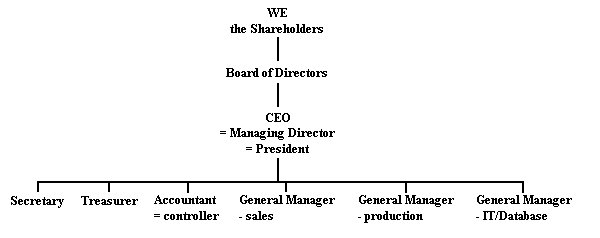
We will now look at the positions in the above map of a typical company.
Some important players
Some important players are:
- shareholders:
- buy shares from company's agent when company issues new shares
- buy shares from other shareholders on the open market
- 'small' shareholders are rarely treated with respect by CEO, directors and 'large' shareholders.
- 'small' shareholders have no say in the running of the company and cannot stop CEOs bleeding the company for personal profit.
- 'small' shareholders cannot get inside information needed for correct appraisal of company performance.
- board of directors:
- sets broad policies
- appoints a CEO
- sets officers' salaries
- recommends dividends
- authorizes long-term borrowing, share issues, large projects
- checks internal controls
- usually includes large shareholders
- supposed to protect all shareholders' rights but big shareholders are rarely interested in little shareholders
- in big companies, directors usually come from the small number of the country's elite families
- in big companies, directors often lack adequate training, experience and intimate knowledge of the accounts
- to be studied and watched very carefully
- CEO:
- CEO = chief executive officer
- responsible to the Board of Directors
- rarely tied financially to the company like the shareholders are
- expects big payout regardless of quality of performance
- to be studied and watched very carefully
- secretary:
- maintains minutes of board meetings, which contain board decisions
- represents the company in legal processes and contract negotiations
- usually maintains the register of shareholders (although this may be farmed out)
- treasurer
manages:
- the cash
- company funds (and signs the cheques with one other officer)
- plans and conrols cash position
- controller
chief accountant, responsible for:
- budget
- internal checks and controls
- accounts and financial reports
- tax returns
- other legally required documents.
- making the books produce a profit when the company makes a loss;
always study the attachment to the financial statement, carefully.
Forming a company
To form a company:
- Gather 5 or more to subscribe their names to a memorandum and
comply with the registration requirements (one person for a proprietary company)
- the memorandum
this is the initial legal document, an agreement between subscribers forming the company,
which may be changed, but will include:
- name of company
- details of company's registered share capital (if any)
- limited laibility/unlimited liability/no liability
- full names, addresses occupations of subscribers forming the company
- (may include) objectives of the company
- the articles
a second legal document containing rules for managing the company,
especially the relationships and dealings between directors and shareholders;
usually attached to the memorandum, and required for companies:
- limited by guarantee
- limited by shares and by guarantee
- unlimited
Companies limited by shares (but not by guarantee) or no-liability companies, do not need the articles.
- certificate of registration
issued by the ASC on receipt of the memorandum and articles (if any),
along with an Australian Company Number ACN.
The company is considered to be incorporated from the date on the certificate
and hencforth can:
- operate fully as a corporation
- acquire and dispose of property and plant, as a corporate entity,
- be sued and sue.
- prospectus
a prospectus must be registered with the Australian Securities Commission ASC,
and issued to investors before seeking finance through:
- shares
- debentures
- other securities
- The purpose is to provide all information for investors required for an informed assessment:
- assets
- liabilities
- financial position
- profits/losses
- prospects of the company
- the rights attached to the securities being issued
- the interests of every director in any property
which may be acquired with the money from the issue of the security
Those issuing the prospectus are open to litigation for failure to meet requirements.
Costs of forming a company
The costs of forming a company are preliminary expenses and include:
- incorporation fee
- legal fees
- promoters' and underwriters' fees
- producing and distributing the prospectus
- advertizing
- share certificates
- ASX fees, CHESS fees etc
Since the preliminary expenses will benefit the company for its life-time,
they are usally put in the accounts as a non-current asset and
amortized for a specified period, such as 20 years.
End of Company structure