Auditing
This chapter revises some of the chapter Accounting in this book.
Have you read:
Accounting >> Designing accounts ?
It is a tough chapter but does explain a lot about accounting.
Stock (UK) = inventory (US)
Stock take (UK) = count of the inventory (US)
Auditing
Auditing: is the checking of accounts to evaluate the legitimacy of the accounting methods, and the accuracy of the accounting.
Auditing is done by registered accountants called auditors.
What policies, procedures, standards, laws and regulations will the auditors have in mind as they check the accounting and accounts ?
There are two types of auditing:
- internal auditing
- external auditing
In addition to the policies and such listed above (asking you to detail them), internal auditors check the systems of control.
Systems of control: are methods within the bookkeeping processes which afford checks to ensure error-free accounts.
These controls check transactions, asset valuation, and so on. If these controls are not adequate, the auditors recommend changes to policies and procedures.
Internal auditing
Internal auditing: is auditing by the company's own internal auditors or controllers.
External auditing
Public companies must submit their financial statements to external auditors, accountants registered as auditors and independent of the company.
External auditors: are accountants registered as auditors and independent of the company.
These external auditors check:
- systems of internal control to record tansactions without error
- existence of assets
- valuation of assets
- annual stock take (goods ready for sale)
- unusual items on the books
- whether the accounts give a true and fair view or instead uses creative accounting.
Some auditing firms offer consulting services but now keep these independent of their auditing branch, to avoid conflict of interest.
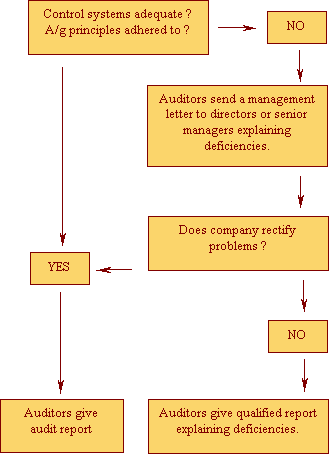
What happens if there are irregularities ?
Discussion time