Cost accounting
Overheads (UK) = overhead (US)
Cost centre (UK) = cost center (US)
Cost accounting: calculates cost of each good or service with the aim of:
- determining the selling price
- determining which goods are most profitable.
Direct & indirect costs
Direct costs: are costs that can be directly attached to a particular unit of a good.
These direct costs include materials and manufacturing wages.
Indirect costs or overheads: are costs which cannot be attached to a particular product. For example, the cost of services, electricity, water and phone; rates, salaries for administration. These indirect costs are grouped on the profit and loss account as Selling, General & Administrative Expenses.
Fixed & variable costs
Fixed costs: are costs not influenced by the number of units produced.
Fixed costs include rates or rent, interest on loans, administrative salaries.
Variable costs: are costs proportional to the nmber of units produced.
These variable costs include materials and overtime.
Total cost: = fixed cost + variable cost
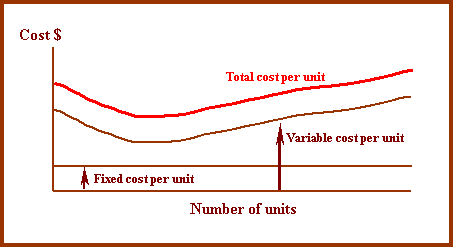
Note that the variable cost decreases as production increases till it reachesa minimum value, then, as inefficiencies creep in, the variable cost rises.
To maximize efficiency in production and costing, companies might try to apportion fixed costs and then add the variable cost, for each product.
Absorption costing: tries to all direct costs, all production costs, and perhaps all indirect costs, to each product.
Activity-based costing: costs by activity instead of by product.
Breakeven analysis
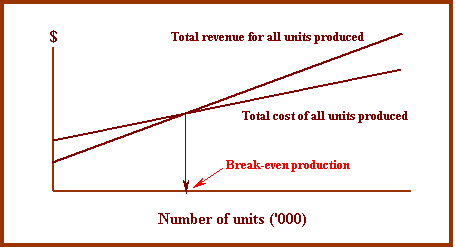
Break-even analysis: finds at what level of production, total cost = total revenue.
This is done by calculating expected costs and expected revenue for each of several levels of production. These points are plotted on a graph, and the lines drawn through the points to find where the lines cross. This intersection gives the break-even point where expected sales = expected costs.
At this level of production, the sales volume or number of units which must be sold for the company to cover its costs. With greater production and sales, it begins to make a profit.
When you go into production you will also need to consider:
- probable level of demand
- quality and prices of competitors
- your own financial position, including your predicted cash flow
- your company's objectives
- your marketing policies - to maximize profit by selling more at a lower price, or fewer at a higher price.
When I was at agricultural college in England, the most successful farmers were:
- farmers who had cheap farms resulting in low yields per hectare but low costs
- farmers who had expensive farms with high costs but high yields per hectare.
In contrast, those who had medium farms with medium yields and medium costs, were struggling.
Discussion time