| Fragment | Maximum size (mm) |
Surface area cm2 per gram |
|---|---|---|
| boulder cobble pebble granule sand fine sand very fine sand silt clay |
above 256 64 4 2 - - 1/16 = 0.0625 1/256 = 0.004 |
23 |
The bacteria in soil organic matter are specific in that they attack only one or two types of food as they eat, grow and divide into two, again and again. They also operate wqithin a temperature range - if the temperature drops too much they go into a resting stage.
Fungal hyphae are long strands growing out from the central body in search of food, secreting enzymes that enable them to burrow through cell walls into living and dead plants.
With them come masses of bacteria, some boring holes in the fungal hyphae to eat the contents, while others consume other living and dead bacteria, or finish breaking down the lignin.
Actinomycetes or branched bacteria, able to survive on lower-nitrogen diets than other bacteria, reduce woody residues and thrive in cow manure.
So everyone gets their share for converting big molecules into little molecules, spinning off:
Only the tip of the root extends, the rest just becomes thicker, pushing the soil sideways to make room for itself. Just back from the tip of the root are fine white hairs which explore all the tiny pores in the soil, flattening themselves against the surface of the soil particles drawing in nutrients from those surfaces.
The root loses root hairs and cells as it pushes through the soil; as much as 30-40% of food reaching the roots from the leaves can be lost in secretions and lost cells. The root cells secrete organic chemicals, such as amino acids, sugars, acids, vitamins, enzymes, and gelatinous substances, which, alon gwith broken cells, are consumed by bacteria growing along the root. In return the bacteria help the root collect nutrients from the soil. The mycorrhizal fungi send out hundreds of strands through the soil, carrying back nutrients to the root.
Many large organic molecules produced by all this activity, bind the soil minerals together into silt-sized particles which may last hundreds and some for thousands of years. The average age of all organic matter in soils is over 1000 years.
If the soil dries out, the bacteria coat themselves with a membrane impermeable to water, forming a spore, and wait for the return of moisture.
Atoms are balls consisting of a tiny spherical core inside a huge spherical space in which tiny electrons whizz around. The outermost electron, whizzing around, determines the size of the atom. Molecules are composed of atoms joined together by the attraction of electrons. (See the Chemistry unit for more details.)
An atom consists of a tiny tiny nucleus of tiny tiny protons and neutrons, which are amazingly heavy. Whizzing around this nucleus, but a long long distance away, are electrons. Imagine a pair of electrons whizzing around the surface of a hollow shell. At the very center of this hollow shell is the nucleus full of protons and neutrons. Now imagine more hollow shells, all concentric, all with electrons whizzing over their surface. On the outermost shell, there are up to 8 electrons whizzing around.
When we add up all the electrons on all of these concentric shells, we find the number of electrons equals the number of protons. These protons always have a positive electric charge, while the electrons always have a negative charge. The type of atom, that is the type of element, whether, hydrogen, sodium, iron, etc, is determined by the constant number of protons in the nucleus. This almost never changes, but if it does, then the atom becomes a different type of atom. For example, on the Sun, the number of protons in the nucleus of a hydrogen atom, changes from one to two. This turns hydrogen into helium, and releases enough energy to keep the sun hot.
What makes atoms join together ?
The electrons in the outermost shell gives atoms almost all their chemical and physical properties. Except for helium, all atoms want 0 or 8 electrons in their outermost shells because this gives them maximum stability.
Most atoms tend to give away the electrons in their outermost shell, and this gives those atoms the properties of metals. The few remaining atoms, the non-metals, prefer to take electrons from the metal atoms, or to share electrons with other non-metals.
Sharing electrons is called covalent bonds, as in carbon dioxide where a carbon atom shares 2 electrons with one of the oxygen atoms and another 2 electrons with the other oxygen atoms. This gives those oxygen atoms their full 8 electrons in the outermost shell. At the same time, each oxygen atom shares two of its electrons with the carbon, so the carbon ends up with 8 electrons in its outermost shell. And every one is stable. Such covalent bonds are very strong and difficult to break apart.
When a metal atom gives electrons to a non-metal, as in salt or sodium chloride, where a sodium atom gives the only electron in its outermost shell to the chlorine which has 7 in its outermost shell. Sodium loses that unstable outermost shell while chlorine gets 8 electrons, both becoming stable. Such an electron bonding is called ionic bonding.
Ionic bonding depends solely on electrostatic attraction, that is, the attraction of 2 oppositely-charged ions. Such attraction is very weak. Dissolve these salts in water and the water molecules will come between the sodium and the chlorine, separating them into free-floating ions.
All this is treated in more detail in the Science/Chemistry/Inorganic/Basics.
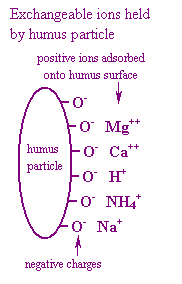
Plants take up their nutrients usually as ions, taking them from the water in the soil, or from the surfaces of mineral crystals and organic matter. On humus particles there are many negative charges and therefore many sites to attach cations, like all the metal ions, and hydrogen and ammonium ions.
However there are relatively few positive sites to attach anions, like nitrate, sulfate, phosphate molybdate, borate and chlorine ions. So these remain in water solution, and are easily leached from the soil.
| In soil as | ||
|---|---|---|
| Element | Cation | Anion |
| Nitrogen N | nitrate NO3- | |
| Phosphorus P | phosphate H2PO4- | |
| Potassium K | K+ | |
| Sulfur S | sulfate SO4-- | |
| Calcium Ca | Ca++ | |
| Magnesium Mg | Mg++ | |
| Iron Fe | Fe++/+++ | |
| Manganese Mn | Mn++ | |
| Boron B | B4O7--/HBO3--/etc | |
| Copper Cu | Cu++ | |
| Zinc Zn | Zn++ | |
| Molybdenum Mo | molybdate MoO4-- | |
When plant roots take up a cation such as K+, they exchange a hydrogen cation, H+, so maintaining electrical neutrality.
Similarly, when taking an anion, like NO3-, they exchange an hydroxyl anion, OH-.
This is easily done because water provides both:
H2O >> H+ + OH-
Where do all the ions come from ?
As soil minerals and organic matter breakdown, they release ions. These ions then become adsorbed by the soil particles or attached to the organic molecules.
Organic matter provides: