Nutrients
Contents
Intro
In most chapters, when naming elements, the abbreviated form or symbol is included after the name. This is to help you to learn these symbols.
The book Core/Science/Chemistry/Inorganic/Core1 will help you with the chemistry aspects.
Nutrients are categorised by the relative quantity consumed by plants:
- Major- or macro-nutrients:
- Nitrogen N
- Phosphorus P
- Potassium K
- Secondary nutrients:
- Sulfur S
- Calcium Ca
- Magnesium Mg
- Minor- or micro-nutrients or trace elements:
- Iron Fe
- Manganese Mn
- Copper Cu
- Zinc Zn
- Boron B
- Molybdenum Mo
- Sodium Na
- Chlorine Cl
- Cobalt Co
Remember the symbols
To help remember the symbols, note:
- potass-ium = potash; K from the Latin kalium
- magnesium has g before n, so use Mg; manganese has n before g, so use Mn
- iron but Fe from the Latin ferrum, still retained in ferric, ferrous
- sodium = soda + ium; but Na from the Latin natrium
- copper has Cu from the Latin cuprum, still retained in cuprous, cupric
Sugar
Carbon C is never listed as a nutrient because it comes from carbon dioxide, a gas which is part of the air, and is 'breathed' in through the leaves. None is taken from the soil.
When sunlight is available, the carbon dioxide is taken into the leaves, and converted by chlorophyll into sugar.
This soluble compound is then taken to other parts of the plant to:
- combine with the 'nutrients' to make other chemicals, such as lignin
- combine with oxygen from the air, turning the sugar back into carbon dioxide, but also releasing energy. In this way, the energy from the sun is carried to all parts of the plant.
Operation
By understanding how a plant uses a particular element, we can anticipate the symptoms of a deficiency. For example, nitrogen is used for making protein and for chlorophyll, that green pigment used by chloroplasts to capture the sunlight to convert carbon dioxide to sugar, which in turn provides energy to the plant.
Lack of nitrogen will therefore show:
- poor production of green chlorophyll:
- so leaves turn pale green and even yellow
- low chlorophyll reduces sugar production, so plant lacks energy
- low energy, so growth is stunted.
- poor production of protein:
- cell reproduction slows, so growth is stunted
- cannot meet high-protein needs for seed and fruit production, so this is poor.
Major elements: N, P, K
Nitrogen N
Plants use nitrogen for:
- all proteins - low protein gives stunted growth, poor seed and fruit production
- chlorophyll, the green pigment in leaves - low nitrogen makes leaves lose their green-ness, becoming pale-green, yellow with perhaps reddish tints.
In most soils, more than 95% of nitrogen is held in organic matter, as:
- amino acids
- proteins
- hexosamines
- purines
- pyrimidines
Proteins are long strings of amino acids.
Plants cannot access this nitrogen until it is converted to ammonium or nitrate ions. The microbes usually grab the ammonium ions before the plant can, and they convert it to nitrate ions. Plants have evolved to survive on what nitrate ions are available in the soil, but farmers want high yields and so have evolved plants needing high nitrate intake.
Thus farming has a nitrogen problem:
- high-yielding crops need high-nitrate soil
- repeated cropping reduces nitrates.
The farmer needs to know:
- most nitrate released by micoorganisms comes from organic material added to or formed in the soil within the previous 1 to 5 years
- very little nitrate comes from humus that has been in the soil for more than 25 years (Cultivation helps, but repeated cultivation does not.)
- growing legumes increases the nitrates if the roots are left in the soil to decompose
- nitrogenous fertilizer increase nitrates but does not directly increase the humus required for plant health
- therefore repeated applications of organic materials with sufficient levels of nitrogen are needed for good plant growth.
To increase levels of nitrogen, remember:
- Nitrate from chemical fertilizer, being in the form of anions, is easily leached down to levels below the plant roots by even sprinkler water. (see intro) Organic matter provides a slow steady source.
- Nitrogen can also be lost quickly for large amounts of succulent green high-N crops dug into the soil - it is best to plant soon after:
- immediately after mature compost
- after 5 weeks for green manures and organic residues
- Burning plant residues, such as stubble, leaves, lawn clippings and prunings, loses all nitrogen - not a good idea.
- Plant residues left to rot on the surface, may lose half their nitrogen to the air. Digging them in will reduce that loss but increase low of moisture (a problem in dry zones). It might be best to dig them in after a rain, so the surface moisture is buried too.
- The greater the nitrogen content in the organic matter, the quicker the release of nitrate to plants (from 12 months for 1.2% N in organic matter, to 3 months for 2.0% N)
- Some materials, like fallen leaves, are low in nitrogen, such that microorganisms breaking down the leaves use soil nitrogen, leaving the soil worse off.
- The ratio of carbon to nitrogen, C:N < 30:1, to ensure microbes do not reduce soil nitrates. Stubble, with its C:N = 100:1, can reduce soil-nitrogen levels, delaying crop start.
- Low-N organic materials are:
- straw
- sawdust
- dead leaves
- sticks
- paper
- High-N organic materials are:
- animal manure
- green weeds
- food scraps
- lawn clippings
- small amounts of nitrogenous fertilizer
- A solution is mixing high-N and low-N, such as lawn clippings with leaves in the ratio of 5:1. For farming, perhaps let the weeds grow before ploughing in the stubble. (But stubble can also produce toxins.) Do not mix fertilizer with the stubble to help it break down - the fertilizer must be placed in a band below the seed of the new crop.
- soil temperature of 12 - 250 is ideal, with adequate moisture and aeration.
- legumes (peas, beans, lupins, clovers, lucerne, acacias, etc) have nodules on their roots which contain nitrogen-fixing bacteria. The N-compounds they produce, are released when the roots die, thus raising N-levels in soil.
Phosphorus P
Plants use phosphorus for:
- nucleo-proteins
- growing tissue where cells are actively dividing
- developing seedlings
- root growth
- flowering
- seeds and fruit.
Symptoms of deficiency are:
- poor root development
- stunted growth
- often purplish discoloration of leaves
High rainfall areas may be deficient. Australian soils are usually deficient.
Problems with phosphorus are:
- Supplying enough phosphorus to high-demand crops, is dificult (especially in phosphorus-deficient soils like Australia)
- Phosphorus is contained in the soil organic matter, some 15 - 85% of it, and this is unavailable till converted by microbes to inorganic phosphate ions.
- Perhaps 50% of organic phosphorus is in stable parts of humus.
- The remaining 50% is in groups of compounds called:
- phytates, decomposed with difficulty by microbes
- nucleic acids, decomposed easily by microbes but ...
- phospholipids, decomposed easily by microbes but ... the microbes use most of that inorganic phosphorus for themselves, particularly when P content is < 0.2% of organic matter.
- Minerals in soils remove inorganic phosphate - so use organic phosphate to 'neutralize' them by adding organic matter to the soil
- Microbes, when consuming organic matter, produce acids which react with minerals, releasing small amounts of phosphate ions, especially in acid soils. Some of these phosphate ions are converted to organic phosphates by the microbes but some may become available to the plants. Therefore, add organic matter to the soil.
Solutions are:
- Add poultry manure, superphosphate, rock phosphate
- When making compost sprinkle in a concentrated phosphatic material
- Increasing pH from acid to near neutral will increase microbial activity and increase the release of phosphorus from organic material.
- Add organic material to:
- neutralize minerals which remove phosphate ions
- encourage microbes which produce acids which release phosphate ions from minerals
- encourage mycorrhizas, soil fungi growing around roots, which increase the effective root nutrient-gathering by up to 60 times
Potassium K
Calcium Ca & Magnesium Mg have similar chemical properties as potassium, and so exist in the soil in the same form.
Plants use potassium for:
- chlorophyll
- strengthening cells
- movement of water within the plant
- resist disease
- flowers, fruit, seeds
Sandy soils in high rainfall areas may be deficient.
Deficiency causes:
- older leaves become floppy, yellow or brown tips or scorched margins (Mg and K are mobile, shifting to younger leaves if need arises.)
- weak stems
These metals occur in soil in 4 main forms:
- soil water
- adsorbed on minerals and organic matter
- in compounds of relatively insoluble minerals
- as part of soil inorganic matter
Organic matter provide these 3 elements by:
- decomposition giving all 3 elements as ions.
- acids from decomposition attack soil minerals, releasing all 3 as ions
- humus particles having large surface areas with many negatively-charged sites ready to hold the positive ions in a form readily available to plants, yet safe from leaching.
- almost all dead plant material providing all 3 elements, but with green manure crops superior in these and all other essential elements:
- tick beans
- vetch
- lupins
- barley
- oats
Secondary elements: S, Ca, Mg
Calcium Ca, Magnesium Mg
See Potassium above. In the Periodic Table calcium and magnesium are in Group II, next to Group I, and so have very similar properties.
Calcium is used for:
- construction and strength of plants
- functioning of growing tissue, especially in root tips
- neutralizes acids in cell sap
In soils, calcium reduces acidity, and is rarely deficient except in extremely acid soil.
Magnesium, a rarely deficient, is used for:
- a small part of the chlorophyll
Magnesium deficiency causes:
- older leaves to turn yellow (Mg and K are mobile, shifting to younger leaves if need arises.)
Sulfur S
Plants use sulfur for:
- proteins
- chlorophyll formation (although Sulfur does not occr in chlorophyll)
Symptoms of deficiency are:
- similar to N-deficiency
- stunted growth
- yellow leaves
The sulfur facts are:
- Burning organic materials oxidizes the sulfur in the organic molecules, into sulfur dioxide which escapes into the air - not a good idea.
- Ample sulfur is needed for microbes to release nitrate from soil organic matter to plants.
- Sulfur is only available as sulfate ions, which are readily leached form the soil by rain and irrigation. Organic matter can provide a slow release source of sulfur.
- Organic matter contains 50-70% of sulfur in most surface soils, as:
- amino acids
- complex humus compounds
- organic/sulfate compounds
- Plants take up sulfur mostly as sulfate ions, so organic matter must first release them.
- Organic matter releases sulfur by:
- the sun's heat:
- Hot sun-baked soil breaks down organic matter and releases sulfates, making them more available after a hot dry period.
- Rewetting the soil dissolves the sulfates, ionising them and making them suddenly available.
- microbial action:
- converts organic sulfur to sulfate ions, (and sulfate ions to organic sulfur)
- but requires carbon to sulfur ratio, C:S < 50:1 for there to be a net gain in sulfate ions.
- High-sulfur organic matter includes cabbage and cauliflower leaves
- High-sulfur organic material includes gypsum or calcium sulfate. Superphosphate is about 50% gypsum. The sulfate ions are slowly released from the gypsum into soil water where it is taken up by plants or by microbes (who turn it into organic matter).
Minor or trace elements: Mn, Fe, Cu, Zn, B, Mo
Trace elements are growth regulators or enzymes (catalysts) for making chemical compounds inside plant cells.
Organic matter formed from whole healthy plants will contain all nutrients, but some plants have greater amounts than others.
Availability of nutrients from organic matter depends upon:
- type of plants
- the part of the plant used for manure (assuming some of the crop has been harvested)
- soil used to grow the plants (and its provision of nutrients to the plant)
- interaction between plant residues, microbes in the soil and soil minerals.
Manganese Mn
MaNganese = Mn, compared to MaGnesium = Mg. In each case the first and third letters are combined to make their symbol.
Manganese is used for:
- similar role to iron
- making proteins
Deficiency symptoms are:
- similar to those of iron
- young leaves show yellowing, especially between the veins
- stunted growth
The manganese facts are:
- In neutral and alkaline soil, organic matter interacts with manganese like copper does.
- In very alkaline soils with excess lime, dolomite or wood ash (after forest fire) organic matter can aggravate manganese deficiency by holding onto manganese. Adding large amounts of orrganic matter to a well-aerated calcareous soil may produce severe manganese deficiency in many plants.
- In mildly acid soils (pH 5.5 - 6.5) organic matter is often beneficial in regulating manganese supply.
- In very acid soils, manganese toxicity can be a problem. Addition of organic matter can worsen this problem. Rescue by adding lime to reduce acidity to above pH 5.5.
Iron Fe
Iron is used for:
- making chlorophyll, although not in the chlorophyll
Deficiency shows as yellowing of young leaves because iron is not mobile (like magnesium and potassium) and so cannot move from older leaves to younger ones. (It is helpful to think about this and understand it.)
Alkaline soils are more likely to be deficient [see diagram below.]
The iron facts are:
- Iron chelates, organic forms of iron, last longer than inorganic iron which can be precipitated as insoluble iron oxide, which plants cannot use. Synthetic iron chelates can be sprayed onto the leaves or applied to the soil.
- Iron becomes much less available when the pH increases into the alkaline range.
Click for close-up.
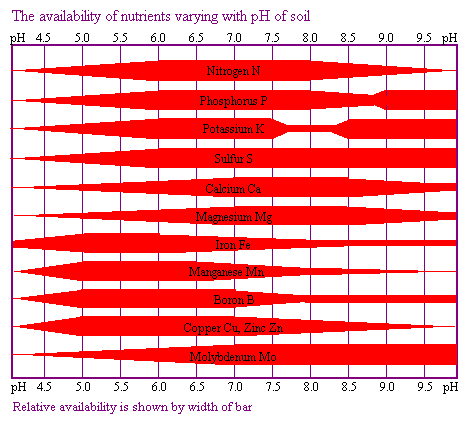
- Green manuring of alkaline soils can produce iron chlorosis (severe iron deficiency).
The green manure produces coarbon dioxide. The calcium carbonate in alkaline (calcareous) soils, reacts with moisture and the carbon dioxide to produce calcium bicarbonate which inhibits the availability of iron to some plants. The solution is to wait a few weeks between digging in the green manure and planting.
Copper Cu
Copper and zinc are:
- enzyme activators (enzymes are organic catalysts, that is, they make chemical reactions happen or accelerate them, without being used up, so little is needed)
Deficiency symptoms for Cu & Zn are:
- leaf mottling
- young leaves go yellow (what does this say about the mobility of Cu and Zn ?)
- Zinc causes 'little leaf' in citrus trees.
Deficiency is more likely on very acid sandy coastal soil; in Australia, also on fertile black earth soils in dry inland areas.
The copper facts are:
- Plants need only minute amounts of copper.
- Plants get most of their copper from organic complexes in the soil.
- High doses of copper, such as from the fungicides copper oxychloride and Bordeaux mixture, can poison plants, particularly if soil organic matter or pH is low.
- Soil organic matter readily combines with copper so it is not leached but remains available to plants.
- Copper can be added with copper sulfate of finely ground copper ore.
Zinc Zn, Boron B, Molybdenum Mo
For Zinc, see Copper above.
Boron is used for:
- growing tissue in young shoots
- flower buds
- fruits
Deficiency of B causes:
- breakdown of internal tissue and corkiness:
- in apples, turnips, beetroot where it is called 'brown heart'
- in stems of celery, silver beet
- in flower buds of cauliflower and broccoli.
Deficiency of B is more likely on alkaline soils or those heavily limed.
Molybdenum is used for:
- growth regulation for building proteins from nitrates (most nitrogen in plants comes from nitrates in the soil)
Deficiency symptoms of Mo are:
- 'whiptail' in cauliflower, brussels sprouts,, other cabbage falmily members
Deficiency of Mo is most common in acid soils in high rainfall areas. Often this is rescued by application of lime to release the molybdenum. As little as 25g per hectare will be sufficient.
For all 3 elements, Zn, B & Mo, the facts are:
- Organic matter has little effect on the supply of these elements except for providing:
- a steady supply
- adsorption sites on humus particles for ions/li>
- On alkaline soils, organic matter assists the supply of zinc to plants.