Acids include lemon juice, vinegar, stomach juices, battery acid, muriatic acid; usually sour to taste. Hence acid soils are called sour soils, while alkaline soils are called sweet. However, do not be fooled - alkaline soils can kill plants.
pH is just a numerical meazure over a range of acidity to alkalinity, with pH equal:
Most agricultural land lies in the range 4.5 to 9.
Why is pH so important ?
Nutrients are carried through the soil to the roots by water.
The solubility of nutrients varies with pH.
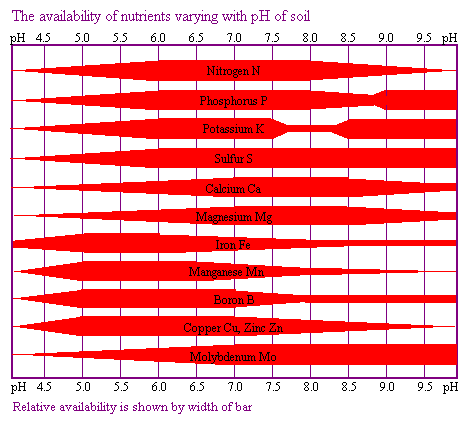
Such acidity can be reduced by adding an alkali in the form of:
Beware of calcium oxide which, with water, generates heat enough to blow up into your face.
Avoid putting on too much, since, by raizing the pH too high, you can damage your crop production.
Clay soils need more lime than sandy soils for the same effect, but that lime will also make the clay friable or crumbly, which is good for tilling the soil.
Add lime at the rate of 120g/m2 or 1.2t/ha for clay, but one-quarter of this for sandy soil. If it disappears within a few months and the pH is still too low, add more.
Strongly acid soil eliminates small animals like earthworms. Thus a peaty layer often develops. Otherwise soil pH has little effect on the amount of organic matter in soils.
High alkalinity can be reduced by:
What pH is right for you:
Obviously, the cheapest way of overcoming difficult pH is to grow the crops that like that pH.
This table shows the acid tolerance of common vegetables.
| Acid tolerance | pH down to | Vegetables |
|---|---|---|
| Very | 5.0 | potato, rhubarb, shallot, watermelon |
| Moderately | 5.5 | bean, brussel sprout, capsicum, carrot, cucumber, eggplant, garlic, horse-radish, parley pea, pumpkin, radish, tomato, turnip |
| Slightly | 6.0 | asparagus, beet, broccoli, cabbage, canteloup, cauliflower, celery, leek, lettuce, onion, parsnip, siver beet, spinach |
| pH | Described as ... | Coments |
|---|---|---|
| 4.0 - 5.5 | strongly acid | All major nutrients - N, P, K, Ca, Mg, S, plus Mo - are almost unavailable.
pH 5.0 - 5.5 is liked by: (1) lime-hating plants like azalea, camelia, erica, gardenia, rhododendron. (2) potato, sweet potato, watermelon. |
| 5.5 - 6.0 | medium acid | Liked by:
(1) amaryllaris, cineraria, clematis, cyclamen, dianthus, ferns, fir trees, junipers, lupin, magnolia, orchids, veronica, weeping willows, most bulbs, and many garden plants will tolerate it; (2) Australian native shrubs and trees (and probably African too, since the soil, climate and vegetation are similar). (3) pineapple (the only fruit which likes this acidity). |
| 6.0 - 6.5 | slightly acid | Liked by most vegetables and herbs. Most plants like pH 6.0 - 7.0. |
| 6.5 - 7.0 | very slightly acid | Liked by most vegetables and herbs. Most plants like pH 6.0 - 7.0. |
| 7.0 - 7.5 | very slightly alkaline | |
| 7.5 - 8.0 | slightly alkaline | P, Fe, Mn, B, Cu, Zn poorly available. |
| 8.0 - 8.5 | medium alkaline | P, Fe, Mn, B, Cu, Zn poorly available. |
| 8.5 - 10.0 | strongly alkaline | N, Fe, Mn, cu, Zn poorly available; Ca, Mg with reduced availability. |
Between pH 6.0 and pH 8.0, all elements are available, if they are in the soil. Thus most plants grow well if soil is between pH 6.0 and 7.0.
In Australia, high rainfall areas on the coast and eastern highlands are naturally acidic, between pH 5.0 and 6.5, but some as low as 4.0.
Dry inland areas move up to nearly neutral, that is, just below pH7.0. Some reach slightly alkaline at pH 7.5 - 8.5.
Soil pH can be tested with a Soil Test Kit, by mixing the liquid indicator with a small soil sample to form a paste. A second chemical is added to the paste, and the resulting color matched againsta color chart, to see the pH. The colors grade to give pH at 0.5 intervals.
A bitumen road will raize the pH on the downhill side, where rain runoff goes, damaging native vegetation. A bitumen or concrete car park will starve the ground of organic matter, water and oxygen, eventually killing all microbial activity.
Fertilizers should be applied in small amounts often, instead of big amounts.
This table looks at the disadvantages of some fertilizers (other than cost of fertilizer and application).
| Fertilizer | Advantage | Disadvantage |
|---|---|---|
| Ammonium sulfate/phosphate | adds nitrogen | Several disadvantages are:
|
| Urea | adds nitrogen | as for ammonium salts |
| Calcium/sodium nitrates | adds nitrogen | Make soil alkaline. Use sulfur (expensive) or an acidifying fertilizer to counteract this. |
| Gypsum | affects salinity, not acidity or nutrient levels | Has no effect on pH below 8.3; is not a liming agent, and may slightly decrease soil pH. |
| Superphosphate | adds phosphorus without altering pH | The acidity of the leachate from a granule of superphosphate is balanced by the alkalinity of the remaining calcium hydrogen phosphate, leaving the pH alone. However, the resulting increased pasture growth may increase organic matter building up under the pasture, and their organic acids may lower pH. Regular cropping of pasture prevents such buildup. |
This table gives the amount of lime or sulfur to restore the soil pH after using fertilizers.
| Kg needed to neutralize 1kg of fertilizer | ||
|---|---|---|
| Fertilizer | Lime | Sulfur |
| sulfur ammonium sulfate urea ammonium nitrate ammonium phosphate superphosphate sodium nitrate |
2.8 1.0 0.75 0.6 0.5 0.2* -- |
-- -- -- -- -- -- 0.2 |
| gypsum | Does not affect pH < 8.3 | |
* An educated guess; but see superphosphate in the preceding table.
If your soil is already acid, be careful about adding acid fertilizers. Usually soils covered with thick pasture tend to be acidic, if only because decaying organic matter produces organic acids.
The most common cause of toxic elements in the soil are:
| Fertilizer | Formula | Salt index |
|---|---|---|
| Potassium chloride | KCl | 116 |
| Ammonium nitrate | NH4NO3 | 105 |
| Sodium nitrate | NaNO3 | 100 |
| Ammonium sulfate | (NH4)2SO4 | 69 |
| Potassium sulfate | K2SO4 | 46 |
| Superphosphate | Ca(H2PO4)2 + CaSO4 [1:1] | 8 |
| Urea | CO(NH2)2 | 75 |
Plant roots need oxygen. apart from mangrove plants which put their roots above the water level, and some wetalnds plants, those in soil saturated with water for more than a few days will begin to drown.
An expensive cure is to put in deep drains or drain pipes to remove the water.
Lack of water for a few hours can cause wilting and reduce growth. Plants lose a lot of wate out through their leaves (transpiration) and need water to assist the chemical processes for living, growing and reproducing. The plant needs more water BEFORE the leaves show signs of wilting - the chemical processes will have slowed down and take several days to return to normal speed.

Many plants exude chemicals from their leaves or roots to inhibit the germination of seed, including their own, and the growth of competitors.
In rainforests you may find scores of seedlings up to 600mm high, held in check for years by these toxins and lack of light, until the dominant tree is blown over. Then the toxins stop and the seedlings grow frantically to win their space in the canopy.
Old peach roots, many vegetables such as cauliflower, cabbages, turnips, swedes, broccoli,and the brassicas, release toxins which can inhibit germination and growth of succeeding crops, especially of their own kind, for many months.
Therefore, rotate crops - do not plant the same crops on the same plot, for 2 succeeding years.
Folklore has it that some plants are beneficial to others.
Weeds, besides taking nutrients from the soil, also exude chemicals which can inhibit germination and growth of crops.
Examples are: thistles, wire weed, summer grass, fat hen, pig weed, chinese lantern, barnyard grass, evening primrose.
Soil microorganisms also produce inhibiting chemicals, like those associated with rotting straw. The toxins produced by these microorganisms are later broken down after a few weeks to non-toxic chemicals.
This problem can be avoided by:
Herbicides can: