- difficulty in digging; difficult root penetration
- poor water penetration - see surface crust and compaction
- poor water drainage; waterlogging in wet
- surface crust, especially when drying, usually caused by too much sodium preventing the clay particles from aggregating. The crust prevents emergence of seedlings, increases rain runoff, and makes digging difficult.
- compaction
Heavy machinery and ploughing with moldboard plough, when clay is wet, causes smearing which creates a water-tight seal, preventing drainage and turning root growth along surface of compacted layer. The plough creates this smear at the tip of the board, about 230mm below the surface. Rotary hoes with bladeds spinning vertically (on a horizontal shaft) do the same. Machinery can cause compaction much deeper. Hard-hooved animals compact the surface and immediately below.
In England, big machines are used to pull 1 meter deep splines through the paddock, to tear up the compacted layer - cloddiness
- expands when wet; shrinks when dry
- cracking when dry, damages roots, causes rain to disappear down deep cracks
- all of which are caused by:
- lack of sand-sized articles to break up the silt
To create loam, add sand to clay in ratio 3:5. That is a lot of sand; but even a little bit helps. - mostly silt-sized particles which glue together when wet
- types of clay minerals
- too much sodium
Too much sodium can cause crusting and poor water penetration. Adding gypsum at 500g/m2, spread evenly,enables the calcium to push sodium off the clay particles, allowing them to aggregate into small clumps around which water and air can percolate.
to test whether gypsum will be useful, drop a 6mm dry fragment of soil into a glass of rainwater or distilled water (pure) and let it stand for 24 hours. If the fragment is surrounded by a milky-brown halo, the soil will respond to gypsum. The milkinees is caused by the clay dispersing. The greater the milkiness the more effective will be the gypsum.
If there is no milkiness, repeat the test with wet soil. Add just enough water so the soil can be rolled between the fingers into a (tiny) 0.3mm diameter thread. Break off a small piece and drop it into water. If a halo appears, adding gypsum will help prevent structural damage under wet conditions (like compaction).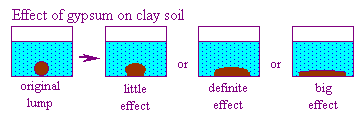
- too little organic matter (humus)
When organic matter breaks down, the humus produced binds the soil particles into aggregates or crumbs; the soil structure becomes more open and water, air and plant roots can move through it more easily. With time, the humus disappears, so keep adding.
As discussed above, it is safer if organic matter is composted before adding to the soil. Use anything from fallen leaves to sawdust and manure to seaweed, but balance them. Low nitrogen materials like sawdust and leaves should be mixed with high nitrogen materials like lawn clippings, weeds and kitchen scraps.
- lack of sand-sized articles to break up the silt
- do not hold water
- allow rain to leach nutrients quickly
- therefore 'drought' and starvation are perils. The solution may be:
- add clay soil
- add organic matter, preferably as compost. Compost:
- is a slow release fertilizer
- generates its own moisture with decomposition of organic matter
- use insoluble or slow-release fertilizers rich in nitrogen, potassium, phosphorus and sulfur
- with less than 8% clay, sandy soils become water-repellant because their grains become coated with secretions of a fungi. Rain may sit on the surface, unable to soak in, until evaporated. Turning over the top few centimeters just after a light rain may be worth the cost in times of drought.
During 2 years, I planted 2000 trees on ground which was up to 80% rock; so rocky that when a hole was dug to plant a tree, all that was left was a hole - soil had to come from elsewhere.
Having watched those trees grow for the first 4 years, I learnt surprising things:
- the rocks do not necessarily render the land 'useless' or barren; ground which is rockier may produce better growth - this is probably more due to underground moisture.
- the rocks are less important than the soil matrix and the underlying moisture
- rocks can force the roots to go downwards more quickly, away from the hot tropical sun which damages them, and so protects the tree from drought (there was a 3-year drought but only one-quarter of the trees failed)
- rocks make a good substitute for mulch because they shield the seedlings roots from being baked by the sun, (roots die at 350C). Through the night, rocks present cold surfaces for the dew to condense and drip to the ground. In contrast, rotting mulch is warm. Rocks also allow the rain to flow to the ground and prevent an emerging sun from evaporating it. Mulch can pack down to tightly for rain to penetrate, thus causing rain to run off or sit there till evaporated.
- on Java in Indonesia, I watched a farmer plant a tuber in a hollow in solid volcanic rock. Obviously he had put the rich red soil into that hollow. The leaf of the tubers grow on stalks about 2.4 meters high. It disturbed me to see such desperate poverty, and I watched in respectful silence.
His father and himself had tried to clear the rocks because every rock displaces grass, but after decades, they admitted defeat, for removing rocks only allowed others to grow in their place. Translate this into "removing rocks increases erosion, erosion uncovers more rocks", and I have to agree. Removing rocks might work on flat land but only if the percentage of rocks-to-soil is very low. On our land there was not enough soil.
Following the Chinese method of terracing might help, but wet-rice is a unique agriculture productive enough to repay such intensive capital works.
In many places, farmers have improved the land by using the rocks for fences built by dry-stonewalling:
I'm a dry stonewaller
All day I dry stonewall.
Of all appalling callings,
dry stonewallings
worst of all [anon]
When I was a kid, we let the stumps dry over 2 years, then lit a fire on top. Once lit, the fire would burn slowly for a week, eating down along the roots, for meters.
An Australian invented a stump-jump plough, which, when it hit a stump, instead of burying in, would flip up out of the ground, then settle back down once the stump was passed. Only for the rich.
| Regional type | ||
|---|---|---|
| Root growth | Temperate | Tropical |
| Minimum Optimum Death |
70C 25-280C 350C |
12-160C 25-280C 350C |
- organic mulches keep plant roots cool in summer
- mulches of black or gray plastic can cook roots in summer but in winter increase warmth
- organic mulches can retard winter growth in cool climates by keeping roots too cool (but if mulches are actively decaying they generate heat - check with thermometer if available)
- applying cold water can chill roots and retard growth; may delay maturity.
- poor and spindly growth may be due to excessive shade.
- indoor plants are usually forest plants that have evolved in the shade.
- most vegetables and fruit trees need ample sunlight.
- in hot climates do not water vegetables in the morning, or the hot sun will steam them.
- very loose soil prevents close contact with roots, which then cannot get enough water and nutrients (always compact the soil after planting)
- crowding increase competition for nutrients and sunlight.
- wet soil - do not cultivate wet clay soil - cultivating destroys soil structure, removing permeability to water and air, and reducing availability of phosphorus - wait till soil aggregates do not glisten with water.