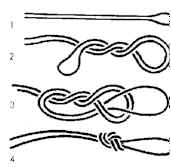
A loop for snap-on tackle
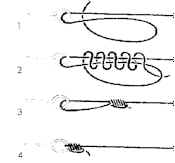
For adding tackle with eyes
Fishing tackle, also called fishing gear, is a general term that refers to the equipment used by fishermen while fishing.
Almost any equipment or gear used for fishing can be called fishing tackle.
Some examples are lures, bait, lines, rods, reels, nets and trawls, downriggers, outriggers, gaffs, harpoons, clevises, floats, and traps.
Gear that is attached to the end of a fishing line, such as hooks, leaders, swivels, sinkers and snaps, is called terminal tackle.
The beginner should read the chapter "Basic tackle".
When getting started in the sport of fishing, you don't need fancy and expensive gear. A hook and a length of fishing line will catch fish! You might like to start with a handline (about 100m of fishing line wrapped onto a plastic ring called a caster) This will help give you the "feel" for catching fish. You will get to know the feel of a fish taking the bait and how a fish runs and fights. You wont be able to throw (cast) the line as far as a rod and reel, and a handline is best used off a wharf, jetty or boat.
A good size line for your handline is about 4 kg breaking strain. Lighter line works best, thicker line can be seen by the fish and it gets dragged around by the wind and current. Also with lighter line, you can "feel" the fish messages.
Add a hook, sinker and bait (more about that below) and you're ready to go fishing!
A fishing line is a cord used or made for fishing.
Fish are caught with a fishing line by encouraging a fish to bite on a fish hook, although with squid and some fish, the animal's body can be hooked by suddenly jerking the line. A fish hook will pierce the mouthparts of a fish and may be barbed to make escape less likely. Another method is to use a gorge, which is buried in the bait such that it would be swallowed end first. Most fish, like couta and salmon, swallow their prey whole. Tightening the line fixes it cross-wise in the quarry's stomach or gullet to fix the capture.
Fishing with a hook and line is called angling. Once hooked, a heavy fish may be landed by landing net or hooked pole called a gaff. With barbless hooks, use a net because rising out of the water panics the fish into violent thrashing, enough to come off the hook. Barbed hooks necessitate cruel treatment to remove them, but not as cruel as the usual treatment of letting them die slowly in a bucket, or as cruel as being swallowed whole by another fish to die by digestion. Life is cruel. In the food chain, the only species which has it easy, is the recreatioal fisher, only rarely enjoyed by a shark or a crocodile.
Important characteristics of a fishing line are:
Trolling is a technique in which a fishing lure on a line is drawn through the water. Trolling from a moving boat is a technique of big-game fishing and is used when fishing from boats to catch large open-water species such as tuna and marlin. Trolling is also a freshwater angling technique most often used to catch trout. Trolling is also an effective way to catch northern pike in the great lakes. It's also good for muskellunge in deeper lake using large baits also known as crankbaits or other big baits using strong line. This technique allows anglers to cover a large body of water in a short time.
Two of us troll for Pacific salmon around our huge bay (about 9km across), moving till we make a strike, which signals there is a school below, then oscillating over that spot till they move on. Speed of the baitless lure dancing in the water, is essential to attract salmon. Two schools yields our self-imposed limit of 20 fish, to share with friends.
Long-line fishing is a commercial fishing technique that uses hundreds or even thousands of baited hooks hanging from a single line.
Snagging is a technique where the object is to hook the fish in the body. Generally, a large treble hook with a heavy sinker is cast into a river containing a large amount of fish, such as a Salmon, and is quickly jerked and reeled in. Due to the often illegal nature of this method some practitioners have added methods to disguise the practice, such as adding bait or reducing the jerking motion.
In case you think that expensive lines are a necessity, here are some old ideas.
Fishing lines were often constructed from horse hair or silk thread, with catgut leaders. From the 1850s, modern industrial machinery was employed to fashion fishing lines in quantity. Most of these lines were made from linen, silk, and more rarely cotton or flax, sometimes with a waterproofing compound added during line manufacture.
Modern fishing lines intended for spinning, spin cast, or bait casting reels are almost entirely made from artificial substances, including nylon, polyethylene, Dacron and Dyneema (UHMWPE).
The most common type is monofilament, made of a single strand, and favored because of its buoyant characteristics and ability to stretch under load to reduce risk of breaking.
Recently, other alternatives to standard nylon monofilament lines have been introduced made of copolymers or fluorocarbon, or a combination of the two materials. Fluorocarbon in particular is well regarded for its refractive index, which is similar to that of water and as a result less visible to fish. Fluorocarbon is also a more dense material, and therefore, is not nearly as buoyant as monofilament. Anglers often utilize fluorocarbon when they need their baits to stay closer to the bottom without the use of heavy sinkers.
There are also braided fishing lines, cofilament and thermally fused lines, also known as 'superlines' for their small diameter, lack of stretch, and great strength relative to standard nylon monofilament lines. Both braided and thermally fused 'superlines' are now readily available.
Fly lines consist of a tough braided or monofilament core, wrapped in a thick waterproof plastic sheath, often of polyvinyl chloride (PVC). In the case of floating fly lines, the PVC sheath is usually imbedded with many 'microballoons' or air bubbles, and may also be impregnated with silicone or other lubricants to give buoyancy and reduce wear.
In order to fill up the reel spool and ensure an adequate reserve in case of a run by a powerful fish, fly lines are usually attached to a secondary line at the butt section, called backing. Fly line backing is usually composed of braided dacron or gelspun monofilaments.
All fly lines are equipped with a leader of monofilament or fluorocarbon fishing line, usually (but not always) tapered in diameter, and referred to by the 'X-size' (0X, 2X, 4X, etc.) of its final tip section, or tippet.
Wire lines or tracers are frequently used as leaders to prevent the fishing line from being severed by toothy fish. Usually braided from several metal strands, wire lines may be made of stainless steel, titanium, or a combination of metal alloys.
When you think it's time to progress further than a handline, it's time to visit your local tackle shop to select your first rod and reel.
Select a good medium priced outfit. There are some very cheap rods and reels on the market, but these may break easily and in the long run you will be better off buying a better quality outfit. When visiting your local tackle shop, discuss with the staff the type of fishing you would like to do, and tell them you're a beginner. This way you will get an outfit that is suitable to your needs.
There are several types of reels that you can choose from:
Each one of the above reels is suited to a particular type of fishing. When you're starting out choose one of:
A medium sized, lightweight threadline that holds 150 - 250 metres of 3-6 kg line will cover most fishing conditions.
A lightweight sidecast reel with a fairly large spool, say around 14 cm diameter, will hold plenty of line, be easy to cast, quick to wind in and not be prone to twist and tangles.
Always look after your reels. When you have finished fishing for the day, wash it down with some mild soapy water and oil the moving parts about once a month. This way, your reel will be in good condition for the next time you want to go fishing.
Now that you've chosen your reel, you need a rod to match. There are many types of rods to choose from, made from many types of materials. The rod needs to match your reel, and this is where good advise from your local tackle store comes in handy. Take your time when choosing a rod. Try using some of your friends, or most tackle shops have some that you can wave around a bit! A rod should be light enough for you to fish all day, and not tire you, but be strong enough to help you pull in that big fish.
If you have chosen a threadline reel, choose a rod that is about 1.7 to 2.2 metres long, with a light tip and a stiffer lower end. If you will be fishing from the beach, rocks or a wharf using a larger threadline, choose a slightly longer and heavier rod.
Rods can be one or two piece. The two piece rod transports and stores easily. Care for your rod the same as your reel - wash it down with mild soapy water after each fishing trip.
Well, you've got your rod, reel and line. Now we need what is called the Terminal Tackle. These are the bits and pieces to put it all together and make it work (that is catch fish)
Obviously the most important type of terminal tackle is the hook. There are numerous types of hooks in all shapes and sizes, but to start out you will only need a few types.
Example of Hook Sizes:
Smaller Hook 16, 14, 12, 10, 8, 6, 4, 2, No.1, 1/0, 2/0, 3/0, 4/0, 5/0, 6/0 Larger Hooks
Hook sizes can be confusing, as the larger the number - the smaller the hook when sizing is below a No. 1 (a good all-round hook size for general fishing) After No. 1 the numbering system changes and the larger the hook, the bigger the number. By the way - 1/0 is pronounced as "one-oh" in Australia or sometimes "one-naught".
To have a good range of hook sizes to suit your needs when beginning, buy some No. 12, 6, 4, 1, 2/0, 4/0 and 6/0. Your tackle shop will be able to advise you on what type of patterns will suit you. Get a few "long shank" hooks as well. These are easy to remove from fish and can stop some toothy fish biting through your line.
Always make sure your hooks are SHARP. Use a hook hone or a fine file to touch up the point each time you go fishing.
Sinkers are lead weights that come in many weights, sizes and shapes. They help you to cast and get the bait down to the fish. There are only a few types that you need to get started. Two very useful ones are the Ball Sinker and the Bean Sinker. These have a hole through the middle, through which you thread your line and they can move freely up and down the fishing line. Buy a few of each in different sizes. Remember, use the lightest and smallest sinker that does the job of helping you to cast and getting the bait to the fish.
Swivels are made of brass or stainless steel with a body and an eyelet at each end. They do just what the name says - swivel. They join pieces of line together in a rig and take the twist out of your line (which can cause tangles) They are numbered the same way hooks are, and as a general rule, the smaller the better (to suit the line) For fishing with a threadline, choose No. 12 and No. 10 sizes. For beach or rock fishing with a heavier line, choose about a No. 8.
These do what the name says - Float! They are used to keep your bait from sinking to the bottom. You can set the depth from just under the surface to just above the bottom.
There are several different types of floats to choose from. Popular types are the quill, bobby cork, bubble and pencil. For general fishing one or two pencil floats and light bobby corks are all you need.
Bait is the thing you put on your hook to entice fish to eat. Below are a few types of bait you can use. Since fish see the bait and taste the water around it, lures must look like escaping fish, and the bait must not be touched with hands smeared with motor oil, fuel, suncream.
There is a wide choice of baits you can use for freshwater, they can be used live, fresh, frozen, dried or salted:
With saltwater baits there is a very large range. Following are just a few. They can be used live, fresh, frozen or salted:
You just need a few basic knots to get you started, and once you've mastered these, you won't have to learn many more to see you through your fishing life.
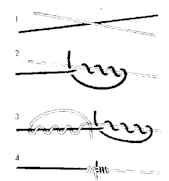
For joining 2 lines
A loop for snap-on tackle
For adding tackle with eyes