Line fishing - hooks
Contents
Naming the parts
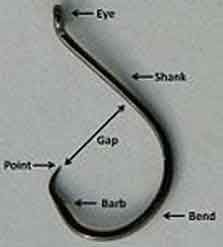
Definition
A fish hook is a device for catching fish either by impaling them in the mouth or, more rarely, by snagging the body of the fish.
Hook types
There are many types of fish hooks, promoted to match the fish's physique, behaviour and eating preferences, as well as the personal preference of the fisher and his belief in the superiority of a particular design.
Compare with
previous
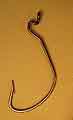
Hook types
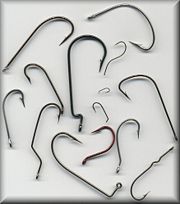
3 hook types
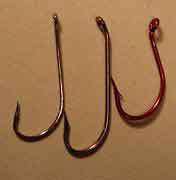
Triple hook
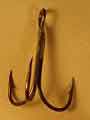

Single, double,
treble hooks
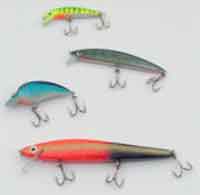
Hook attached
to lure
3-hook lure

Plastic worm

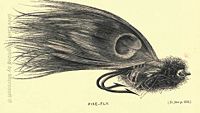
Fly lure

Pliers hold hook

Many fly lures
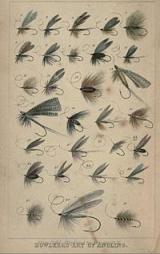
fly detail
3 broad types:
- bait hooks
- fly hooks
- lure hooks.
Fish hooks are manufactured for a range of purposes from general fishing to extremely limited and specialized applications. Fish hooks are designed to hold various types of artificial, processed, dead or live baits (Bait fishing); to act as the foundation for artificial representations of fish prey (Fly fishing); or to be attached to or integrated into other devices that represent fish prey (Lure fishing).
Differences
Within each of these 3 categories, hooks differ in:
- size
- thickness
- shape:
- materials
- hook:
- eyes
Differences - detail
In detail, hooks differ in:
- size: Hook sizes are referred to by numbers ranging from 32 (the smallest) to 20/0 (the largest). The numbers do not represent any specific measurement of a part or portion of the hook, but they do represent a relative size. For hook sizes from 32 to 1, the larger the number, the smaller the hook. For hook sizes from 1/0 (one aught) to 19/0, the larger the number, the larger the hook. There is no internationally recognized standards' body for hooks and thus size is somewhat inconsistent between manufacturers. However, within a manufacturer's range of hooks, hook sizes are consistent.
- thickness: matches the strength of the metal to the strength of the fish.
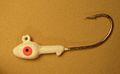
- shape: for hooking efficiency, The shape of the hook shank can vary widely from merely straight to all sorts of curves, kinks, bends and offsets. These different shapes contribute in some cases to better hook penetration, better fly imitations or better bait holding ability. Many hooks intended to hold dead or artificial baits have sliced shanks which create barbs for better baiting holding ability. Jig hooks have are designed to have lead weight molded onto the hook shank. Hook descriptions may also include shank length as standard, extra long, 2XL, short, etc. and wire size such as fine wire, extra heavy, 2X heavy, etc.
- shank: the straighter portion of the hook that connects the point and the eye
- bend: the pronounced curve between the shank and the point.
- gap: the distance between the shank and the point.. It has to be big enough to curl around the fish's lips.
- materials: for corrosion resistance, weight, strength. Modern hooks are manufactured from either high-carbon steel, steel alloyed with Vanadium, or stainless steel, depending on application. Most quality fish hooks are covered with some form of corrosion-resistant surface coating. Corrosion resistance is required not only when hooks are used, especially in saltwater, but while they are stored. Additionally, coatings are applied to color and/or provide aesthetic value to the hook. At minimum, hooks designed for freshwater use are coated with a clear lacquer, but you can find hooks coated in gold, nickel, Teflon, tin and different colors. Mustad, for example, produces hooks in six colors, including black.
- hook: Hooks are designed as either single hooks--a single eye, shank and point; double hooks--a single eye merged with two shanks and points; or treble--a single eye merged with three shanks and three evenly spaced points. Double hooks are formed from a single piece of wire and may or may not have their shanks brazed together for strength. Treble hooks are formed by adding a single eyeless hook to a double hook and brazing all three shanks together. Double hooks are used on some artificial lures and are a traditional fly hook for Atlantic Salmon flies, but are otherwise fairly uncommon. Treble hooks are used on all sorts of artificial lures as well as for a wide variety of bait applications:
- points: the sharp end that penetrates the fish's mouth or flesh.
Hook points are commonly referred to by these names: needle point, rolled-in, hollow, spear, beak, mini-barb, semi-dropped and knife edge.
Hook points are mechanically (ground) or chemically sharpened.. Hook points are also described relative to their offset from the hook shank. A kirbed hook point is offset to the left, a straight point has no offset and a reversed point is offset to the right.
The hook point is probably the most important part of the hook. It is the point that must penetrate fish flesh and secure the fish. The profile of the hook point and its length influence how well the point penetrates.
- barbs: the projection extending backwards from the point, that stops the fish from shaking itself off the point, and the bait from being lost.
The barb influences how far the point penetrates, how much pressure is required to penetrate and ultimately the holding power of the hook.
Some hooks are barbless. Historically, many ancient fish hooks were barbless, but today a barbless hook is used to make hook removal and fish release less stressful on the fish.
- eyes: which control the angle of both the hook and its point. Design is usually optimized for either strength, weight and/or presentation.
In many cases, hooks are described by using these various parts of the hook. Example: Wide gap, 2X Long Shank, Hollow Point, Turned Down Ring Eye Bait hook.
1, 2, 3-hook
Hooks are designed as:
- single hooks: a single eye, shank and point
- double hooks: a single eye merged with two shanks and points
Double hooks are formed from a single piece of wire and may or may not have their shanks brazed together for strength.
- treble: a single eye merged with three shanks and three evenly spaced points.
Treble hooks are formed by adding a single eyeless hook to a double hook and brazing all three shanks together.
Double hooks are used on some artificial lures and are a traditional fly hook for Atlantic Salmon flies, but are otherwise fairly uncommon. Treble hooks are used on all sorts of artificial lures as well as for a wide variety of bait applications.
Hook eyes
The eye of a hook, although some hooks are technically eyeless, is the loop of the hook where the line is tied.
Hook eyes can also be positioned in 3 ways on the shank:
- up-turned
- down-turned
- straight.
Hook eye design is usually optimized for either strength, weight and/or presentation.
Typical eye types include:
- the ring or ball eye:
- brazed eye: the eye is fully closed
- tapered eye: to reduce weight
- looped eye: traditional on Atlantic Salmon flies
- needle eyes:
- spade end: no eye at all, but a flattened area to allow secure snelling of the leader to the hook.
Safety
Hooks are often too small to handle easily, especially when our fingers are cold, or we are trying to retract a hook from a writhing fish. Hooking our own finger shows just how efficient is the design of hooks.
If a hook goes in deep enough below the barb, pulling the hook out will tear the flesh. There are two methods to remove a hook. The first is by cutting the flesh to remove it. The second is to cut the eye of the hook off and then push the remainder of the hook through the flesh.