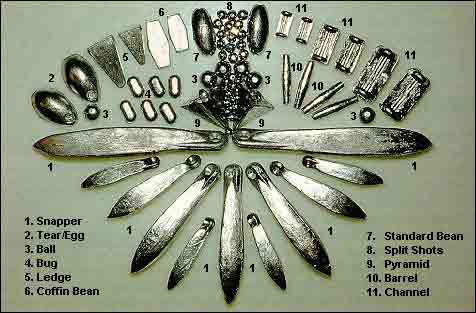
[Courtesy of Wikipedia]
Can't afford to buy sinkers ? Sinkers not available in your local shop ? Then make them.
Instead of worrying about problems, find solutions.
A sinker is a small heavy object which drags the hook or net down thru the water.
The purpose of sinkers is to provide a weight which:
Collection of sinkers
[Courtesy of Wikipedia]
There are dozens of different sinker styles, each one designed to suit a particular condition and each style comes in different sizes.
As a basic rule, you should use as little sinker weight as you can get away with, as this will usually mean your bait is presented attractively to a fish without being anchored so firmly, that a shy fish wont pick it up. Many anglers use far too much sinker weight. For example, a 45gm spring sinker for mullet is an overkill in the surf, whereas a 15 to 30gm sinker will drift around enough to let the baits move freely with the current flow and appear more natural to the fish.
The ordinary plain sinker is made of lead, shaped round like a pipe-stem, and swelling out in the middle. There are loops of brass wire on either end to attach the line. The weight is from a quarter of an ounce for trout fishing up to a couple of pounds or more for sea bass and porgies.
In the following table the ounzes have been converted to grams, for your convenience, giving peculiar quantities. In the shop choose the sinker nearest the suggested figure.
| Line breaking strain | Lure-sinker | |
|---|---|---|
| lb | ounze | grams |
| 1 2 3 5 7 9 12 15 18 21 25 | to 1/4 1/4 1/2 5/8 3/4 1 2 3 4 4 6 | to 7 7 14 18 21 28 57 88 114 114 170 |
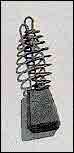
Pyramid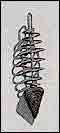
Ball
Barrel & ball
Splitshot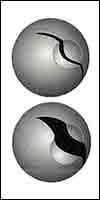
Tear or egg
Snapper_lead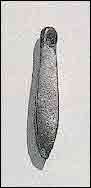
Pyramid or
star dropper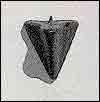
Lead is popular because:
The swivel sinker is similar to the plain one, except that instead of loops, there are swivels on each end to attach the line. This is a decided improvement, as it prevents the line from twisting and tangling. In trolling, swivel sinkers are indispensable.
Deep-water boating situations can also call for heavy weights, to get the bait down quickly to the fish and to hold against the current and tide. On other occasions though, a drifting bait or one sinking slowly with just enough weight on (usually a ball or bean sinker above the swivel and trace) can be deadly on snook, Trevally, snapper and mackerel, when the tide starts to run. Sinker weight can be altered according to the changing strength of the tide, so as to keep baits in the strike zone without sinking too quickly below it, or being whisked up to the surface with too little weight on.
In many places where tidal currents pass thru narrow and deep channels, heavy sinkers, up to 500gm, are needed to reach the bottom. Add the weight of the fish to that of the sinker, and you need a strong rod and reel.
There are various sinker types available and each has its place and time. Collect a range of styles and sizes. Duplicate them because there are few fishing stores out on river or beach where you most easily lose your favorite sinker.
The lead wheel-balances off cars and trucks, are ideal for making sinkers, but avoid lead poisoning by wearing gloves and washing your hands before eating. If smelting, avoid breathing the lead fumes.
If you do not have a drill, then hammer a hole thru with a nail, or cut a groove then hammer the lead over a nail held in the groove. Experiment.
The smallest weights available are split shots. They look like a tiny metal ball with a slice thru the middle of it. You place your line into the slice and clamp down on the lead. Unfortunately, unclamping a split shot damaging your line, and thus necessitating that you cut and retie your line when you need to alter the position of split shot.
These small weights, only fractions of an ounce, are handy when you only need a small amount of weight attached to a line. Depending on the strength of water currents and tides, they are ideal for drift-bait fishing. They can also be used as stoppers for floats, preventing the floats from running up your line when surface fishing. Split shot comes in a wide variety of sizes. Originally, there was a system of grading into sizes similar to that used for shotgun pellets. Now the weights are so varied there doesn't seem to be any effective standard of grading.
In the 14 - 85g range (0.5 - 3.0 ounce), there are the barrel sinkers. All these sinkers, with the exception of the snapper leads and pyramid/star droppers, are running varieties. Once threaded onto your line they are free to slide as they like. The advantage is, fish can take the bait without feeling any weight. Large baits fished in current will negate this feature unless your reflexes are sharp. Water pressure on the bait will keep it moving, dragging the line after it.
For shy fish you will need to hold the line until a bite is detected, then allow the fish to run until you judge the moment right to strike. Fishermen who become proficient at this technique catch a lot of bream. The two options with a running sinker are to thread it onto your line allowing it to run up and down unimpeded, or to set sinker stops or a swivel on your line. The first method is easy and leaves the line free of excess encumbrances. Some anglers worry that their sinker will run down the line and rest against the bait. They believe such a situation will stop shy fish biting. Whether this in fact does deter the fish is hard to say.
Another sinker that is widely used in this weight range is the egg sinker or teardrop sinker. These are used mainly when bottom fishing, like drifting for Flathead. They are meant to skim the bottom without getting hung up. If you are fishing from shore or an anchored boat, they will drift along the bottom at a slow pace.
The spoon sinker (which is a half-tear) is flat on one side and tear shaped on the other, so that as soon as you begin to reel in, it rises to the surface and skims along the top, which is good for avoiding rocks and some seaweeds.
The snapper lead is shaped so as to drop easily through the water and will get your bait to the bottom quickly. They are excellent casting weights and makes them suitable for reef fishing from boats. When used as a reef rig, they are usually rigged Paternoster style, with the sinker in a fixed position below the hook. When rigged for casting from rocks, they can be attached to a short trace and allowed to run down the main line on a brass ring or swivel.
The spoon sinker is designed to plane as you retrieve so taking itself and your hook quickly up clear of rocks or coral. It also planes and flutters on the way down and, as a result, will not drop as quickly as most other sinkers.
When fishing in heavy surf or heavy current, large bank sinkers or pyramid sinkers in the three to eight ounce range are of great use. Pyramids, or Star Droppers are just as the names imply, and the sharp corners of the weights bury themselves into the bottom to keep the line from drifting. The down side to these type of weights is a fish must pull against the dug-in weight to get the bait.
On a final note about sinkers, there seems to be some debate within various fishing newsgroups and forums about environmental trends towards banning the use of Lead Sinkers. The issue of using lead for sinker weight is considered to be an extremely sensitive and argued topic. Countries such as Canada, USA and Britain are taking extreme measures to ban the use of lead as weights, and promoting "Bismuth" sinkers. As Australia has a relatively low population compared to say the USA, and its beaches and coastline is immense, the use of lead in sinkers has been generally deemed as having little if any impact on the environment. For 'environment' read 'human life'; but since the impact on wildlife can be expected to be similar to that in the US, this continuing refusal to care for the environment, is typically Australian.