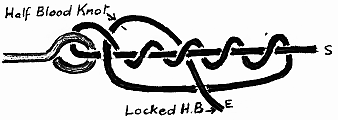
 For tying a nylon line to hook, swivel and ring, this half blood knot is one of the most important but simple fisher knots:
Running end: is the end you are tying.
Standing part: is the main part of the line.
Bitter end: is the other end of the line, in this case, the one attached to your reel.
The beginner or casual fisher needs only 2 knots, the half blood knot for line-to-hook and the blood knot for line-to-line.
For tying a nylon line to hook, swivel and ring, this half blood knot is one of the most important but simple fisher knots:
All knots weaken the line, so we choose one that weakens the least.
It has been shown that the more turns the less strength is lost, which is why 4-5 turns are essential.
Example: for a blood knot on a 20lb line, 2 turns results in a 40% loss; 4 turns 25% loss, 5 turns 4% loss.
Remember however, that abrasion from sand and rocks, and heating when it slides over runners, and mosquito repellant, probably weaken the line more than a good knot does.
This half blood knot reduces the line strength by 4%, that is, a 4kg line will be reduced to 3.84kg; an 8lb line to 7lb 11oz, which makes it the strongest knot for this purpose.
To prevent it slipping, which it does occasionally, you can use the locked half blood knot, which takes the end thru the loop as before but continues on thru the biggest loop.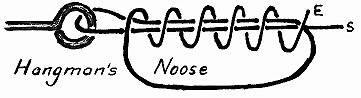
With knot strength similar to that of the locked half blood knot, remember to snug the knot before pulling the standing part thru the knot.
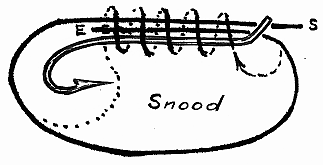
Snoozing is the tying of a snood, a knot which will tie any hook to a line, whether it be an eyed or flatted hook (whether the eye is in line with the shank of the hook or bent toward the hook or away from it – turned-down or turned-up eye). An eye is bent to change the direction of the barb when pulling it thru the water. However, the snood avoids the effect of having a bent eye because it ties to the shank instead of to the eye. (See diagram.)
The snood is superior in knot strength to most other knots and will not work loose.
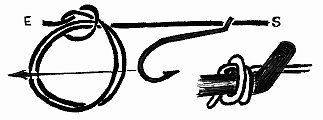
The 2-circle Turle Knot, with strength of only 62%, is designed to hold the bent-eyed hook (turned-down or turned-up) parallel to the line, thus negating the hook's design to give the best penetrating angle of the barb (which tying to only the eye, not the shank, will do).
2-circle Turle Knot:
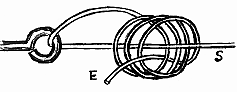
Made known by Dick Lewers in his book Knots & Rigs (1969) he claims this knot was tested at 96% strength, and is non-slip, and is easily tied in the dark:
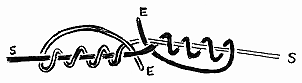
For joining 2 line, this, along with the half blood knot for hook-to-line, is the second basic fishing knot. With a knot strength of 77%, it is considered to be the best for joining 2 lines. If you trim the ends to 2mm, it will pass easily thru runners/rod guides; and being small will not significantly affect casting distances. When one line is much thicker than the other, the thinner line should be doubled at the tying end, but such situations are as rare as catching 2 fish on the one hook.
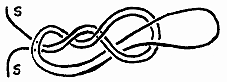
For those common occasions when you want 2 hooks on the same line, this gives 92% strength. Clip a swivel to this bight and attach a nylon line (with the hook) to the swivel. If the loop is long enough, the sinker can be attached directly.
Two good choices attaching the line to the spindle:
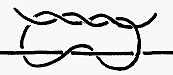
A float stop is a knot on the line to prevent a running float from running too far. Tie 150mm of nylon line with a double overhand knot, as shown, snugged tight, will grip the line but still be small enough (after trimming the ends to 2mm) to pass thru the runners/rod guides. if necessary, pinch the top eye of the float just enough to block this knot.
There are 2 kinds of trout angler (fisher): one who spins, one who uses flies. The knots already described are enough for the former, but the latter needs finer knots. A fly line usually has:
The solutions to joining these lines are: