Spearfishing - intro
Practice
The requirements for spearfishing are:
- knowledge of the 3 effects of the refraction of water:
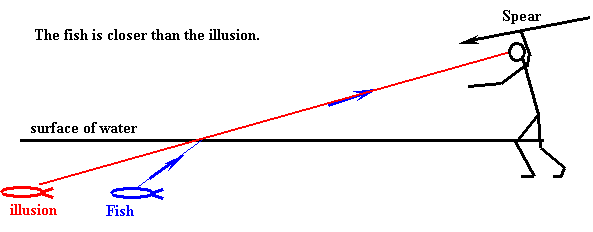
- fish look further than they are
- fish look bigger than they are
- fish look closer to the surface than they are
This requires an upward correction in your aim.
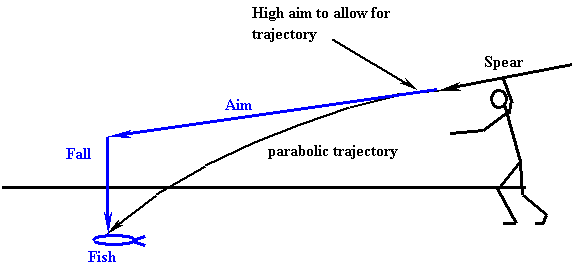
- knowledge of the parabolic trajectory of thrown spear. This requires an upward correction in your aim.
- the effect of the spear's bouyancy, which makes it rise as it passes thru the water, requiring a downward correction inyour aim.
- clear water, altho this can be overcome where the fish species is prone to surfacing.
- a spear which floats, such as bamboo; otherwise it must have a handline attached. The Australian Aboriginals add thrust by projecting with a woomera.
- for diving, a Hawaiian sling, with the spear freely sliding inside a tube to which a rubber cord is attached to give a sudden thrust to the spear
- stealth.
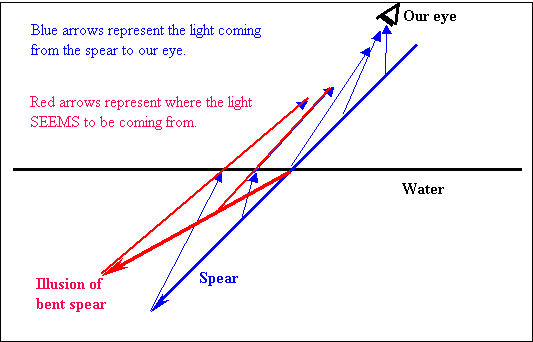
As the light rays from the spear pass thru the water's surface, it is bent towards us, as in the diagram. This gives the impression of a bent spear, making the spearpoint look further away.
This refraction makes the fish appear further away than it is. Correct by aiming downwards.
Since the spear or arrow follows a parabolic trajectory, your aim must be higher the further away you are. Correct by aiming upwards.
Since spear and arrow are buoyant in water, they tend to rise the further they pass thru water. Correct by aiming downwards.
This need for 3 corrections, 2 downward, one upward, will require much carefully meazured practice.
The law
Spearfishing in the past has been detrimental to the environment when species unafraid or unused to divers were targeted excessively. However, it is also highly selective and has extremely low amount of by-catch; therefore with education and proper regulations spearfishing can be the most ecologically sustainable form of fishing.
Spearfishing has been implicated in local extinction of many larger species, including the Goliath grouper on the Caribbean island of Bonaire, the Nassau grouper in the barrier reef off the coast of Belize, the giant black sea bass in California, and others.
Laws may ban spearfishing, or allow it only during certain seasons or in specified areas, or limit the catches. Often spearguns are outlawed.
Purposes of spearfishing
People spearfish for sport, for commerce or as subsistence. In tropical seas, some natives spearfish in snorkeling kit for a living, often using home-made kit.
Types of spearfishing
The very best free-diving spearfishers can hold their breath for durations of 2-4 minutes and dive to depths of 40 or even 60 meters (about 130 to 200 feet). However, dives of approximately 1 minute and 15 or 20 meters (about 50 to 70 feet) are more common for the average experienced spearfisher.
Spear fishing can be done with an ordinary spear, a 4-prong spear or a specialised variant such as an eel spear or the trident. A small trident type spear with a long handle is used in the American South and Midwest for gigging bullfrogs with a bright light at night, or for gigging carp and other fish in the shallows.
The methods and locations freedive spearfishers use vary greatly around the world. This variation extends to the species of fish sought and the gear used.
Shore diving
Shore diving is perhaps the most common form of spearfishing and simply involves entering and exiting the sea from beaches or headlands and hunting around reef, rocks, kelp or sand. Usually shore divers hunt between 5 and 25 meters (about 17 to 83 feet) depth, though it depends on location.
In some locations in the South Pacific, divers can experience huge drop-offs from 5 meters up to 30 or 40 meters very close to the shore line. Sharks and reef fish can be abundant in these locations. In more subtropical areas, sharks may be less common, but other challenges face the shore diver, such as entering and exiting the water in the presence of big waves.
Headlands are favored for entry because of their proximity to deeper water, but timing entries and exits is important so the diver does not get pushed onto rocks by waves. Beach entry can be safer, but more difficult due the need to consistently dive through the waves until the surf line is crossed.
Shore-dives can produce a mixed bag of fish, mainly reef fish, but ocean-going pelagic fish are caught from shore dives too, and can be specifically targeted. (Pelargic = open-sea or ocean.)
Shore-diving can be done with trigger-less spears such as pole spears or Hawaiian slings, but, where the law allows it, people prefer triggered devices such as spearguns. Speargun setups to catch and store fish include speed rigs, fish stringers.
The use of catch bags worn close to the body is discouraged because the bag can inhibit movement, especially descent or ascent on deeper freedives. Moreover, in waters known to contain sharks, it is positively dangerous and can greatly increase the risk of attack. The better option is to tow a float behind, to which is attached a line onto which a catch can be threaded. Tying the float line to the speargun can be of great assistance in the event of a large catch, or if the speargun should be dropped or knocked out of reach.
Boat diving
Methods and gear used for diving from a boat diving are similar to shore-diving or blue water hunting depending on the prey sought. Care must be taken with spearguns in the cramped confines of a small boat, and it is recommended that spear guns are never loaded on the boat.
Blue water hunting
Blue water hunting is the area of most interest to elite spearfishers, but has increased in popularity generally in recent years. It involves accessing usually very deep and clear water and trolling, chumming for large pelagic fish species such as marlin, tuna, or giant trevally. Blue water hunting is often conducted in drifts; the boat driver will drop one or more divers and allow them to drift in the current for up to several kilometers before collecting them. Blue water hunters can go for hours without seeing any fish, and without any ocean structure or a visible bottom the divers can experience sensory deprivation. It can be difficult to determine the true size of a solitary fish when sighted due to the lack of ocean structure for comparison. One technique to overcome this is to note the size of the fish's eye in relation to its body - large examples of their species will have a relatively smaller eye.
Notably, blue water hunters make use of breakaway rigs and large multi band wooden guns to catch and subdue their prey. If the prey is large and still has fight left after being subdued, a second gun can be used to provide a kill shot at a safe distance from the fish. This is acceptable to IBSRC and IUSA regulations as long as the spearfisher loads it himself in the water.
Without diving
These methods have been used for thousands of years. A fisher wades in shallow salt or fresh water with a hand spear. The fisher must account for optical refraction at the water's surface, which makes the fish appear to be further away. By experience, the fisher learns to aim lower to hit the target. Calm and shallow waters are favored for spearing fish from above the surface.
Spearfishing can also be done directly from a boat, and can have similarities to bowfishing. See gigging.
Equipment
This is a list of equipment commonly used in spearfishing. Not all of it is necessary and spearfishing is often practised with minimal gear:
- Speargun: see chapter Speargun.
- Polespear: Pole spears, or hand spears, consist of a long shaft with point at one end and an elastic loop at the other for propulsion. They also come in a wide variety, from aluminum or titanium metal, to fiberglass or carbon fiber. Often they are screwed together from smaller pieces or able to be folded down for ease of transport.
- Hawaiian slings: Hawaiian slings consist of an elastic band attached to a tube, through which a spear is launched.
- Wet Suit : Wetsuits designed specifically for spearfishing are often two-piece (jacket and 'long-john' style pants) and have camouflage patterns, blue for open ocean, green or brown for reef hunting. Commonly they have a pad on the chest to aid in loading spearguns.
- Weight belt or weight vest: These are used to compensate for wetsuit buoyancy and help the diver descend to depth.
- Fins: Fins for freedive spearfishing are much longer than those used in SCUBA to aid fast ascent.
- Knife: A knife should always be carried as a safety precaution in case of the diver becoming tangled in his spear or float line. It can also be used as an iki jime or kill spike.
- Kill spike: In lieu of a knife, a sharpened metal spike can be used to kill the fish quickly and humanely upon capture. This action reduces interest from sharks by stopping the fish from thrashing. Iki jime is a Japanese term and is a method traditionally used by Japanese fishermen. Killing the fish quickly is believed to improve the flavor of the flesh by limiting the build up of adrenaline in the fish's muscles.
- Snorkel and diving mask: Spearfishing snorkels and diving masks are similar to those used for scuba diving. Spearfishing masks sometimes have mirrored lenses that prevent fish from seeing the spearfisher's eyes tracking them. Mirrored lenses appear to fish as one big eyeball, so head movements can still spook the fish.
- Buoy or float: A buoy is usually tethered to the spearfisher's speargun or directly to the spear. A buoy helps to subdue large fish. It can also assist in storing fish, but is more importantly used as a safety device to warn boat drivers there is diver in the area.
- Floatline: A floatline connects the buoy to the speargun. Often made from woven plastic, they also be mono-filament encased in an airtight plastic tube, or made from stretchable bungee cord.
- Gloves : Gloves are a value to spearfisherman that desire to maintain a sense of safety or access more dangerous areas, such as those between coral, that could otherwise not be reached without use of the hands. They also aid in loading the bands on rubber powered speargun.
- Flag: A floating flag signals to powered boats that you are diving. Such boats, often driven at high speed by people who do not care, cripple and kill divers.
Management of spearfishing
Many countries have specific laws restricting spearfishing.
Australia: Spearfishing is a recreational-only activity and generally only breath-hold free diving. There are numerous restriction placed by the Government such as Marine Protected Areas, Closed Areas, Protected Species, size/bag limits and equipment.
The peak recreational body is the Australian Underwater Federation. The vision of this group is "Safe, Sustainable, Selective, Spearfishng" and the AUF provides membership, advocacy and organises competitions.
Norway: Because of its relatively long coastline compared to its population, Norway has one of the most liberal spearfishing rules in the northern hemisphere, and spearfishing with scuba gear is a widespread activity among recreational divers. Restrictions in Norway are limited to anadrome species, like atlantic salmon, sea trout, and lobster.
Mexico: a regular fishing permit allows for Spearfishing, but not for electro-mechanical types of spearguns.
Everywhere: Remember that if you want your children to fish as you do, then you must restrict your catches. Taking more than what you can eat, causes populations to diminish. Always taking the biggest, selects for the smaller so that the big ones are bred out of the species.
Tips from Hawaiian Spearfishermen
Take advantage of a fish's curiosity. Fish see their world with their eyes and with vibrations picked up by their lateral line (a line of nerves along the sides of their bodies). Therefore minimize vibration by moving very slowly in the water, and using weights to carry you to the bottom instead of kicking your fins.
Once on the bottom or in sight of a fish remain perfectly still, and lack of vibration in the water will usually cause the fish to come within spear range to investigate. Walk along the shoreline and enter gently, going straight to the bottom for as long as you can hold your breath.
Any large fish in the area will usually come to investigate the appearance and then disappearance of something, as no picture is available to their lateral line of a non moving object. Any rocks or other objects on the bottom that the spearfisherman can get close to will further disguise his appearance and warrant closer investigation by fish within 40 yards. Exiting the water and moving 40 yards down the shore usually produces another shot at a big one.
Carry several small pieces of coral or shells and when a fish is reluctant to come into spear range, rub or click these to draw them closer. Throwing up sand also will bring a fish closer and helps to camouflage the diver. Contact with coral should be avoided as this may damage the reef. Blue water divers will float on the surface 100 yards from their boat and continue to rap a dive knife or a softer object against their spear gun until a big one comes to investigate.
In areas where many holes are available for a fish to hide in, a strong swimmer can clip his gun to his belt, and force a fish into a hole by swimming full speed and slapping his cupped hands on the surface with each stroke. Another shoreline technique for the big ones is to spear fish that are favorite prey of the desired species or collect the seaweed, mussels, etc. that they eat and chum them into the area. Tying a flapping new kill to your belt is an effective way of bringing sharks closer, as many a legless diver will confirm.
Some think chumming the water is dangerous as it will draw sharks, but many big predator fish travel with reef sharks, and the instances of spearfisherman being attacked is a very low percentage of the total number of shark attacks. Sharks are like dogs,: if you cower from a bad dog, it will bite you, but if you stand your ground with a big stick, you can usually back it down. [True in Hawaii, but come down to our southern Australia waters and tell that to our white pointers. Out-staring a 1.5-tonne 6-metre shark could give you a great adrenalin buzz.]
Spearfishing in areas with many sharks larger than 8 feet and of aggressive species does not require chumming as these areas are plentiful in big fish that are not used to seeing spear fisherman. Care needs to be taken in these areas to stay out of areas where blood from a kill is in the water.