from northern Quebec to Florida in the autumn and back in the springtime.
from central Canada along the Mississippi to the Gulf of Mexico
from Alberta and Saskatchewan Canada to Texas, the Gulf Coast, and western Mexico.
from central Alaska to southern Mexico.
There are several items used by almost all waterfowl hunters:
- shotgun:
- ammunition:
- hunting blind:
- decoys:
- boat:
- a duck or goose:
- call:
The decoys are used to lure the birds within range, and the blind conceals the hunter. When a hunter or hunters sees the waterfowl, he or she begins calling with the duck or goose call. Once the birds are within range, the hunters, rise from the blind and quickly shoot the birds before they are frightened off and out of shooting range. Duck or goose calls are often used to attract birds; sometimes calls of other birds will also be simulated to convince the birds that there is no danger.
Hunters position themselves in blinds near rivers, lakes, ponds or in agriculture fields planted with corn, barley, wheat or millet. Hunters build blinds to conceal themselves from waterfowl, as waterfowl have sharp eyes and can see colors. That is why hunters use camouflage. Waterfowl hunters also often use dogs to retrieve dead or injured birds in the water. There are many retriever breeds, such as Labrador Retrievers and Chesapeake Bay Retrievers, specifically bred for the task. Hunters also may use a boat to get downed birds. Some hunters use boats as blinds or float rivers in search of waterfowl. When the ducks see the hunters in the boat, ducks flush off the water and hunters shoot. Then birds are collected and placed in the boat.
Each hunter prefers a certain type of weather condition, depending on the type of hunting setting. Some hunters prefer sunny days vs cloudy or rainy days. However, ducks and geese fly more extensively and actively on cloudy days, rain or snow.
Shotguns
The smaller the gauge number the bigger the bore. AAlthough the largest gun used today in the United States is the ten gauge shotgun, the preferred shotgun is the 12 gauge because it is lighter than the 10# at seven and a half pounds (3 and a half kilograms) and has less recoil. Some hunting guns have camouflage-patterned stocks and low-gloss finishes on the metal to reduce their visibility to waterfowl.
Although it is legal to use a bow or crossbow to take migratory waterfowl in many areas,
most hunters prefer taking migratory birds with a shotgun because of the great difficulty of striking a moving bird with an arrow. Taking migratory birds with a rifle is illegal due to the great distances rifle bullets travel, making them unsafe.
Shotgun ammunition
In the late 1960s, it was determined that lead shot poisoned waterfowl eating in shallow water areas where there was heavy hunting. In 1974, Steel shot shells was offered for sale to hunters at the Brigantine Waterfowl Refuge in southern New Jersey by Winchester at five dollars a box. These shells are marked "Experimental" and are orange in color.
Waterfowl hunting with lead shot, along with the use of lead sinkers in angling, has been identified as a major cause of lead poisoning in waterfowl, which often feed off the bottom of lakes and wetlands where lead shot collects. In the United States, UK, Canada, and many western European countries (France as of 2006), all shot used for waterfowl must now be non-toxic, and therefore may not contain any lead. Steel is the cheapest alternative to lead.
However, some hunters do not like its shooting properties, as steel is significantly less dense than lead. Therefore its effective range is decreased due to rapidly decreasing velocity of the shot: thirty to forty yards is considered its maximum effective range for duck hunting.
Many companies have improved steel shot by increasing muzzle-velocity, by using fast burning powder such as rifle powder thus making more consistent 'shot' or pellet patterns. Steel shot now travels at 1400 to 1500 Feet per second
Within recent years, several companies have created "heavier than lead" non-toxic shot out of tungsten, bismuth, or other elements with a density similar to or greater than lead. These shells have a more consistent patterns and greater range than steel shot. The increase in performance comes at a higher cost. Shell boxes can cost up to thirty dollars a box for twenty five shells.
Hunters use pellet sizes 5, 4, 3, 2, 1, or BB for ducks, and 2, BB, BBB or T shot for geese. Buckshot is not allowed by law.
Waterfowl calls
Early duck calls were simple woodwind instruments, consisting of a barrel, a sounding board and a reed, used by hunters to attract birds by simulating their vocalizations. Later, a variety of other whistles and other devices were created that are simpler to use, but the basic design as a simple reed instrument remains the most common type.
The most prevalent and hunted duck in the United States, the mallard, makes the well known "quack" sound many associate with ducks. Other species make many different sounds, ranging from high-pitched whistles to very low, grunt-like quacks. There are calls for almost all species of ducks. Pintails, teal, wood ducks, diving ducks and other ducks including the calls of both the male, or drake and the female, or hen. In many species, the call of the drake (male) is different from that of the hen (female). Mallard drakes make a lower pitch, longer quack than the hen mallard, and is actually more of a buzzing sound than that of a quack. This call is often used while feeding and when a mallard drake is landing. It gives the other birds a heads up. The quack of a mallard drake can be replicated by a special whistle-like call. This whistle is often called a 6-in-1 whistle, due to the fact that it can replicate six different duck species sounds. In teal, the drakes make a call of short bursts of a high pitch whistle. The "teet! (pause) teet! (pause) teet!-teet!" or any other order of repetition. This call can be made by blowing short bursts of air into the "6-in-1" whistle. The (Greenwing) teal hen call resembles that of the mallard hen, but with a much higher pitch, and faster, more staccatto rhythm.
The majority of duck sounds such as quacking people have heard and are familiar with comes from females, or mallared hens. Mallared hens are extremely vocal and this is probably why the number one call for duck hunting in North America is a mallard hen call. Many calls from the mallard hen include the feed call (when the hen has found food), the hail call (when the hen sees other ducks high in the air), and the comeback call (when ducks are disinterested or leery and the hen "on the water" is aggressively insisting that the ducks which have overflown her return to light where she is).
Pintails and balpate widgeon are called with a simple whistle: short, monotone for the pintail; ornate and varied (not unlike a songbird) for the widgeon.
Blinds
A hunting blind is a structure intended to conceal hunters, dogs, and equipment from the intended prey. Waterfowl have excellent eyesight and will not land in an area where they spot anything unusual or threatening. Blinds can be temporary or permanent.A blind may be constructed out of plywood, lumber, large logs or branches, burlap fiber, plastic or cotton camouflage, or natural vegetation. Many of these permanent blinds look like a small shack with an opening that faces the water and a portion of the sky. Blinds can be as simple as natural vegetation piled onto branches, or they can be small outbuildings with benches, tables, heaters, and other conveniences.
Temporary blinds are common in protected and public areas where a permanent fixture blinds are forbidden. Many are tent-like "pop-up" blinds which are easy and quick to erect. Boat blinds are used to conceal a hunter while hunting from a boat. Boat blinds can be handmade or are available from manufacturers.
There are two common types of blinds for land and field-based waterfowl hunting: pit blinds and layout blinds. The pit blind can be a solid structure that is placed into a hole in the ground or on the bank of a waterbody. Since pit blinds rest below the top of the surrounding soil, some structural strength is required to prevent the soil from collapsing into the blind. Commercially available blinds can be made from fiberglass, polyethylene or even lightweight metals. Homemade blinds can also be constructed of wood, but typically cannot withstand the moisture of an underground habitat. Concrete walls are also constructed to form pit blinds typically on land owned or controlled by hunt clubs since this creates a permanent structure. Pit blind amenities can vary greatly from a basic blind with sticks or other temporary camouflage to elaborate multi-level blinds with small quarters for sleeping or cooking. Most pit blinds will have some form of movable door or slide that can be opended quickly when waterfowl are approaching while still allowing the hunters a good view while closed. Camouflage netting or screens are common materials for the movable top. One common drawback to pit blinds is their propensity to accumulate water. Especially in marsh or wetland areas, the soil can hold a large amount of moisture. Pit blinds are sometimes fitted with sump pumps or even hand operated pumps to assist the hunters in draining any water that has invaded the blind.
Layout blinds allow a hunter to have a low profile in a field without digging a hole. They are made of an aluminum metal frame and a canvas cover. Most modern commercial layout blinds are fitted with spring-loaded flaps on top that retract when the hunter is ready to fire. The layout blind allows the hunter to lie prone in the blind with only the head or face exposed to allow good visibility. Newer blinds also have a screen that provides a one-way view outside the blind to conceal the hunter, but allow him/her to observe the waterfowl. When birds are in range the hunter can open the flaps and quickly sit up to a shooting position. Layout blinds come in many different colors and patterns from plain brown to new camouflage patterns that simulate forage found in typical hunting locations. A favorite trick of savvy hunters is to use loose forage found in the specific field being hunted to camouflage the layout blind. Most blinds are fitted with canvas loops designed to hold stalks, grass or other material.
Blinds are known by different names in different countries. In New Zealand, for instance, the term maimai is used for a permanent or semi-permanent hide or blind.
Decoys
Decoys are one of the most important pieces of equipment for the waterfowler. Using a good spread of decoys and calling, an experienced waterfowl hunter can successfully bag ducks or geese if waterfowl are flying that day.
Live birds were also used as decoys. They were placed in the water and had a rope and a weight at the end of the rope so the duck could not swim or fly away. This method of hunting became illegal in the 1930s.
Modern decoys are typically made from molded plastic, that began in the 1960s. Making decoys of plastic, decoys can be made many times faster than carving from wood. The plastic allows a high level of detail, a resilient product and reasonable cost. Most are still hand painted. Most modern decoys are fitted with a "water keel" which fills with water once the decoy is immersed in water or a "weighted keel" filled with lead. Both types of keel help the decoy stay upright in wind or high waves. Weighted keel decoys look more realistic by sitting lower in the water. This also allows for decoys to be thrown into the water and the decoy to float upright. The obvious drawback to weighted keels are the added weight when carrying decoys for long distances. Decoys are held in place by some type of sinker or weight and attached via line to the decoy. Various weight designs allow the line to be wrapped around the decoy when not in use and secured by folding or attaching the lead weight to the decoy.
Decoys are placed in the water about 30 to 35 yards from the hunters. Usually a gap is in the decoy spread to allow ducks to land in the gap.
Recently, decoys have been introduced that provide life-like movement that adds to the attraction for waterfowl. Shakers are decoys with a small electric motor and an offset weighted wheel. As the wheel turns it causes the decoy to "shake" in the water and create realistic wave rings throughout the decoy spread. Spinning wing decoys are also fitted with an electric motor and have wings made of various materials. As the wings spin a optical illusion is created simulating the wing beats for landing birds. These decoys can be quite effective when hunting waterfowl and have been banned in some states. Other types of movement decoys include swimming decoys and even kites formed like geese or ducks.
Boats
Boats are used to set up decoys, pick up birds, and travel to hunting areas. They can also be covered and used as a blind. Some hunters use grass and others use burlap or other material to camoflauge their boats. Often painted brown, tan, green, and black, some boats are motor powered while others have oars. Most are flat bottomed to increase stability with keels made of wood or aluminum, between 10 and 16 feet (3.0 and 4.9 m) long. Painted kayaks or canoes made of aluminum or fiberglass reinforced with kevlar are also used – these can navigate shallow streams or small narrow rivers in search of waterfowl. Care must be taken when shooting from boats, canoes or kayaks as hunters have in the past fallen out of such craft due to loss of balance (recoil ?) when shooting at waterfowl. Whole boats have been known to capsize, tipping all hunters into the water. Swimming while wearing waders is not recommended. Sink boxes, boats that conceal the hunter under the water surface are now illegal to use.
Clothing
Duck season takes place in the fall and winter where the weather can be harsh. Waterproof clothing is critical to duck hunting. Most duck hunters hunt over water, and they stand in water or in a boat. In order to stand in the water and stay dry the hunter must wear waders. Waders are waterproof pants (usually made of a neoprene like material) that have attached boots and are completely waterproof. Typical waders are chest high, but waist high and knee high waders are sometimes used in shallow water.
Ducks have keen vision and can see color, thus compelling hunters to camouflage clothing with various shades of brown or green or brown and green combined, suited to the area. Face masks and camouflage gloves are also worn.
Dogs
Duck hunters often employ a dog to retrieve downed birds. Most hunters use Labrador Retriever, Golden Retriever or Chesapeake Bay Retriever to retrieve waterfowl.
The use of a dog provides a number of advantages. As duck hunting often takes place in cold wet locations, the use of a dog frees the hunter from potentially dangerous forays into cold water to retrieve the bird. Such efforts can be dangerous for the hunter, but are managed by a dog quite easily. It also allows for the recovery of wounded birds that might otherwise escape. A dog's acute sense of smell allows them to find the wounded birds in swamps or marshes where weeds can allow a duck to hide.
The use of a dog ensures that a higher percentage of the birds shot end up on the table. A disadvantage of having dogs in the duck blind, is that some dogs are not well-trained to sit still. They can potentially ruin a good hunt. Dogs that run into the water looking for birds when guns are fired, rather than waiting until sent or released, create a hazard to the dog and hunters. Nevertheless, dogs are considered the greatest conservation tool known to waterfowlers.
Hunting Guides
Hunting guides are used by water fowlers who do not know an area. They will employ a guide for a half day or a whole day. The cost of hiring a guide varies from one hundred fifty dollars for a half day to four hundred dollars for a day. Guides have boats, blinds, decoys, and dogs for retrieving ducks or geese.
They know flight patterns of game and know how to call ducks or geese in. They know how to set up decoys. Some guides specialize in certain types of waterfowl while others will be more generalists. Some guides specialize in sea hunting while others will specialize in bay hunting, river hunting, lake hunting or swamp hunting.
Guides may have houses for hunters to sleep for the night. They may provide the service of cleaning the game and keeping it on ice in coolers or refrigerators. Guide may have coffin blinds or more fancy house blinds, that provide seats and heating. Guides are usually registered with the state that they guide in.
Wildfowling in Europe and the UK
In British English, the term "hunting" is generally reserved for the pursuit of game on land with hounds, so the sport is generally known as "wildfowl shooting" or "wildfowling" rather than "hunting."
Wild ducks and geese are shot over foreshores and inland and coastal marshes in Europe. Birds are shot with a shotgun, and less commonly, a large single barreled gun mounted on a small boat, known as a punt. Due the ban of use of lead shot for hunting wildfowl or over wetlands, many wildfowlers are switching to modern guns with stronger engineering to allow the use of non-toxic ammunition such as steel or tungsten based cartridges. The most popular calibre is 12-gauge.
Only certain 'quarry' species of wildfowl may legally be shot in the UK, and are protected under the Wildlife and Countryside Act 1981. These are Mallard, Wigeon, Teal, Pochard, Shoveler, Pintail, Gadwall, Goldeneye, Tufted Duck, Canada Goose, White-fronted Goose (England and Wales only), Greylag Goose and Pink-footed Goose. Other common quarry targets for the wildfowler include the Common Snipe.
An intimate knowledge of the quarry and its habitat is required by the successful wildfowler. Shooting will normally occur during the early morning and late afternoon 'flights', when the birds move to and from feeding and roosting sites. The wildfowler is not looking for a large bag of quarry and his many hours efforts are rewarded by even a single bird. It is recommended that wildfowlers always shoot with a dog, or someone with a dog, to retrieve shot birds on difficult estuarine terrain. When a bird is in hand, wild ducks and geese make fabulous eating, but not all are available to buy. You cannot sell wild geese, for example, and ducks other than Mallard are difficult to find; but try farmers markets. The favourites on the table are Mallard, Wigeon and Teal.
Wildfowling has come under threat in recent years through legislation. Destruction of habitat also has played a large part in the decline of shooting areas, and recently in the UK "right to roam" policies mean that wildfowlers' conservation areas are at risk. However, in most regions, good relationships exist between wildfowlers, conservationists, ramblers and other coastal area users.
In the UK wildfowling is largely self-regulated. Their representative body, WAGBI (Wildfowlers Association of Great Britain and Ireland), was founded in 1908 by Stanley Duncan in Hull. This Association changed its name in 1981 to become the British Association for Shooting and Conservation (BASC) and now represents all forms of live quarry shooting at European, national and local levels. There are also many wildfowling clubs around the coast of Great Britain, often covering certain estuary areas where wildfowl are found in large numbers.
Anyone wishing to try wildfowling is recommended to contact a local club or try the wildfowling permit scheme run by the British Association for Shooting and Conservation (BASC).
Regulations, sportsmanship, and safety
Waterfowl hunting is highly regulated in most western countries. Hunters are required to obtain a hunting license and face strict limits on the number of birds that can be taken in a day (bag limits), and the total number of birds a hunter can possess (possession limits).
In the United States, hunters must also purchase a federal duck stamp and often a state stamp. It is illegal to shoot ducks from a motor vehicle or a moving boat. Shooting sitting or swimming ducks is considered unsportsmanlike by some and possibly unsafe. Many practices that were once common in commercial duck hunting before the turn of the century, including laying baits such as corn, use of live ducks as "decoys," and use of guns larger than a 10-gauge, are now prohibited. In most areas, shotguns that can hold more than three shells must be modified to reduce their magazine size. A wooden plug is installed in the hollow magazine of the shotgun. Legal hunting is limited to a set time period (or "season"), which generally extends from fall to early winter, while birds are migrating south.
The Conservation Order established by the USF&WS allows for the hunted of snow geese in March and April. The reason for this is that snow geese populations have become so large that more hunting is needed to control their populations, as they are destroying their habitat. Shotguns can be loaded to full capacity for hunting these geese.
It is also considered good sportsmanship to make every possible attempt to retrieve dead or injured waterfowl the hunter has shot. Birds are shot within range to prevent cripples. Shooting before birds are within range is also considered poor sportsmanship, as this often merely injures the birds and may drive them away before other hunters can fire.
Many provinces in Canada and all States require hunters, including waterfowl hunters, to complete hunter safety courses before they can obtain a license. Waterfowl hunters fire short-range shotgun rounds into the air over often deserted bodies of water, so accidental injuries are rarer than in other hunting activities such as big game or deer hunting.
Hunting areas
All states have public land for hunting. Some states call them fish and game lands. Other states call them fish and wildlife management areas. These are lands purchased from hunting license revenue. Water in bays or ocean are open area to hunting, as no one can own these areas. The problem is getting access to the ocean, bay, marsh or river. Hunters usually need boats to travel in these areas.
Flyways
In North America, the routes used by migratory waterfowl are generally divided into four broad geographical paths known as flyways. Each flyway is characterized by a different composition of species and habitat.
Mississippi flyway
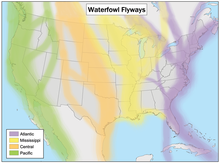
The Mississippi flyway is a migration route used by waterfowl to travel from central Canada to the Gulf of Mexico, flying along the route of the Mississippi River and its tributaries. In the Midwest and central United States, wildfowl hunting generally occurs on lakes, marshes, swamps, or rivers where ducks and geese land during their migration. Cornfields and rice paddies are also common hunting grounds, since geese and ducks often feed on the grain that remains in the field after harvest. In some areas, farmers rent or lease hunting rights. Some farmers or hunters form hunt clubs, which can cover thousands of acres and have resort-like amenities, or be as simple as a shallow pit blind dug into a field. On the East and West coast of America and many parts of Europe, waterfowl hunters often focus on the seashore.
The U.S. Fish and Wildlife Service maintains millions of acres as National Wildlife Refuges open to public hunting. All States have public Hunting and fishing areas. States publish maps of these areas.
Atlantic flyway
The Atlantic Flyway is a migration route used by waterfowl flying from northern Quebec to Florida in the autumn and back in the springtime. This is where duck hunting first started in North America when Europeans arrived. Ducks and geese are born in the tundra of Quebec and fly south in autumn to Chesapeak bay, North and South Carolina, and Georgia for the winter. The St Lawrence River, the coast of Maine, Long island harbors, Barnegat Bay, Great Egg Harbor, Little Egg Harbor, Absecon Bay, Delaware Bay, and Chesapeak Bay have been known for centuries for great waterfowl hunting.
Mountain (Central) Flyway
The Rocky Mountain Flyway is used by waterfowl of that region to fly from Alberta and Saskatchewan Canada to Texas, the Gulf Coast, and western Mexico.
Pacific flyway
The Pacific flyway is a migration route from central Alaska to southern Mexico. It is used by nearly all waterfowl species in that region.
Waterfowl conservation
Waterfowl are indigenous to marsh and wetland areas, which are shrinking at alarming rates due to the drought, the draining of wetland areas to plant crops, and the over-consumption of river water to irrigate such crops as cotton. Wetland conservation aIn the US, organizations such as Ducks Unlimited are making a concerted effort to buy, maintain and expand wetland to breed waterfowl to kill.
Back to fishing & hunting index