Animal Trapping
Back to fishing & hunting index
Contents
Steps to Trapping
Proper identification of your target is vital for a successful trapping:
- identify the pest
- bait
- type of trap
- size of trap
- camouflage to use on trap.
- identify the pathway between its home and its food
Traps are then placed along these pathways.
So you have a problem with a pesky possum, rats, mice, snakes, birds, or stray cat ? Well here are some practical tips on how to trap pest animals and more effectively deal with the problem once and for all. There is far more to trapping pest animals than just buying and setting a trap. Sure you may just may get lucky and catch something if you do this, but for your control measures to be really effective you need both the correct equipment and the know how to use the equipment correctly.
The more you understand about the animal you are trying to trap the more effective your efforts will be. Knowing whether the animal lives by itself or in groups. Knowing when the animal is most active as well as its activity patterns. Knowing what the animal likes to eat. And finally knowing how to dispose of the trapped animal are all considerations that will help make the process go smoothly.
Back to Contents
Population Dynamics
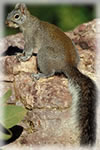
Under normal circumstances wild animals self-regulate their populations in line with the availability of food and shelter in any given area. In doing so they protect their population from overextending and collapsing. Any individuals removed from a population will generally be quickly replaced, but as most animals have more than one young, the replacement numbers can be higher than the original number lost. So in dealing with a pest animal population it is important that all efforts be expended to ensure that the pests are eradicated completely or otherwise you may end up with more pests than you started with.
Back to Contents
Control the problem not just the pests
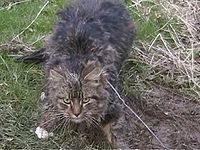 Most of the pests species found around houses are there for a reason. If you can understand why those pests are there in the first place and remove that reason then any trapping efforts you undertake are going to be more fruitful. The combination of removing the problem and the pests is also going to result in a longer term resolution of the problem.
As mentioned above food and shelter are two key requirements of pest animals so by cleaning up rubbish, removing food sources, and removing water sources you are making the environment less attractive to the pests as well as making it much easier to attract the pests into a trap.
Back to Contents
Pre-bait before you set any traps
In most cases pre-baiting is going to get you much better results than just buying a trap and sticking it somewhere. Pre-baiting essentially means that you feed the pest animal at the location that you intend to do your trapping. By free feeding the animal with the bait that you will be using during trapping you will:
- establish a feeding pattern with that animal that will bring it to the trapping location in order to get the reward of the food that you have left
- ensure that the animal is indeed present in the area before wasting any efforts on trapping
- give the target animal confidence by rewarding it for taking the food.
All of the above will help you once you are ready to set your traps and make your trapping efforts more productive. Your target animal will be accustomed to coming to the trapping area and getting the reward of a treat of food. The reward they get will outweigh any concern that they may have with your presence in the area as well as making them familiar with the feed source that you will be using as bait.
This single step will help increase the effectiveness of any trapping that you undertake more than any other factor.
Back to Contents
Overcome trap-shy animals
Animals that are trap-shy may never enter a trap as the risks outweigh any rewards for doing so. Also trap-shy animals can act more tentatively around the trap mechanism which can result in them setting off the trap prematurely without getting caught. An animal that gets spooked by a closing trap may never return.
In most cases the placement of the trap is going to be a concern for any animal as it is something that they are not familiar with. If you have prepared well by pre-baiting then you will be ensuring that the target animal is active in the area that you are placing the trap and you will have already built up some confidence in that animal that there is a reward for the risk.
Place the trap in the area but do not set it for a couple of days. Allow the pests to continue to take the feed treats from on and around the trap so that once again they become accustomed to the trap being there and no longer see it as a risk. Once the animals have become familiar with the bait and the trap then it is time to set the trap and catch your quarry.
Back to Contents
Birds
Bird traps:
- Funnel entrance:
an extensive cloth meah which funnels the birds up a funnel entrance hole that gets smaller as the bird progresses, entering the trap and then unable to find its way out, or passing through swinging one way doors.
- Fine mesh:
a fine polyester mesh into which the bird flies, usually at dusk without seeing, and the net drops down on it, entangling it.
- Corvid (crow) trap:
A stiff wire mesh cage with an opening on top big enough to allow the corvid to drop into and onto the bait, but too small for it to fly out.
- Pigeon trap:
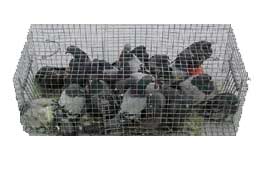 Pigeons may be live-trapped on buildings and other likely locations. Live-traps for pigeons are available. Pre-baiting the traps with grains that the birds are accustomed to will increase success. A variety of baits, including cracked corn, millet, popcorn, sunflower seeds, peas, bread, and peanuts can be used. Water is available in the trap at all times. Trapping in any given area usually will reduce the number of pigeons quickly and humanely but is labor intensive. Most of the time the pigeon trap will quickly reduce pigeon numbers.
- Night:
To remove chickens (fowl), enter the chook-house at night and gently pick them up and put them in a cardboard box. You need someone to open and close the lid on the box, without letting the chooks escape. You can empty a whole fowl house by this technique, without a fuss.
- Netting:
When chooks escape I capture them with a net hung around stiff fencing wire, which is attached to the end of a pole. Dead easy.
- Barbaric:
If you place grain outside a wire-mesh pen, the chooks will poke their heads and necks through very quickly, but they are not so quick at removing them. If you grab with both hands and twist one hand, you have dinner. How fast are you ?
Back to Contents
Deer
Deer facts:
- Diet:
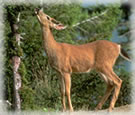 Deer are primarily browsers. They enjoy a variety of fruits, vegetables, plant buds and shoots, bark and shrubs. In winter, when they're most hungry, deer browse whatever they can find. Spring and summer, they're a problem for tender crops and flowers. In fall, ripening apples bring them into orchards.
- Physique:
Deer have no front teeth but strip bark by raking their incisors upward, making two-inch gouges. When deer eat foliage, they tear it off, leaving ragged edges.
- Hearing:
A deer's hearing, being far superior to that of a human, can easily detect a faint sound. It is believed that a deer's hearing is so sensitive that it can determine how far away a sound was made.
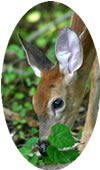 A deer's hearing is one of the reasons that it is so difficult to sneak up on it without being detected. The ears of a deer are vital in helping it avoid danger.
When a deer hears a sound it will instantly turn its head and point its ears in the direction of the sound. The deer will focus all of its attention on smelling, looking and listening for any more signs of danger. If the deer doesn't smell, see or hear any danger, after checking the area several times, it will usually go back to its normal routine.
- Sight:
A deer's eyes are located on the side of their head. The advantage is that deer have 310 degrees vision around themselves. This wide view allows the deer to be totally aware of the surroundings, even when it is staring straight ahead.
The disadvantage is that deer cannot focus on one location with both eyes. This causes the deer to have very poor depth perception (compensated by keen hearing).
Deer also see at a lower resolution than humans, and are believed to be color blind.
It is believed that deer can also see in the ultraviolet light range, which is abundant during the early morning and late afternoon. This ability to see better in early morning and late afternoon helps to explain why deer are more active during these time periods.
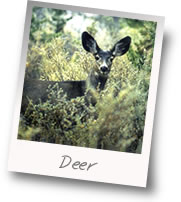 Smell:
Deer have a highly developed sense of smell; it is one of their best weapons for detecting approaching danger. The moist nose of a deer, similar to that of a dog, allows the deer to pick up the faintest of odors.
The odor particles, drifting by on the breeze, stick to the moisture on the deer's nose and are then drawn into the olfactory organs. A deer can detect the odor of approaching danger several hundred yards away.- Whitetail deer (US):
A full grown white-tailed deer will weigh approximately 150 pounds or more. They are nocturnal and typically live for 16 years in the wild.
Whitetail deer have played a very important role in the history of our country, being used extensively by Native Americans for both food and clothing and then by the early settlers.
Extensive clearing of land, unregulated hunting, and loss of habitat brought the whitetail deer population to a record low by the late 1800s
but recent changing land uses, strict game laws, and a lack of natural large predators have caused the whitetail deer population to rebound dramatically. Whitetail deer are the number one game animal in the United States.
- Deer (UK):
Deer are classed as vermin (varmint) and so can be shot by the public.
Back to Contents
Groundhogs
Groundhog facts:
- Species:
Groundhogs, also known as woodchucks or whistling pigs, are members of the squirrel family and are found in the great bulk of the central and eastern United States as well as Canada.
Groundhogs usually live 2-3 years in the wild, but can live up to six.
- groundhog control:
Groundhog control is extremely important because these nuisance animals, also known as woodchucks, can remove 700 pounds of soil to complete a 20 to 25-foot-long burrow with multiple chambers which pose a serious threat to homes by damaging and undermining building foundations.
- physique:
Groundhogs weigh an average of eight pounds and can eat approximately 1/3 of their weight in vegetation each day.
Groundhogs or woodchucks have heavy bodies with short and strong legs. Curved claws on their front paws make for easy burrowing. Groundhogs have four toes on the front foot and five on the back.
They have keen eyesight and sensitive hearing.
The closer it is to autumn the fatter a groundhog will become as it prepares for the coming winter.
- Diet:
A groundhog or woodchuck's diet consists of grasses, clover, garden vegetables, leaves, twigs, apples, berries, and dandelion. In your garden the groundhog seeks beans, peas, herbs, strawberries, pansies, and impatiens.
- Habits:
| Condition | Normal | Hibernation |
|---|
Temperature
Heartbeat (/min)
Breathing (/min) |
37.2oC/99oF
80
12
|
4.4oC/40oF
5
4 |
The groundhog emerges from hibernation, not because of the increasing length of day, but because the mating season begins.
Back to Contents
Mice
Unless you are in a rural area, any mice that you see in or around your house are more than likely going to be the introduced House Mouse Mus musculus. These introduced mouse species have adapted far better than their native couterparts to living in close proximity to humans. There is no easy way to visibly distinguish introduced mice from native mice so do not be misled by suggestions to the contrary.
House Mice are very sociable and generally live in small to large groups. Mice need access to a good and reliable food source which may be in the form of food scraps, foods left out for pets etc. To deal effectively with these pests it is advisable to remove any other food sources when traps are set to ensure that the mice go for your trap.
Multicatch mouse traps work well with mice as they will readily follow the smell of other mice. So once you have caught one mouse, catching the others will prove much easier. There are a range of mouse traps on the market but non-electric, non-battery operated ones are generally the best choices.
Many mice traps work on the principle of a funnel entrance hole that gets smaller as it enters the trap or a flap door that closes behind each mouse that enters the trap. Some have a trigger and barrell mechanism.
Mice will generally follow a regular path from their house to the food source. This path will usually track along a wall as this gives them more security than being out in the open. So it is generally best to set a mouse trap against a wall and / or near some other form of cover as this is where the mice will more easily come across the trap. You can place a large box parallel to the wall, but apart from it by a gap just wide enough for your mouse trap, so that the mice become used to its presence. This then acts to funnel the mice into the trap.
In areas where mice are in plague proportions a multi-catch trap can be a convenient way of dealing with the problem. In order to limit the numbers of mice entering the trap at any one time it is generally best to set the trap out in the open rather than near cover as mice are less likely to break cover in any numbers and you can catch the ones that do break cover one by one.
The best bait for mice is peanut butter.
Back to Contents
Opossums

This is the only marsupial in North America. With a body length of 12 to 24 inches and its tail 9 to 20 inches. Obviously not the largest marsupial weighing in at less than 15 pounds. And with a life span of only 2 to 3 years no wonder he is a nocturnal creature. They are scavengers of the night looking for food and a place to spend the night. Their diet; well they have no diet, they can eat anything and do so. But caution any food left out specially cat, and dog food will attract them to your home. About the only benefit to you as a home owner is that they sometimes control your rodent problems. A sticky critter in the wild although gentle when left undisturbed, contrary to its vicious looks.
Back to Contents
Possums
Possums are protected by law in Australia so check with your local wildlife authorities about the rules for trapping and dealing with pest possums. The rules vary from state to state.
There are two types of possum generally encountered around human dwellings, being the Common Brush Tailed Possum and the Common Ringtailed Possum.
Brush Tailed Possums are generally solitary animals that naturally live in hollows so have adapted well to house ceilings and other cavities in dwellings. Brush Tails are generally the culprit when it comes to the scenario of possums in the roof. Brush Tailed possums can also be a problem eating flowers, fruits and vegetables in gardens as these are often located at a convenient distance from their rooftop home.
Brushtails rarely make a hole to enter the roof; they access the roof through existing holes. The only way to so solve the problem of a possum in the roof is to find and repair any and all access holes, but do the repair when they are out foraging, to prevent the possums from getting back in. If you do the repair while the possum is inside the roof, it will die and rot slowly, creating a noxious stench throughout the house.
There are standard-size possum traps available; bait with apple. It is best to place the trap inside the roof to make sure you catch the correct possum. Once caught the possum needs to be dealt with according your state government regulations.
Ringtailed Possums generally live in small family groups that live in shrubbery in the garden. They are becoming more and more common inside roof cavities and wall spaces but traditionally would not enter buildings. They can be caught with a standard possum trap baited with apple but are more difficult to catch than Brushtails and as they generally live in groups the trapping work takes longer. Also as they can fit through smaller holes than Brushtails they are more difficult to proclude from the roof.
Napthalene flakes and camphor in the ceiling do not deter possums. Bright lights placed in the ceiling space will not deter possums. Placing a possum box in a tree will not result in a possum leaving your roof of its own accord to live in the possum box. Trapping and relocating possums will not solve a problem with possums in the roof. The only way to solve the problem is to fix your roof and there are professional possum catchers that can help you with this work.
Most possum traps work on the principle of a door that springs closed when the trap is triggered.
Back to Contents
Rabbits
Seeing a bunny in the yard may, at first, seem cute but wild rabbits can destroy a country, as witnessed in Australia before myxo was introduced. They can turn good country into a desert along with unbelievable erosion and extinction of plant species, while displacing native fauna.
Rabbit facts:
- Habitat:
Cottontail rabbits are found in every state in the U.S., as far north as southern Canada and south into Central America.
Wild rabbits prosper in a variety of habitats, where an abundance of natural cover to hide, nest and eat is available. Cottontails are most active at dawn and dusk. Pay attention to where and when rabbits appear in your yard - it will help plan rabbit control methods.
- Physique:
Wild rabbits live an average of 2 years. Fully grown, they typically weigh 2 to 3 pounds and are less than 12" long.
- Diet:
Wild rabbits eat flowers and vegetables, damaging trees and shrubs by clipping stems, buds and small branches and by girdling larger trees. Keep your garden and landscape protected by trapping rabbits and using repellents. Rabbit control is essential or they will control your yard.
Wild rabbits are herbivores. Their diet is 90% grass, but they'll eat almost any type of vegetable in the summer.
Grasses, broadleaf weeds, garden crops, beans, peas, cabbage and lettuce are all favorites. In the winter wild rabbits will eat tree buds, twigs and bark.
- Reproduction:
In early spring, cottontails begin to reproduce. In Australia, rabbits reproduce when the grass turns green, that is, when the new shoots sprout amongst the standing 'hay'.
A female rabbit can produce three or four litters a year, with four to six young per litter. Over a five year period, a single pair of cottontails and their kin would number around 350,000. Obviously, rabbit control is necessary or they would overtake our yards and gardens.
Rabbits are caught with:

- foot-traps: steel foot-traps
- cages: cages
- nooses: nooses of picture-framing multi-stranded brass wire pegged around a burrow to snare the emerging rabbit about the neck
- dogs: a small dog, usually a terrier, to follow the rabbit down the burrow
- cunning: My father as a teenager trained his dog to chase the rabbits through a hole in a board-fence where he would catch them and quickly break their necks.
These days you need to check which methods are legal.
Back to Contents
Raccoons
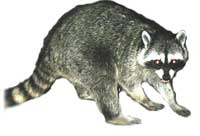
The raccoon can be recognized by its notorious black mask and tail with black rings. Adult raccoons can be up to 3 feet long and weigh between 10 to 60 pounds. Raccoons have a whitish gray coat. This fur is long and dense, a grizzled brown and black color that has often been described as "salt and pepper." The tail can grow to be fifteen inches. A tail can have five to seven black rings on it.
Although, raccoons are carnivores and have long canine teeth, their molar teeth are adapted for a varied diet which includes more than just meat. They have sharp claws so they can climb trees eat birds and open shell fish like clams and oysters. Raccoons are mostly nocturnal animals. Yet they are seen in the daytime.
Back to Contents
Rats
Native rats are generally not a problem in urban areas and any problems with rats generally revolve around the introduced European Black (House or Roof) Rat Rattus rattus and Norwegian Brown (Sewer) Rat Rattus norvegicus. Black rats like to climb so can be found in roofs, wall cavities, sheds etc. Brown rats can climb but are generally found at ground level in burrows, under houses, in drains etc.
Rats are not generally as sociable as mice and will generally live a solitary life or in small groups of less than half a dozen animals. Rats generally do not come inside houses and are more at home in our gardens, but an exposed fruit bowl on a dining room table or kitchen bench can be a tasty treat that will bring rats inside.
Rats tend to be more wary than mice and can prove more difficult to trap. The pre-baiting technique mentioned above is the best way to overcome this natural shyness and help to ensure trapping effectiveness.
As with mice rats will generally have a trail that they follow when feeding so placement of the trap on or close to one of these trails is also going to help increase the effectiveness of your trapping.
Most rat traps work on the principle of a door that springs closed when the trap is triggered.
Back to Contents
Skunks
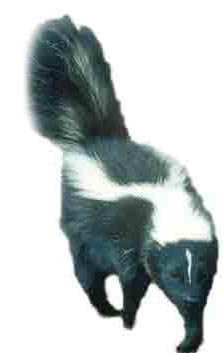
Skunks can be found near forests, bushes, Holes, and under buildings. They release a strong stench from a gland as a defense against any attackers. usually identified by their 2 white stripes on the back. They are about the same size as a house cat.
Back to Contents
Snakes
Most snake bites occur because some hero tries to demonstrate his prowess by hitting it on the head with a spade. Although snakes avoid biting large animals, they make an exception for aggressive dimwits armed with spades. Instead of being bitten, you can just move quietly away and let the snake continue with his hunt. Snakes are nomadic; if there is no food, they will leave your area. If there is food, such as mice and rats, they will stay long enough to do you a favor, then move on. I provided friends with snakes to clear their attics and barns.
My 2ha property has many snakes continually moving around and across it. I have stepped within inches of the head of a brown; reached into a van door to find a tree brown inches from my face. Each year the snakes come into my little hut where I sleep, to slough their skins. (And a possum comes in to raise its young in a cardboard box – it is that sort of place.) The main thing in snake country, is to relax into nature, and carry an expandable/compression bandage at all times, and know how to use it.
As a trained wildlife volunteer, I frequently removed snakes from houses, simply by picking them up by the tail (just behind the vent) and dropping them into a sack – but this requires training under experts, since some venemous species, being very fast and agile, are dangerous. I suggest you call on your wildlife volunteers to remove snakes; considering the danger, the charge is minimal and all of it goes towards wildlife protection.
Contrary to popular advice it is possible to trap snakes but it is not commonly done. Once again every state has its own regulations as far as trapping snakes so refer to those organisations as a first step.
Snakes can be trapped with only live food,** and mice work well for this purpose due to their smell. Animal welfare rules come in to play when using live bait as the live bait are considered to have equal rights as the predator as far as animal welfare goes. [** It is enough that snakes will follow the smell of mice; you do not need to use live bait.]
In most cases it is far better to deal with the reasons behind why you have a snake in the first place rather than trying to trap and remove the snake. Snakes will be attracted to gardens that offer shelter, food, and water. By cleaning up a garden, removing rubbish that could house mice, and removing water sources, your chances of getting a snake in your garden in the first place and significantly lessened. [True but my property is now a rainforest corridor encouraging wildlife, including snakes.]
Snake traps work on the principle of a funnel entrance hole that gets smaller as the snake enters the trap.
Back to Contents
Back to fishing & hunting index