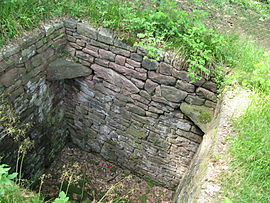
Wolf or bear trap
Back to fishing & hunting index
From Wikipedia, January 2009
Picture: Pit for hunting wolves, near Hohenwart, Bavaria, Germany.
Click to enlargeTrapping pits are deep pits dug into the ground, or built from stone, in order to trap animals. European rock drawings and cave paintings reveal that the elk and moose have been hunted since the stone age using trapping pits.
Wolf or bear trap
Pits for hunting eurasian elk (moose) are normally found in large groups, crossing the elk's regular paths and stretching over a large landmass. Remains of wooden fences designed to guide the animals toward the pits have been found in bogs and peats.
In Norway two forms are found; one is typically a tapered construction with a timbered box at the bottom where the legs of the animal was locked, or a bigger one where the animal fell through a covered lid. The later one will typically have a bowl form today, while the former most often lacks the timbered box. The tapered construction seems to be the most common one, especially in the mountains.
Early examples of these trapping devices have been excavated by archaeologists and older sites are questionably dated to around 3700 BC while one of the later one in Lesja municipality in Gudbrandsdalen is dated to 1690. An other location Rødsmoen at Gråfjell has been in use over a period of 2000 years, from older bronze age around 1800 BC to older iron age around 500-550 AD. From the excavations at Dokkfløy it seems like the hunting pits has been in use in two periods, one older period from around 500-300 BC, perhaps still in use around 1000 AD, and one later period up to about 1700 AD.
Trapping elk in pits is an extremely effective hunting method, and as early as the 16th century the Norwegian government tried to restrict their use and in 1860 the hunting method was banned by law. Nevertheless, the method was in use until the 19th century.
These pits are almost exclusively found in the mountainous areas of Norway. They are stone built and are normally accompanied by leading fences, also made from stone, which would have guided the animals towards the pits. In some areas one can also find bow rests, stone built hiding places for hunters equipped with bow and arrow. The trapping pits are normally rectangular in shape and quite narrow, making it impossible for the animal to move once it had fallen in.
These are deep pits, dug into soft soils, normally near farmland. They would have had a wooden stake in the middle, with a platform on top, onto which offal would have been placed. In certain cases a living animal, such as a lamb, would have been tethered to the stake, the idea being that the wolf would hear the cries of the animal and be lured towards the pit. The pit itself would have been covered by branches and foliage.
Back to fishing & hunting index
Pitfall trapping is a sampling technique which is widely used in studies of seasonal occurrence, to examine spatial distribution patterns, to compare relative abundance in different micro-habitats, to study daily activity rhythms, and in community surveys.
The use of pitfall traps was considered by the Animal Research Review Panel's Wildlife Advisory Group following concerns raised to the Panel regarding the use of formalin as a killing agent in wet pitfall traps. Solutions such as formalin are used in wet pitfall traps because they preserve the specimen, not because they are humane. There is no rapid loss of consciousness before drowning and preserving.
The Wildlife Advisory Group identified two issues:
Definitions:
Pitfall traps are used for sampling animal populations by:
The pitfall trap is a relative method of estimating animal numbers and species, thus it cannot be used to estimate absolute population sizes or overall species richness of an area. It produces an "index" by which several areas can be compared. It is a "passive" form of sampling which relies on the animal rather than the observer making the action that leads to capture and enumeration.
There are three basic approaches to using pitfall traps:
Justification:
The disadvantages include the following, that:
Management:
Modifications to enhance the operation of traps:
Back to fishing & hunting index