| Probably most commonly associated with trapping, the foothold trap is made up of two jaws, one or two springs, and a trigger in the middle which is usually a round pan. When the animal steps on the trigger the trap closes around the foot, preventing the animal from escaping. Usually some kind of lure is used to position the animal, or the trap is set on an animal trail. | Offset leghold trap designed for catching bears, sprung position. 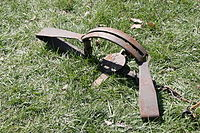 |
Foothold traps set for beaver, mink, river otter, and muskrat are positioned in shallow water along the shores and banks of rivers, lakes and ponds. Sometimes the trap is attached to a weight sunk in deeper water. The animal, when caught by the foot, tries to escape by diving into deep water and drowns. Traditionally, these traps had tightly closing jaws to make sure the animal stayed in place. These traps are made in various sizes from catching weasels to bears. At one time traps for wolves and bears had rounded teeth on the jaws to prevent escape.
Modified traps are now available with offset jaws, or lamination, or both, both of which decrease pressure on the animals legs. Traps are also available with a padded jaw, which has rubber inserts inside the jaws to reduce animal injuries. However these traps are more expensive and not widely employed except by research and conservation experts. A single number 3 foothold trap which has a 6 inch jaw spread and commonly used for trapping beaver and coyote costs about 10 to 15 dollars depending on the make, while a padded jaw or "Soft Catch" trap cost from 12 to 20 dollars. [2011 prices ?]
Today's traps are specially designed in different sizes for different sized animals which trappers and trap manufacturers claim also reduces injuries. Anti-fur campaigns have protested leghold traps on grounds that animals caught in leghold traps will frequently chew off their leg to escape the trap, while the National Animal Interest Alliance states that modern foothold traps have been designed to hold animals as humanely as possible to reduce incidences of the animal fighting the trap, possibly injuring itself or getting loose in the process.
In states that have banned the use of the foothold trap, a number of issues have arisen. In Massachusetts, the beaver population increased from 24,000 in 1996 to over 70,000 beaver in 2001. Coyote attacks on humans rose from 4 to 10 per year, during the five year period following a 1998 ban on leghold traps in Southern California.
Manufacturers of newer types of traps designed to work only on raccoons claim that these traps are dog-proof. These traps are small, and rely on the raccoon's grasping nature to trigger the trap. They are sold as coon cuffs, bandit busters and egg traps just to name a few.
| The body gripping traps are traps designed to kill the trapped animal quickly. They are frequently called "Conibear" traps after Canadian Frank Conibear who first constructed this type of trap in 1957. This type of trap was considered by trappers [who?] one of the greatest innovations in traps in the 20th century. Animals were quickly killed and therefore no animal could escape once caught. The animal must be lured with a bait or guided into the correct position before the trap is triggered. | Rat and mouse traps used for pest control 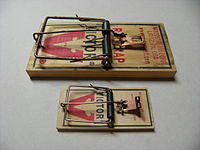 |
A deadfall is a heavy rock or log that is tilted on an angle and held up with sections of branches (sticks), with one of them that serves as a trigger. When the animal moves the trigger which may have bait on or near it, the rock or log falls, crushing the animal.
This is a crude version of the body-gripping trap, good for people lost in the bush, but not to be recommended to boy scouts.
The figure-four deadfall is a popular and simple trap constructed from materials found in the bush (three sticks with notches cut into them, plus a heavy rock or other heavy object). Also popular, and easier to set, is the Paiute deadfall, consisting of three long sticks, plus a much shorter stick, along with a cord or fiber material taken from the bush to interconnect the much shorter stick (sometimes called catch stick or trigger stick) with one of the longer sticks, plus a rock or other heavy object.
Snares are anchored cable or wire nooses set to catch wild animals such as foxes, rabbits, and coyotes. In the UK, they are commonly used for population control, but are used as well at times for food collection (e.g., rabbits) or for research.
In the USA, they are most commonly used for capture and control of surplus furbearers, and, especially, for food collection. They are also widely used by subsistence and commercial hunters for bushmeat consumption and trade in African forest regions.
Snares are one of the simplest traps and are very effective. They are cheap to produce and easy to set in large numbers. A snare traps an animal around the neck or the body and tightens around the animal, restraining it. Snares are widely criticised by animal welfare groups for their alleged cruelty.[29] UK users of snares accept that over 40% of animals caught in some environments will be non-target animals, although non-target captures range from 21% to 69% depending on the environment. In the USA, non-target catches reported by users of snares in Michigan were 17 +/- 3%. Some scientists believe that in animals which are trapped, pressure necrosis may have caused hidden injury to the animal, and that trapped animals should be taken to a vet rather than released. However, trappers claim that modifications now provide working snares that have relaxing locks that do not cinch down, break-away locks that open up after 110 kg of force are exacted, deer stops which prevent the snare from closing down so far as to catch a deer's leg, and live-catch stops that prevent the snare from closing to a point that chokes an animal of a certain size.
Snares are regulated in many jurisdictions, but are illegal in other jurisdictions, such as in much of Europe. Different regulations apply to snares in those areas where they are legal. In Iowa, snares have to have a 'deer stop' which stops a snare from closing all the way. In the United Kingdom, snares must be 'free-running' so that they can relax once an animal stops pulling, thereby allowing the trapper to decide whether to harvest the animal or release it. Following a consultation on options to ban or regulate the use of snares, the Scottish Executive announced a series of measures on the use of snares, such as the compulsory fitting of safety stops, ID tags and marking areas where snaring takes place with signs. In some jurisdictions, swivels on snares are required, and dragging (non-fixed) anchors are prohibited.
The method in which snares are used have been debated recently and many hunters are saying that old methods are obsolete, ineffective and in some cases cruel. But this is hard to be proven true due to the lack of information provided my snare hunters.
| Trapping pits are deep pits dug into the ground, or built from stone, in order to trap animals. Like cage traps they are usually employed for catching animals without harming them. Here is a stone bear trap in Germany: | 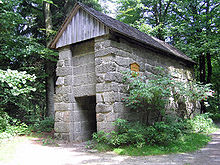 |
| Cage traps are designed to catch live animals in a cage. They are usually baited, sometimes with food bait and sometimes with a live "lure" animal. Cage traps usually have a trigger located in the back of the cage that causes a door to shut; some traps with two doors have a trigger in the middle of the cage that causes both doors to shut. In either type of cage, the closure of the doors and the falling of a lock mechanism prevents the animal from escaping by locking the door(s) shut.
Supporters of cage traps say that they are the most humane form of trapping, and in some countries are the only method of trapping allowed. However studies have shown that animals restrained in cage traps may break claws or teeth, and skin their faces. Cage traps are used by animal control officers to catch unwanted animals and move them to another location without harm, as well as by gamekeepers to catch birds and animals they consider to be pests, and which are killed after catching. |
Setting a trap on an animal pad.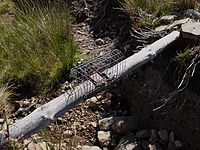 Shading a cage for the trapped animal. 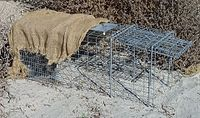 |
| Cage traps are also sometimes used for capturing small animals such as squirrels by homeowners in urban areas, such as in attics of homes, for removal to locations where they may either be legally killed and disposed of, or released unharmed. (Some municipal jurisdictions specifically prohibit transporting live squirrels and releasing them into other areas to control the spread of diseases; for these jurisdictions, killing the squirrels within the cage quickly and humanely is the only legal and ethical means of disposing of them.)
Cage traps are also useful in catching large dangerous animals for transport and are a favourite of Australian crocodile trappers. Due to their bulk and cost, they are hard to set in great numbers or in remote locations. Cage traps are also used in muskrat trapping. A cage trap is set in a runway and the muskrat pushes the door open which is at a 45 degrees. But once the muskrat enters the cage trap the other side is closed with another door at 45 degrees. So the muskrat drowns in the trap which is set under water. No bait is necessary as trap is set in muskrats runway. In the UK cage traps are used to control corvids and it is mainly carried out on game shooting estates. Large Ladder traps and smaller Larsen traps are used. There is vocal opposition to these traps on grounds of cruelty and their misuse in capturing Raptors. http://www.againstcorvidtraps.co.uk/ |
|
| Glue traps made using natural or synthetic adhesive applied to cardboard or similar material. Bait can be placed in the center or a scent may be added to the adhesive. Glue board traps are used primarily for rodent control indoors. Glue traps are not effective outdoors due to environmental conditions (moisture, dust) making the adhesive ineffective. Glue traps are not used by animal trappers or fur trappers and are almost exclusively used by homeowners for rodent control. | 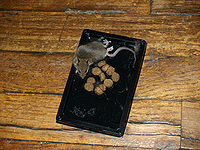 |
| Of note, animals unfortunate enough to find themselves captured in glue traps can be released by carefully applying cooking oil or baby oil to the contact areas and gently worked until the animal is free. This action would be deemed as a compassionate rescue rather than a design of (or justification for) this type of trap.
Many animal rights groups, such as the Humane Society, oppose the use of glue traps for their cruelty, since animals desperate to escape may chew off their own legs, and sizable sections of fur and skin may be ripped out as they struggle. Glue traps are typically not used for trapping birds, however a substance known as birdlime was used in the past in a similar manner to catch small birds, its use is banned now in most countries. In spite of this, the use of glue traps for catching birds is still prevalent in some countries such as Spain, in spite of being illegal. A sticky repellent can be applied to surfaces to temporarily repel perching birds from building ledges and statues. The adhesives registered for this use are classified as tactile repellents. |
|
