Nutrition - intro
This book: School/Leaving/Food/Nutrition/General
is to accompany the book:
School/Leaving/Food/Meals.
There are 2 introductions, very similar, so choose which one you prefer for learning.
What is Nutrition ?
Nutrition is the study of:
- the chemicals needed for the body's processes of growth, maintenance, repair and reproduction
- the provision of those chemicals as food
- the digestion of that food
- the supply of some of those chemicals by bacteria in the intestine.
- factors affecting the efficient absorption or use of those chemicals or nutrients by the body
- the effects of nutrient deficiencies on the body's processes
- the toxicity of those chemicals or nutrients when taken in excess.
Food is any solid or liquid which, when swallowed, can supply nutrients.
Nutrients
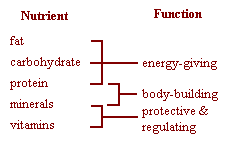 Nurients are chemicals which provide:
- energy required for movement, brain-activity, heat and chemical reactions
- material for growth, maintenance, repair, reproduction
- enzymes, which accelerate chemical reactions (a different enzyme for each chemical reaction).
These chemical reactions are necessary for:
- providing energy to the muscles and brain
- combining simple molecules into big molecules for growth, and so on
- moving chemicals from the cells which manufacture them to those which use them.
A chemical is any one type of molecule. A molecule is a combination of a small number of elements or types of atoms, although the total number of atoms can be extremely large. These atoms are linked together in specific patterns by movement of their electrons. (Refer the Chemistry book.)
A diet is the sum of foods eaten by a particular person. To say:he is dieting is an ambiguous distortion of the meaning of the word diet. It usually means a reduced-calorie diet, but could mean a liquid diet for a person with intestinal problems or dehydration, or a high-fat diet for followers of the Atkins' let's-die-from-fatty-arteries club.
A balanced diet is a diet containing adequate amounts of nutrients with adequate fibre, each day.
Fibre is roughage, that is, indigestible matter in food, which enables the intestinal tract to push waste along the tract to the anus from which it is eliminated. Lack of fibre can lead to constipation or the slow passage of waste. This can allow time for bacteria to break the waste down to poisonous and malodorous chemicals, causing ill-health, halitosis (bad breath) and smelly farts. However, fibre also reduces the absorption of certain nutrients, especially minerals.
The big dietary problem in the 'west', where machinery has greatly reduced physical exertion, is eating enough nutrients for maintiaining growth and so on, without too much energy. Poor fat-rich diets has led to obesity and malnutrition, in affluent societies. For this reason sedentary people should avoid low-nutrient high-energy foods, and search for high-nutrient low-energy foods. This means avoiding the sugar-rich and fried food which people learn to crave because of their strong flavor. By avoiding them, we develop the sensitivity of our taste buds and our liking for seemingly bland foods. Remember that adding a tiny 500gm of fat each year (the mass of only 0.5 litre of milk) will accumulate over 40 years to an extra 20 kg. Once adulthood is reached, our metabolism slows, our energy expediture drops, and we put on weight rapidly if we do not reduce our energy-input by changing our diet.
Affluent 'westerners' often take supplements, that is, factory-produced chemicals labelled 'multi-vitamins", but these often contain an excess of the cheap chemicals and not much of the expensive ones, thus not helping much but causing an overdose of the cheap ones. Overdosing of nutrients can be damaging. An overdose of vitamin A can cause birth defects and headaches, nausea and loss of appetite, and a breakdown of skin tissue, as suffered by Mawson and his 2 colleagues in Antarctica when they ate the raw liver of their dogs. They became so crippled that only Mawson survived. The taking of supplements should be on a doctor's recommendation only. Why not spend the money on real food ?
The big dietary problem in 'poorer' nations, is lack of money to buy good-quality food and the scarcity of quality food, that is, food which provides a balanced diet. Even when people eat so much that they grow fat, they can still lack the nutrients necessary for immunity to disease or to even maintain and repair their bodies.
For example, lack of iodine in the hill-country of Tibet and China, causes a high proportion of growth deformities. Professor Creswell Eastman of Sydney's Westmead Hospital said iodine deficiency during pregnancy was the most common worldwide cause of preventable intellectual impairment and was also associated with an increase in the prevalence of attention deficit hyperactivity disorder (ADHD). "If the growing fetus doesn't get enough thyroid hormone - thyroxine - particularly in the first half of pregnancy, then the brain will suffer some damamge. ... The IQ is lower, there may be learning difficulties, reading difficulties, hearing difficulties and various other motor difficulties. ... In general, these adverse effects on the central nervous system are irreversible and are compounde by continuing iodine deficiency during infancy." [The Mercury, Tasmania, Set 5, 2005]
The average adult requires about 150 micrograms of iodine per day, but pregnant women need twice that. Most iodine in food comes from seafood, milk and iodised salt. Affluent Australia is again beginning to suffer this iodine-deficiency. In the past, such deficiency was avoided when milk bottles were washed with iodine solution and table salt was always iodised.
Vitamin D deficiency is re-appearing in Australia because of the successful "slip-slop-slap" campaign persuading parents to cover their children from the sun. This, in severe cases, can cause ricketts, a bone-deformity. Ricketts is common in Asian children where deeper skin-color requires more sun-exposure to produce the same amount of vitamin D, and in northern Europe where the cold weather reduces sun-exposure. In such cases, supplements of vitamin D may be necessary.
As the Australian low-income families increase in number and become poorer and poorer, with their educational standards dropping, we can expect malnutrition, with its mental and physical damage, to become widespread and severe, as it was 70 years ago.
Components of food
The body needs about 50–100g of protein per day and about 2500kilocalories per day for a male and 2200 for a woman, both leading sedentary lives. This increases to about 3300kcal when fighting an illness.
Let us now look at the components of food in their broadest categories:
- lipids (fats, oils):
Chemically similar, oils are liquids at room temperature because of smaller molecules than those of fats, which are solid at room temperature. (We use the term 'lipids' to include both fats and oils, and some people use 'fats' for 'lipids'.)
Pure lipids are high-energy chemicals which are either consumed immediately to provide energy or stored as fat globules in fatty tissue. However, lipids are needed in the body's cell walls. In food, lipids carry the vitamins, A, D, E, F, and K, which are lipid-soluble, not water-soluble. For these reasons, 'quality' lipids are important, making oily fish like herring and halibut, and fatty fruit like avocado, important to our diet.
In the alimentary canal, these big molecules are digested, that is, broken down into smaller molecules till they are small enough to pass through the canal wall into the blood stream on the other side, which carries them to the liver.
- carbohydrates:
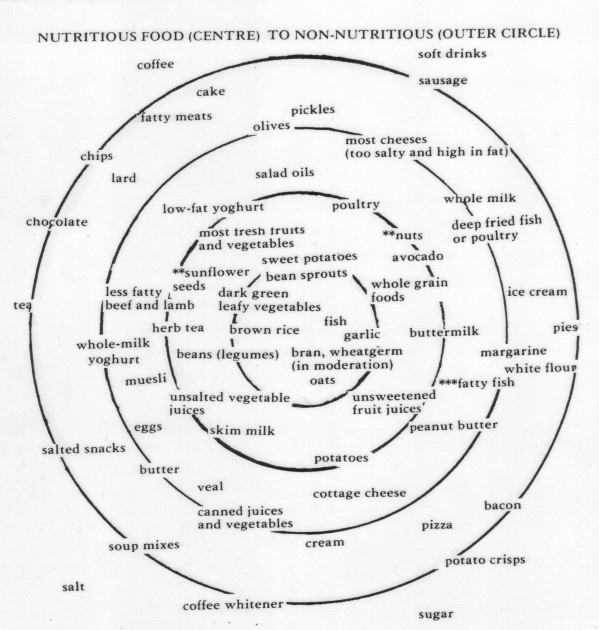
Carbohydrates (CnH2nOn) provide energy in a simple easily digested form. In its simplest processed form, sugars, it is pure and delights with its concentrated sweet taste. However it is without vitamins or minerals, and lessens the appetite, so the body tends to be denied food which provides the same energy but with the advantage of containing important chemicals. Unbleached multi-grain coarse bread, barely-processed rice and fresh fruit are much superior options.
- proteins:
Proteins are strings of amino acid molecules joined together. In the alimentary canal, these are broken down into smaller strings of amino acids, till they are small enough to pass through the canal wall into the blood stream on the other side, which carries them to the liver. There are 2 types of amino acids:
- non-essential amino acids:
These can be manufactured by the body from other amino acids.
alanine, arginine, aspartic acid, cysteine, glutamic acid, glycine, proline, serine, tyrosine.
- essential amino acids:
These cannot be manufactured by the body.
isoleucine, leucine, lysine, methionine, phenylalanine, threonine, tryptophan and valine for adults, while infants also need histidine.
- minerals:
There are 2 types of minerals:
- macrominerals
required in large amounts
Na, K, Ca, Mg, Fe, Zn, Cu, P, S, Cl,
- trace elements
required in only minute amounts
B, Co, Cr, Mn, Mo, I, Se, Si, F (?)
- vitamins:
Vitamins are "essential", that is, vitamins are chemicals essential to our diet because our bodies need them but cannot make them. There are 2 types of vitamins:
- fat-soluble
vitamins, A, D, E, F, and K (in alfalfa)
- water-soluble
vitamins B1, B2, B3, B5, B6, folic acid, B12, C (ascorbic acid), H (biotin), choline.
The UK and US add the following non-essential vitamins. (If vitamins are essential, how can there be non-essential vitamins ?): inosital, PABA (para-aminobenzoic acid), B13 (orotic acid), B15 (pangamic acid), B17 (laetrile or amygdalin), P (bioflavonoids), T, U.
- fibre:
Fibre is roughage which aids peristalsis and tones the muscles of the alimentary canal. Too much roughage can speed the passage of food, thus preventing full absorption. Fibre and phytic acid in wholemeal cereals can reduce absorption of minerals, like calcium, iron and zinc.
- poisons:
Poisons either directly damage the body, or hinder those processes which promote health. These include:
- Alcohol, which damages the brain (memory loss, ataxis), kidneys and liver. In pregnant women, even small doses causes physical and mental damage in the foetus.
- "Brain" drugs with hallucinatory or "get-high" effects
- Caffeine containers: coffee, tea, mate, chocolate
- Chewing tobacco and betel (not seen as foods, but their chemicals are ingested via the mouth)
- Some mushrooms, some molds, some bacteria (salmonella), some virus (SARS)
- Overdoses of some minerals and of fat-soluble vitamins
- Cd, Pb, Hg
- Antibiotics
- With increasing air, soil, river and ocean pollution, contaminated food from these sources is increasing birth defects, cancer and other diseases. (I would not eat fish from the North Atlantic or North Pacific, no matter how tasty or cheap; nor touch shellfish that I have not collected myself.)
- Many plants produce poisons to deter insects from eating them. Leaves must therefore be plucked before the plant can form these poisons; poisonous fruits must be cooked in a way that removes the poison. Include with this, green-skinned potatoes. The green is harmless chlorophyll, but associated with it is a deadly poison which has killed many a family. The green develops if the potatoes are not kept out of the light. Just how green they have to be before becoming poisonous, I do not know.
Fallacies in "dieting"
Source: Dieticians Association of Australia spokesperson Tania Ferraretto (The Mercury May 7, 2005):
Carbohydrates, found in cereals, potatoes, etc, are macronutrients which provide energy.
Lack of carbohydrate in a diet, forces the body to use proteins and fats for energy.
Using proteins for energy is wasteful since they are needed for muscle-building, body-repairs, etc.
when used for energy, proteins produce toxic by-products such as acetone which causes bad-breath (a sign of this is ketosis).
Lacking carbohydrates, the body's metabolism slows, making it harder to lose weight.
Milk is important for calcium, and (does) not produce mucus in the body.
Although butter is higher in saturated fats than margarine, saturated fat is an essential nutrient, providing vitamins A and D (which are fat-soluble but not water-soluble). Butter and margarine have the same kilojoules/gram.
Lean red meat, per 100g, there is 7g of iron. (Required daily dosage is 12g.) [IW: In contrast, the iron in leafy vegetables largely escapes digestion. See Iron for blood.]
Allergies
Dr Valencia Soutter, consultant padiatrician at Sydney's Royal Prince Alfred Hospital (The Mercury May 7, 2005):
Allergy-causing chemicals can include:
Salicylates: many fruits, vegetables, nuts, herbs, juices, tea, aspirin
Amines: fermented foods like cheese, wine, yeast products, some fruit & vegetables
Glutamate: natural MSG in tomatoes and mushrooms.
The highest concentration of these chemicals found in fruit and vegetables, occurs in their skins or peelings.
Dr Robert Loblay, University of Sydney (food reactions expert):
These natural chemicals, from an unbalanced diet, can cause food reactions in children, more so than food additives and colorings. [my italics]