Digestion
The alimentary canal

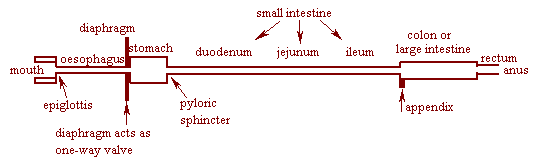
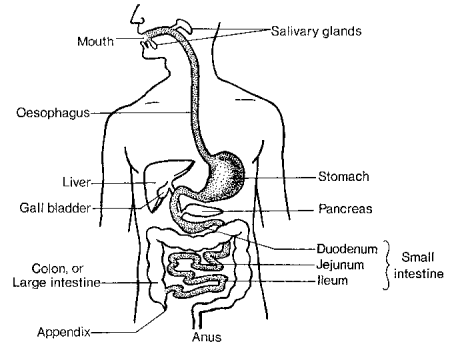
The alimentary canal or tract consists of:
Detail of the canal
In more detail, the alimentary canal or tract consists of:
Digestion
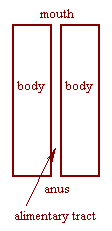
Most people think of food in the alimentary canal or tract as being inside the body. It isn't. Think of the body as a fuel drum and the alimentary tract as a steel pipe welded to the top and the bottom but without any holes along its length. If you put a steel ball bearing in the top end of the pipe it will flow through to the bottom and spill onto the ground. If you put a steel ball bearing into your mouth and swallow, it will eventually do the same - pass right through and fall out onto the ground.

Obviously then the problem is to persuade the food to pass through the walls of the alimentary tract, into the body. That is what digestion is about.

Chewing, grinding and mashing food breaks down the fibres, releasing groups of molecules. However these molecules are macro-molecules which are too big to pass through the cell walls of the alimentary tract. To break down these macro-molecules into small molecules, the tract produces enzymes, chemicals which conduct reactions at body temperature without permanently changing themselves (so they are not used up). In a laboratory, we can also break down these molecules but we need high temperatures or acids, and so on.

The enzymes discussed in the list above are summarized in this table.

EnzymeSourceActive inAction
ptyalinsalivary glandsmouthsome starch to maltose
pepsinstomachstomachprotein to peptides
rennin(in infants only)stomachmilk protein to peptides
trypsinpancreasintestineprotein to peptides and amino acids
chymotrypsinpancreasintestineprotein to peptides and amino acids
lipasepancreas & intestineintestinefat to fatty acids
amylaseintestinal wallintestinal wallstarch (& glycogen) to maltose
maltaseintestinal wallintestinal wallmaltose to glucose
sucraseintestinal wallintestinal wallsucrose to glucose & fructose
lactaseintestinal wallintestinal walllactose to glucose & galactose

Digestion for the new-born requires especial consideration.

AgeDigestion for the new-born
Before birthFood comes via the blood from the mother's placenta.
Birth + few daysFor a few days, some whole proteins can be absorbed without digestion. This allows important proteins to provide immunity from diseases. Cow's milk, fresh or dried, is not a satisfactory substitute in these first few days.
OnwardThe stomach secretes the enzyme rennin to clot the casein of milk and begin its digestion. Mother's milk is considered to be much superior to substitute milks.
After several monthsStarch cannot be easily digested for several months. Late weaning seems to produce healthier children, especially in poor countries where the quality of food is not high.

Absorption
where is the food absorbed:
Function of nutrients
The 3 main nutrients are:
Nutrients & diabetes
The blood system transports nutrients around the body. Various mechanisms exist to control the level or concentration of nutrients in the blood.
For example, while cortisone and adrenalin raise suger levels, insulin 'persuades' cells to accept sugar from the blood to be used as fuel, thus lowering it. When the eating of carbohydrate increases the amount of glucose in the blood, the 'islets of Langerhans' in the pancreas secrete insulin to reduce the sugar-level. In one of the 2 types of diabetes, diabetes mellitus, either the pancreas does not secrete enough insulin, or the tissues are not sensitive to insulin. Both necessitate glucose to be excreted by the kidneys. This sweetness of the urine, formed one of the tests for suspected diabetes.
The solution is: In juvenile-onset diabetes, the symptoms warrant the taking of insulin, but maturity-onset diabetes is usually managed by diet reducing the sugar-level.
(The second type of diabetes, the rare diabetes insipidus, is caused by a failure of the pituitary gland.)
Probiotics
From Wikipedia, the free website encyclopedia

Probiotics are a class of "good" or "friendly" bacteria that are normal inhabitants of the intestinal tract, helping with digestion, by breaking foods into their component parts for absorption into the body.

Although the word "bacteria" is usually associated with germs and illness, there are in fact a number of strains of friendly bacteria that help the human body to function, maintain health and fight illness and disease. "Bad" or "pathogenic" bacteria on the other hand, can cause intestinal microflora imbalances and lead to illness and disease. While human beings usually start life with a relatively healthy intestinal tract, lifestyle and environmental factors can greatly reduce the number of friendly bacteria allowing pathogenic bacteria to take hold and cause problems. Supplementing our diets with an effective probiotic re-populates the intestinal tract with friendly strains to reverse this trend, improve intestinal health and help guard against disease. For example, when troubled by dysentery, take the antibiotic recommended by your doctor and eat yoghurt to re-establish the probiotics. (I was sternly instructed to eat only yoghurt, bananas and white rice for one week. Fortunately I was in India where the yoghurt is the world's most delicious.)
Probiotics
There are almost 100 different species and 100 trillion of total bacteria in the human intestinal tract. Friendly and pathogenic bacteria form a delicate and constantly changing balance as they compete to take hold and remain. Both friendly and pathogenic bacteria can and are affected by changes in the intestinal environment. Bacterial infections, stress, traveling, antibiotic treatment, alcohol, poor diet and a number of other factors can and do disturb the delicate balance in our intestinal tract, often decreasing the number of beneficial bacteria while allowing an increase in pathogenic bacteria. Some common symptoms of this imbalance include flatulence, constipation and/or diarrhea. If this imbalance is left untreated the symptoms can become chronic, as in Irritable Bowel Syndrome, and can compromise the immune system and lead to other serious illnesses.
Lactobacillus is considered an especially beneficial bacteria in its ability to aid in the breakdown of proteins, carbohydrates and fats in food, and help absorption of necessary elements and nutrients such as minerals, amino acids and vitamins required for humans and other animals to survive. Prevention of illness by a well-maintained microflora balance is accomplished by a method referred to as "competitive exclusion". That is, the friendly bacteria take up positions known as enteric sites therefore preventing the pathogenic bacteria from establishing itself and proliferating to become the predominant bacteria. Eating yoghurt and such, containing beneficial bacteria, like Lactobacillus, help to adjust this balance.
History of Probiotics
Probiotics in the form of substances containing lactobacillus, Bifidobacterium and acidophilus cultures have been used for centuries as food preservatives and natural sources to promote good human health without specific knowledge of their active ingredients or how they work. Lactobacillus was first identified by Pasteur (1845 - 1895) in France, the pioneer of modern microbiology. A real understanding of how probiotics function began when the Nobel Prize winning Russian physiologist, Metchnikoff (1845 - 1916), introduced his intoxication theory. He stated that the main cause of aging is "toxicants" formed by intestinal putrefaction and fermentation and suggested drinking beverages such as yogurt containing lactic acid bacteria would prevent aging. Lactobacilli suddenly attracted world attention.

Since Metchnikoff, a lot of research and clinical trials have been made but his "Eternal Youth Theory" has repeated a cycle of disappearing for a time and then returning again to public notice with the issue never really being resolved in either a scientific or practical sense.

Recently, thanks to remarkable advances in microbiology and intestinal bacteriology, it has been made clear that certain lactobacilli, especially a Lactobacillus genus and a Bifidobacterium genus, have high mucus membrane chemical affinity, and play important roles in human health. Metchnikoff's assumption has been substantiated and even become common knowledge in the health sciences.
Probiotics and Health
Probiotic supplements have now been embraced and accepted as agents that can bring significant health benefits:
Scientific classificationLactobacillus casei
Kingdom
Division
Class
Order
Family
Genus
Species
Bacteria
Firmicutes
Bacilli
Lactobacillales
Lactobacillaceae
Lactobacillus
L. casei

Binomial name: Lactobacillus casei (Orla-Jensen 1916) Hansen & Lessel 1971