Protein
Your daily requirement for protein is satisfied by a slice of quality meat, about the size of a pack of cards. Rubbish "meat" like sausages are low in protein, requiring a much greater consumption, which, along with the high fat content, gives an alarming low protein/fat ratio.
Protein Quality
The Protein Quality segment of the analysis includes another unique symbol, called a Protein Quality Indicator.
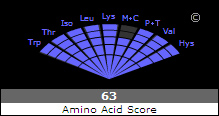
Each spoke on this radial graph represents one of the nine essential amino acids. The size of each spoke is proportionate to the percentage of the optimal level for that amino acid. The amino acid with the lowest level is considered the "limiting" amino acid for that food, and determines the overall Amino Acid Score.
Example:
Note: Optimal levels for amino acids are based on the following amino acid profile recommended by the Institute of Medicine's Food and Nutrition Board:
| Essential Amino Acid | mg/g of Protein |
|---|
Tryptophan
Threonine
Isoleucine
Leucine
Lysine
Methionine+Cystine
Phenylalanine+Tyrosine
Valine
Histidine |
7
27
55
25
51
25
47
32
18 |
The Amino Acid Score calculated by ND is a basic measure of protein quality, but it has not been adjusted for the digestibility of the protein. Protein digestibility depends on the type of protein (animal proteins are more digestible than plant proteins), as well as the method in which the food was prepared. If digestibility is accounted for, the Amino Acid Score will be somewhat lower than stated.
If the Amino Acid Score is less that 100, a link is provided to "complementary" sources of protein. These are foods that are higher in the limiting amino acid(s), and/or lower in the amino acids most prevalent in the food. By combining complementary proteins, you may be able to increase the overall quality of the protein you consume.
More About Essential Amino Acids
Protein is made up of chemical building blocks called amino acids. Hundreds of different amino acids exist in nature, but nine specific ones are essential to human nutrition and cannot be synthesized by the human body. These nine essential amino acids – shown in the above table– must all be supplied by your diet.
Different foods contain different amounts of essential amino acids. In general, most proteins derived from animal sources (e.g. meat, fish, eggs, and milk) contain a full complement of the essential amino acids. These proteins are often referred to as being "complete proteins". Many proteins derived from plant sources (vegetables, fruits, and grains), however, are low in one or more of the essential amino acids, and are classified as "incomplete proteins". For an incomplete protein to supply the body’s minimum needs, a larger total amount of the protein must be consumed, or it must be combined with another protein with higher levels of the limiting amino acid.
While the essential amino acids requirements vary among different individuals, the Institute of Medicine has proposed a standard that specifies the minimum amount of each essential amino acid that should be supplied per gram of protein consumed. This standard is the reference by which protein quality is determined. By comparing the limiting (i.e. lowest level) amino acid in a food with this standard, the amino acid score is determined. A score of 100 or above indicates a complete or high-quality protein; a score below 100 indicates a lower quality protein.
How Important is Protein Quality?
Most individuals living in America and other industrialized nations consume diets containing abundant amounts of protein, and have no need to worry about protein quality. Protein quality is only a factor for those individuals consuming diets that are very low in protein, or that are very restrictive in the types of protein consumed (e.g. vegetarian diets). Individuals on such restricted diets may be able to better meet their body's protein needs if they improve the quality of the protein they consume. This can often be done by combining multiple protein sources. For example, eating a meal that contains both rice and beans could supply your body with more high-quality protein than eating an equivalent amount of only rice or only beans.